


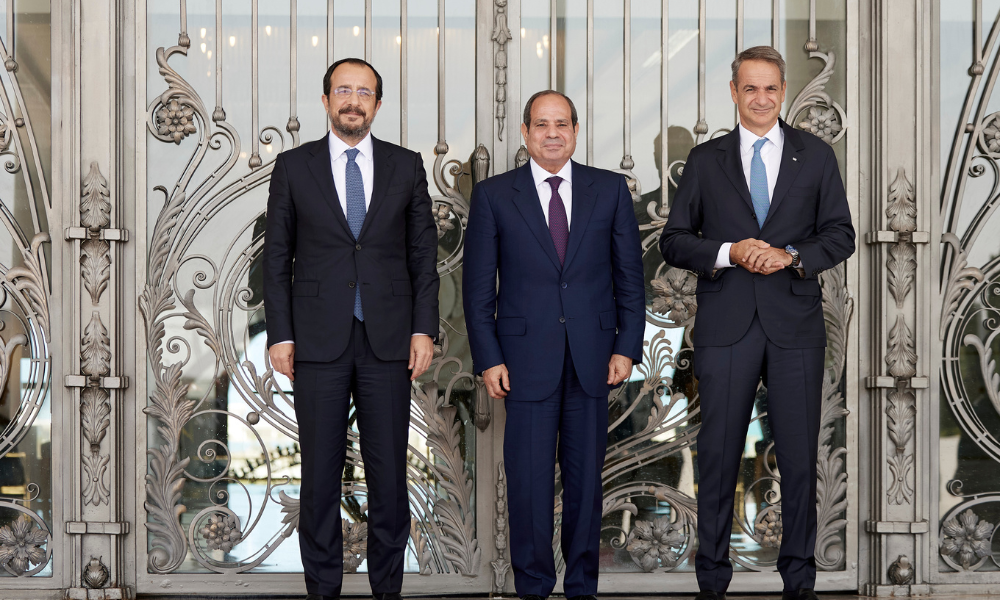
Commercial contracts to develop Cyprus’s Cronos gas field through Egyptian liquefaction infrastructure in the first half of 2028 were signed a few days ago, House President Annita Demetriou said in Nicosia on Wednesday. She was speaking at the second Trilateral Meeting of the Speakers of the Parliaments of Cyprus, Greece and Egypt, where the prospects for deeper energy cooperation between the three countries were the main focus.
Minister of Energy, Commerce and Industry Michalis Damianou and President of the Hellenic Parliament Nikitas Kaklamanis also addressed the meeting, according to CNA.
Complementary strengths
Mr Damianou said the three countries’ strengths are complementary and can create strong synergies:
- Cyprus has significant natural gas reserves in its Exclusive Economic Zone (EEZ)
- Egypt has a developed domestic market, an extensive pipeline network and liquefaction infrastructure that make it an energy hub
- Greece is an important energy gateway for south-eastern Europe, thanks to its natural gas infrastructure and connections with the Balkans and Central Europe
Cypriot gas through Egypt to Europe
According to the minister, commercial and technical steps have advanced in recent years to transport Cypriot natural gas to Egyptian processing and liquefaction facilities for export to Europe.
He said that using existing facilities offers Cyprus a faster and more cost-effective way to commercially develop its discoveries. It also strengthens Egypt’s role as a regional hub and can contribute to security of supply and new investment opportunities.
Mr Damianou described this prospect as a political choice for cooperation and regional cohesion, beyond a commercial venture. He added that Greece’s LNG import facilities and interconnections with Bulgaria, North Macedonia, Romaniaand other countries can support secure energy corridors to the European market, as Europe seeks to reduce its dependence on a limited number of suppliers.
On the challenges, he referred to geopolitical tensions, volatile international energy markets, technological change, higher financing needs for major projects and ambitious decarbonisation targets. He said the answer lies in joint action, coordination, shared investment and regional integration. He added that trilateral cooperation has already produced tangible results through political will, a common vision and mutual trust.
Aphrodite and Cronos agreements
Ms Demetriou referred to landmark agreements for the transport and commercial use of Cypriot natural gas through Egypt. As recent developments, she cited:
- the initialling of an agreement between Egypt and Chevron for the commercial use in Egypt of gas from the Aphrodite field
- the signing of commercial contracts with the Eni/Total consortium for the development of the Cronos field through Egyptian liquefaction infrastructure in the first half of 2028
EEZ delimitation and the Turkish-Libyan memorandum
The House President welcomed the resumption of negotiations between Greece and Egypt on delimiting the remaining section of their EEZ, following their 2020 agreement.
She said Cyprus supports Greece’s position that the Turkish-Libyan memorandum is unfounded, illegal and invalid, including through actions and démarches at parliamentary level. She also reiterated Cyprus’s readiness to proceed with delimiting an EEZ with Greece when conditions are considered suitable and all relevant factors have been assessed.
Ending Cyprus’s energy isolation
Ms Demetriou said the House supports the Republic of Cyprus’s energy objectives: reducing energy costs, ending the country’s energy isolation and achieving a realistic green transition. She added that the House also supports the energy objectives of Cyprus’s Presidency of the Council of the European Union on competitiveness, connectivity and digitalisation.
She described ending Cyprus’s energy isolation as strategically important and referred to the Great Sea Interconnector (GSI). She noted growing interest in the project from international investors and increased involvement by Greece, France and the United States.
She added that parliamentary diplomacy supports trilateral and regional cooperation between the three countries, including through the East Mediterranean Gas Forum (EMGF), with the aim of strengthening energy connectivity and security of supply in the Eastern Mediterranean and Europe.
An alternative energy corridor to Europe
Mr Kaklamanis said cooperation among the three countries concerns the stability, prosperity and future of the Eastern Mediterranean, and the possibility of establishing the region as an alternative energy corridor to the European market.
He said the GREGY Interconnector, which envisages transferring clean electricity generated from renewable sources in Egypt to Greece, and the Great Sea Interconnector between Greece and Cyprus could help end Cyprus’s energy isolation and lay the foundations for a unified regional green energy area. He also said that the EMGF, headquartered in Cairo, establishes respect for international law and the Law of the Sea (UNCLOS) as a principle of regional cooperation.
The President of the Hellenic Parliament said that developing the gas fields could create jobs, attract international companies and increase public revenues. He added that using existing infrastructure reduces costs and speeds up implementation compared with building new facilities. In his view, GREGY and related projects could form a clean-energy bridge between Africa and Europe, making use of Egypt’s significant solar and wind potential, while Greece and Cyprus could strengthen their energy security and export capacity.
Challenges ahead
Mr Kaklamanis described trilateral cooperation as an example of good neighbourly relations and respect for international law. He said it strengthens the three countries’ role as pillars of stability and could support broader cooperation through the EMGF.
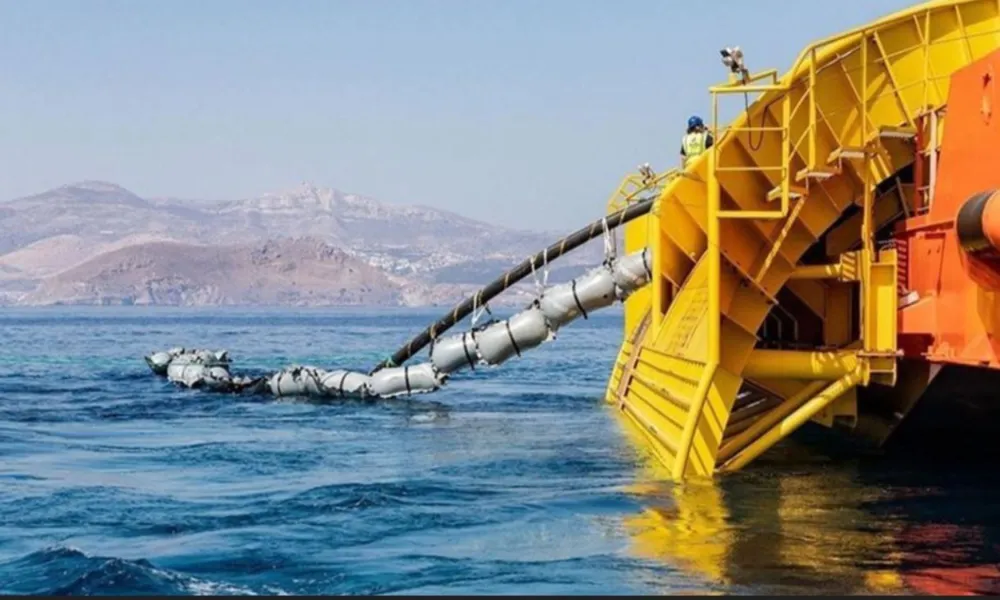
Despite its potential, he said, the initiative faces geopolitical, technical and economic challenges. In particular, laying cables at extreme sea depths increases construction risk and project budgets.
He concluded that the energy transition requires balance: natural gas remains a critical transitional fuel, while the long-term strategy must include renewable energy, electricity interconnections and low-emission technologies.
Source: CNA