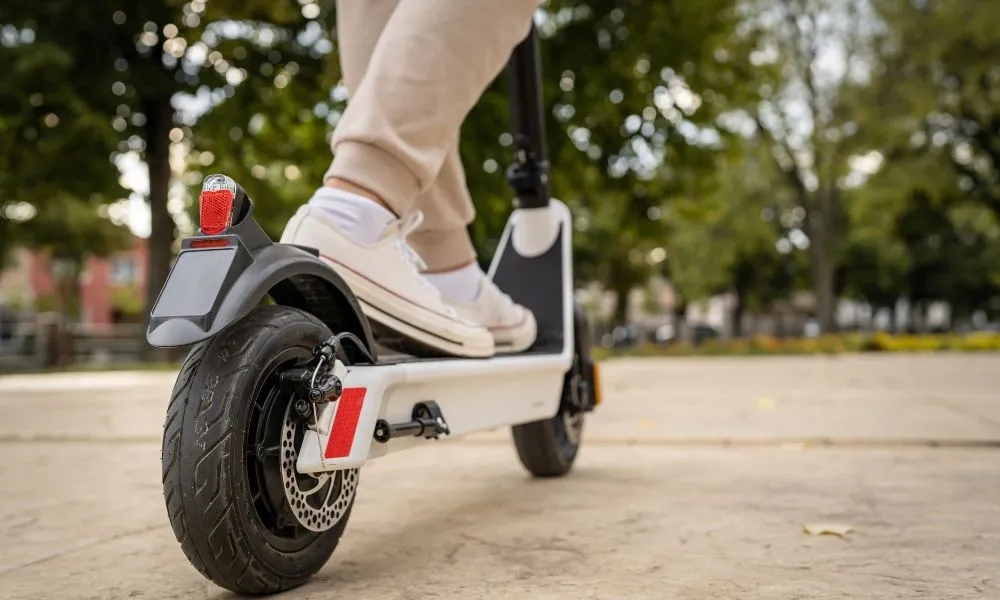

The House Transport Committee will on Thursday examine five bills amending the legislation governing the use of electric scooters on the roads, with the aim of preventing accidents and improving road safety.
The proposed amendments include, among other measures, the creation of a Registration Register and the fitting of registration plates on electric scooters, tougher penalties for their use by minors under the age of 17, and an increase in the relevant out-of-court fines from €85 to €300. The bills also propose allowing a temporary ban on their use in municipal districts and communities without an adequate and safe network, with at least 10 kilometres of suitable infrastructure as the main condition for lifting the ban. The proposals also include a clear legal procedure for the impoundment and release of electric scooters.
The five bills
Two of the five bills were submitted by DIKO MP Chrysanthos Savvides. The first provides for special arrangements for the registration of electric scooters and the creation of a Registration Register, as well as a new offence covering their use by minors under 17. It also provides for a heavier penalty where the owner of the scooter, the person legally responsible for managing and/or keeping it, or the parent or person exercising parental responsibility for a minor under 17 has failed to take all necessary measures to prevent the minor from using the device.
Mr Savvides’ second bill proposes stricter out-of-court fines for these offences. Specifically, it provides for an out-of-court fine of €300 both for the use of an electric scooter by a minor under 17 and for the parent or person exercising parental responsibility who failed to take the necessary measures to prevent the minor from using it.
According to the explanatory memorandum of the two bills, the proposed amendments are considered necessary to make enforcement of the law more effective and to strengthen deterrence against the use of electric scooters by minors under 17. According to Mr Savvides, the aim is to prevent accidents, protect the life and physical integrity of road users, and promote the responsible use of these devices.
Temporary ban on use
DISY, through its MP Andreas Constantinou, proposes arrangements for a temporary ban on electric scooters within the administrative boundaries of municipal districts or communities, together with a procedure for lifting the ban once an adequate and safe network for the devices is confirmed.
Specifically, the DISY bill sets as the main condition for permitting electric scooters the existence of at least 10 kilometres of continuous and functionally connected cycle paths and/or roads with a maximum speed limit of 30 km/h and/or cycle lanes in each municipal district or community.
The ban will be temporary and will be lifted separately for each municipal district or community, under specific conditions and following the issue of a relevant decree by the competent minister.
According to Mr Constantinou, the proposed arrangements aim to improve road safety, protect the users of these devices, pedestrians and other road users, and prevent risks that may arise from their use in areas without suitable infrastructure. They also seek to link the development of micromobility to the creation of the necessary infrastructure, so that electric scooters are used under conditions of greater road safety.
Registration plates
Direct Democracy MP Dimitris Souglis has also proposed, in a separate bill, the fitting of registration plates on electric scooters. Specifically, he proposes special arrangements for the creation of a Registration Register and the issue of distinctive identification marks for these devices.
According to Mr Souglis, the proposed amendment is necessary to make enforcement of the law more effective and to make it possible to identify electric scooters. As he notes, numerous cases of violations of the Highway Code and criminal offences, such as thefts and drug trafficking, have been observed involving their use.
Impoundment procedure
Finally, ELAM MP Sotiris Ioannou proposes removing from the current legislation the provision under which the procedure for impounding an electric scooter is set by decree of the Minister of Transport, Communications and Works. Instead, he proposes specific provisions in the law itself, which would govern the procedure for impounding electric scooters and the conditions for their release.