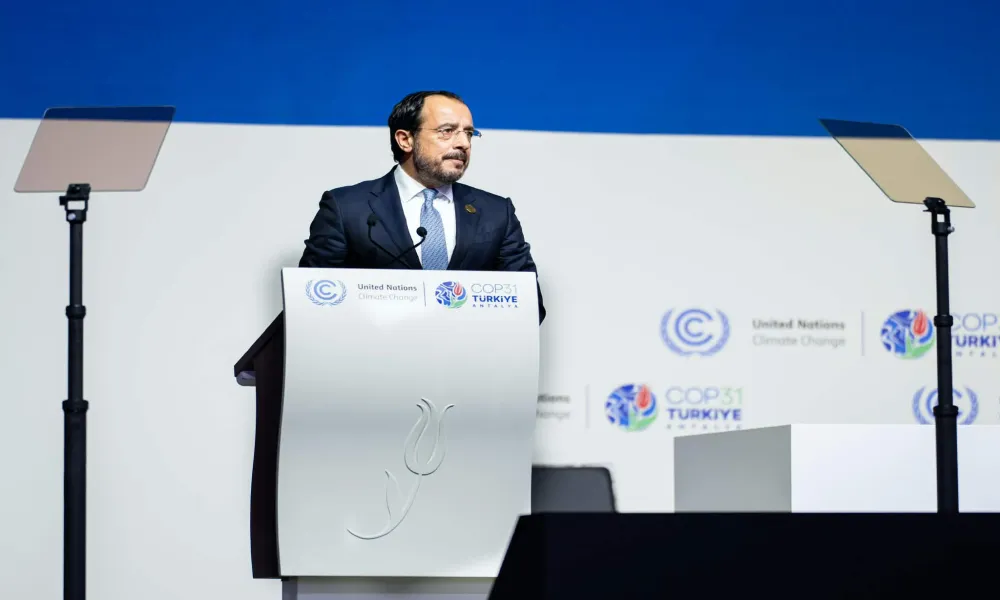



Addressing world leaders at the COP31 Leaders’ Summit in Antalya on Wednesday, President of the Republic Nikos Christodoulides opened by describing Cyprus as “a sovereign, equal and independent member state of the United Nations”. He set out the effects of the climate crisis on the island and presented a Cyprus-led regional initiative that brings together ten partner countries and more than 200 scientific experts.
“The Republic of Cyprus, a sovereign, equal and independent member state of the United Nations, comes to Antalya with a clear message: the climate crisis requires political leadership, collective responsibility and, above all, decisive action,” the President said.
Call for faster action on Paris goals
Mr Christodoulides said collective efforts remain insufficient to meet the goals of the Paris Agreement. He called for:
- faster emissions reductions
- a transition away from fossil fuels
- a tripling of renewable energy generation capacity by 2030
- a doubling of improvements in energy efficiency by 2030
He also urged countries to move beyond declarations and focus on implementing commitments, making investments and securing adequate climate finance, while ensuring a just transition.
Climate impacts already felt in Cyprus
“For Cyprus, an island in the Eastern Mediterranean, the consequences of climate change, namely water scarcity, extreme temperatures, desertification and extensive fires, are already a lived reality. Adaptation and resilience are immediate national priorities,” he said.
Referring to Cyprus’s Presidency of the Council of the European Union in the first half of this year, he said Nicosia placed particular emphasis on advancing the implementation of the EU’s shared climate commitments and remains committed to continuing this effort.
Regional cooperation across the Middle East and the Gulf
“Climate change transcends politics and recognises no borders. Addressing it is therefore an important opportunity to strengthen regional cooperation. Cyprus attaches strategic importance to deepening partnerships throughout the Middle East and the Gulf in the fields of water management, renewable energy and civil protection,” he said.
In this context, he outlined Nicosia’s work through the Initiative on Climate Change in the Eastern Mediterranean and the Middle East. The initiative brings together ten partner countries and, he said, connects governments with more than 200 scientific experts from the region.
“Together, we are working to strengthen our collective capacity for adaptation, mitigation and resilience through practical cross-border action and regional early warning systems,” he added.
Joint aerial firefighting station with Jordan
The President also referred to Cyprus’s Regional Aerial Firefighting Station, a joint initiative with Jordan that became operational at the beginning of this year with the support of the European Commission. He described it as “another tangible expression of our commitment to regional cooperation”.
He explained that the station links European civil protection resources with the region’s capabilities and hosts specialised firefighting crews in Cyprus. Its aim is to strengthen the collective capacity for rapid response and the suppression of large fires across the region.
Success measured on the ground
Mr Christodoulides said COP31’s success should be judged by the effectiveness of action on the ground. He stressed that the climate crisis knows no borders and that countries’ responses should know no divisions, urging everyone to act together to secure a safer future.
Next stop: Dublin
After his address, the President left Antalya for Dublin, where he will take part in the European Political Community (EPC) Summit on 12 November and the informal European Council meeting on 13 November.
Source: CNA