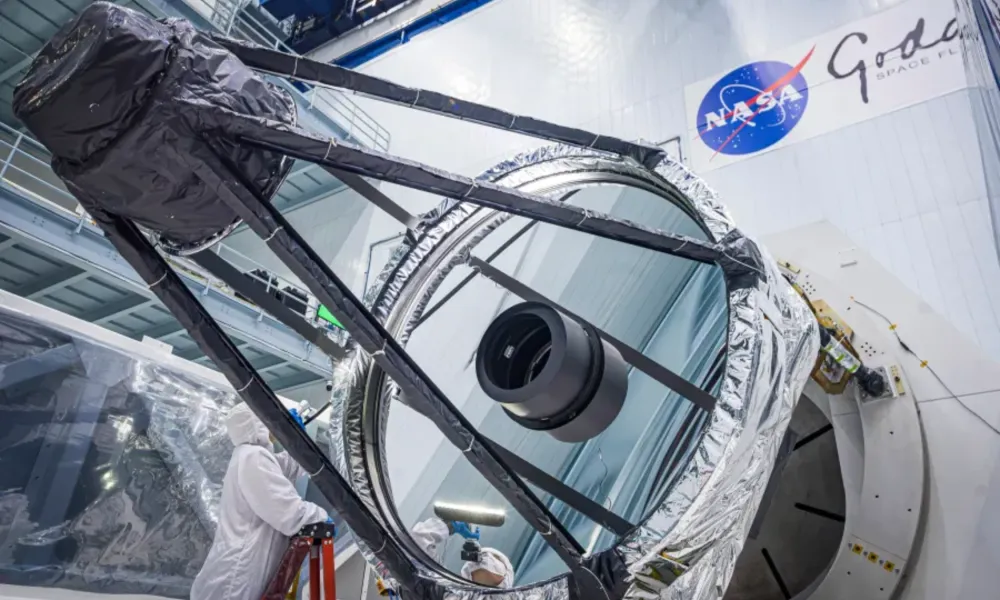

A NASA space telescope that observed the universe for almost 22 years is expected to fall back to Earth in the coming days, after a mission to rescue it failed. According to estimates by the US Space Force, the Swift telescope will re-enter the atmosphere on Friday, 6 November.
What could reach the ground
The telescope weighs about 1.5 tonnes, and most of it is expected to burn up on re-entry. However, according to Brad Cenko, the mission’s principal investigator at NASA, some tungsten components, a very dense metal, as well as parts of its mirrors, may survive and reach the ground.
Any debris that does not burn up will most likely fall into the ocean. However, the wider area where it could land includes parts of Africa, Australia, India, South-East Asia, and Central and South America. The US Space Force is tracking the telescope as it continues to lose altitude.
Why the rescue failed
Swift was launched on 20 November 2004 to observe some of the most powerful events in the universe, such as gamma-ray bursts and the explosions of massive stars known as supernovae.
In recent years, intense solar activity increased atmospheric drag on its orbit, causing it to lose altitude faster than expected.
About a year ago, NASA commissioned Katalyst Space to carry out a rescue mission, aiming to boost the telescope into a higher orbit and extend its life.
The company used a robotic spacecraft called Link, fitted with three arms, which was launched in July. However, it ran into technical problems and was unable to get closer to Swift than 12 to 15 kilometres. The attempt was abandoned, and Link itself re-entered Earth’s atmosphere in September.
After the failed mission, Swift briefly continued its scientific observations. By 20 October, however, it had dropped to an altitude of about 275 kilometres and could no longer maintain the stability its telescopes needed to operate. NASA ended the mission.
More than 3,400 cosmic explosions recorded
During its time in operation, Swift recorded more than 2,000 gamma-ray bursts and 1,400 stellar explosions. It also observed comets, asteroids and black holes tearing stars apart.
Its defining feature was its ability to turn very quickly towards the point in the sky where a powerful cosmic explosion was taking place. This allowed it to detect an event and alert other space telescopes, such as Hubble and James Webb, so they could carry out more detailed observations.
Scientists are now looking for ways to fill the gap left by its loss.
With information from the Associated Press