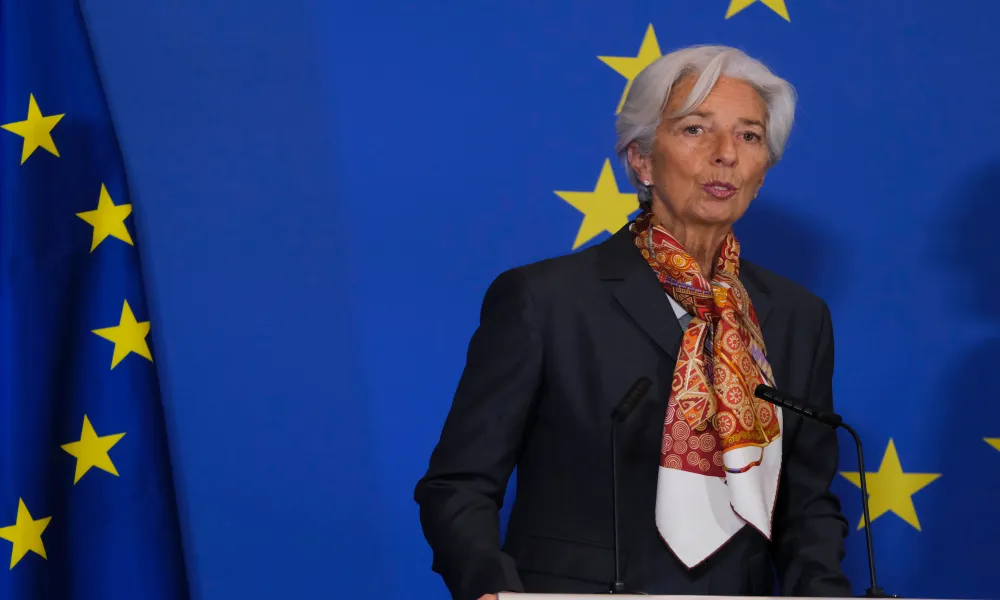

Christine Lagarde will step down as President of the European Central Bank on 7 February 2027, about nine months before her eight-year term ends. The 70-year-old Frenchwoman informed the ECB’s Governing Council and European Council President António Costa of her decision on Thursday, ending months of speculation in Frankfurt’s financial circles. The timing is significant, as her departure comes shortly before the French presidential election.
Why she is leaving
According to reports, Lagarde told fellow members of the Governing Council that she wanted greater freedom to speak. Her role required institutional neutrality, which prevented her from taking a public position on fast-moving political developments in France. The country is facing political instability and turbulence in its bond market.
Her successor will be appointed by the European Council under the procedure set out in Article 283 of the Treaty on the Functioning of the European Union.
An unconventional central banker
Lagarde was the first ECB president with no academic training in economics and no previous central bank experience, which initially drew considerable scepticism. A former corporate lawyer, French finance minister and managing director of the International Monetary Fund, she took over from Mario Draghi in 2019.
Her term turned into an almost continuous exercise in crisis management:
- the worst pandemic in a century
- the bloodiest war in Europe since 1945
- the biggest inflation shock in a generation
- an escalating trade war with the United States
Healing a divided Governing Council
Her first major challenge was internal. Draghi’s aggressive monetary easing, with negative interest rates and large-scale bond buying, had deeply divided the Governing Council. His decision in September 2019 to restart quantitative easing, despite fierce opposition from the bank’s “hawks”, had left the body badly split.
Lagarde made repairing that rift an immediate priority. A few weeks after taking office, she brought the council’s 24 members to a luxury retreat in the Taunus mountains, north of Frankfurt. In a move that showed her tactical approach, she offered cigars and rare whisky to the older members and invited them to air their grievances and past disagreements openly.
The approach worked. Under her leadership, the Governing Council began to act as a united front again, and most interest rate decisions in recent years have been taken by broad consensus. ECB Vice-President Luis de Guindos has said that although differences of view remained, Lagarde succeeded in building a shared understanding that the institution must project unity.
Mistakes and the inflation surge
Her tenure was not without missteps. In March 2020, she said the ECB was “not here to close spreads”, a remark that shook bond markets in southern Europe and that she was quickly forced to walk back.
More serious criticism came over the bank’s slow response to post-pandemic inflation. Inflation rose above the 2% target in summer 2021, but the ECB initially insisted it was “transitory”. It did not raise rates until summer 2022, by which time inflation was approaching 9%.
When the ECB did act, it acted decisively:
- 10 consecutive rate rises in 14 months
- borrowing costs taken from -0.5% to a record 4%
During the banking turmoil of March 2023, triggered by the collapse of Silicon Valley Bank and Credit Suisse, Lagarde kept her nerve. She stuck with tighter policy without causing a credit crunch in the euro area.
The TPI and its critics
To protect the euro area’s weaker economies, Lagarde introduced the Transmission Protection Instrument (TPI), an emergency bond-buying tool with deliberately vague conditions, designed to deter speculation. It has never been used. However, some analysts, such as Professor Volker Wieland, warn that its existence creates risky expectations that the ECB will always step in to shield governments from market pressure.
Beyond monetary policy, she leaves a more contested legacy, including the ECB’s active role in tackling climate changeand its push for a digital euro.
A wardrobe that made headlines
Lagarde also stood out in the male-dominated world of central banking for her personal style, which has repeatedly caught the attention of the international press. Hermès silk scarves, Birkin and Kelly bags, Chanel suits and striking jewellery have made French luxury part of her public image.
Vogue has written about her preference for the great fashion houses, and British Vogue has noted her Hermès bags in shades ranging from turquoise to classic brown. According to The Washington Post, she designs gold earrings with a jeweller friend, and her favourite fragrance is Hermès’ Un Jardin sur le Nil. Germany’s WELT has described her jewellery as including diamonds, pearls, white gold, bold bracelets and rings with large stones. Even Japanese fashion magazines have run photo features on her scarves.
As a guide to prices, a classic Hermès silk scarf costs around £400, while larger silk and cashmere shawls can exceed $1,500. These are general prices for the brand, not necessarily for the pieces she owns.
Fashion expert Hono Uehara, director of the members’ space THE SALON by NORH, analyses style through what she calls the “Fashion Octagon”: silhouette, colour, layering, fabric, posture, accessories, contrast and exposure. In her view, Lagarde is a master of it. The scarf is her signature, often echoing the colours of her jacket so that even bold patterns fit the outfit. It brings light to the face while keeping the seriousness her office requires, and often takes the place of jewellery.
The criticism
Her taste for luxury has also drawn criticism. In 2010, according to Le Parisien, a ring and a pearl bracelet were digitally removed from an official photograph of her. During her time at the French finance ministry, reports said that a set of jewellery given to her by the King of Saudi Arabia had not been recorded in the state’s official register, raising questions about the line between personal gifts and official protocol. Critics also pointed to the contrast between her costly accessories and the harsh austerity imposed on citizens of countries under bailout programmes.
On the international stage, however, she has been widely praised. Former US Federal Reserve chair Jerome Powell called her an exceptional leader and a reliable ally during the pandemic, while Kevin Warsh commended her steadiness and integrity in times of high uncertainty.
A memoir and what comes next
Lagarde’s decision to publish her autobiography, “Lady First”, in January, while still head of the central bank, caused some unease in institutional circles. David Marsh, chairman of the think tank OMFIF, remarked pointedly that memoirs are written after leaving office. Lagarde replied that promotion would be limited to weekends, and with a smile urged people to buy the book, assuring them it contains nothing at all about monetary policy.
Her departure marks the end of an era in which high politics, institutional diplomacy and personal elegance met at the very top of the global economy.
With information from the ECB, Reuters, Vogue, The Washington Post, WELT and Le Parisien