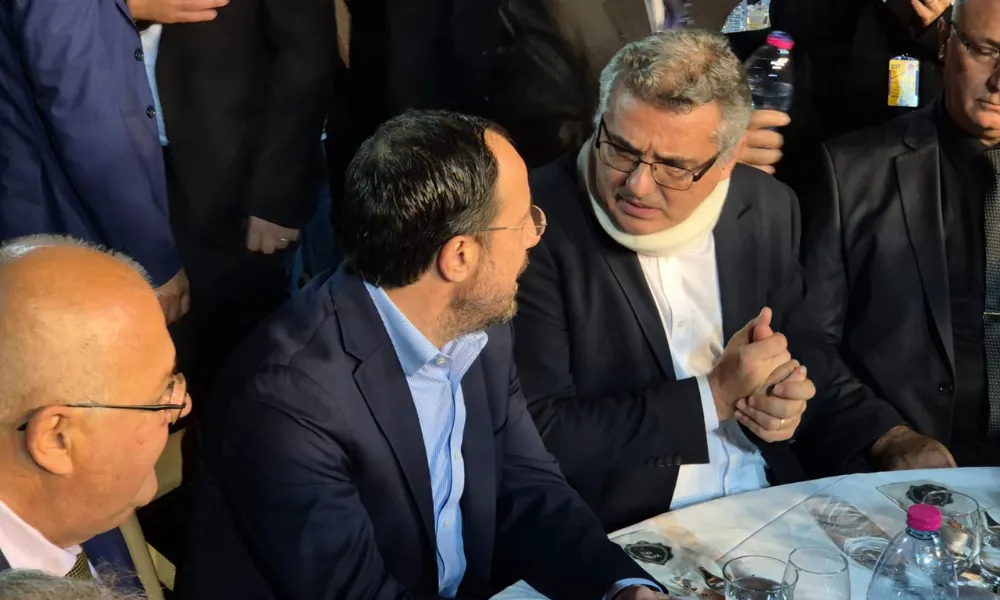
The meeting between President Nikos Christodoulides and Turkish Cypriot leader Tufan Erhurman at the sixth Bicommunal Peace Festival in Pyla has dominated Turkish Cypriot media coverage, with commentators questioning whether the warm public gestures will lead to substantive progress or remain a symbolic moment amid persistent disagreements over the Cyprus problem.
From smiles and toasts of zivania in Pyla to renewed disagreements and mutual accusations over the Cyprus problem, Turkish Cypriot newspapers and news websites have focused on the contrasting messages emerging from the recent meeting between President Nikos Christodoulides and Turkish Cypriot leader Tufan Erhurman.
While the two leaders’ joint appearance at the sixth Bicommunal Peace Festival raised hopes of improved relations between the two communities, subsequent statements have highlighted continuing differences over the resumption of negotiations, the proposed negotiating methodology and key elements of a potential settlement.
Yeni Düzen: ‘Smile in Pyla, agree at the negotiating table’
Turkish Cypriot news website Yeni Düzen published an article by journalist Cenk Mutluyakali entitled Smile in Pyla, Agree at the Negotiating Table, describing two recent developments as encouraging: the joint appearance of Erhurman and Christodoulides at the peace festival and an interview given by the Turkish Cypriot leader to Politis.
Mutluyakali wrote that the images from Pyla had generated hope, as the two communities had not participated in a joint event focused on peace for some time. However, he cautioned that the positive atmosphere had not eliminated underlying tensions.
Calling for greater transparency in efforts to restart negotiations, he argued that the public should be informed about the proposals submitted by each side and the responses they receive.
According to the information available, he noted, Erhurman had accepted six of seven proposals put forward by the United Nations Secretary-General and requested further discussion on the opening of additional crossing points.
The article also criticised Ankara, arguing that its insistence on a two-state policy outside the UN framework restricted Erhurman’s room for manoeuvre.
Mutluyakali suggested this could explain why the Turkish Cypriot leader avoids explicitly referring to a federal solution, despite discussing political equality and a rotating presidency — elements the journalist considers consistent with a federal model.
He further argued that this position allowed Christodoulides to avoid taking responsibility for the lack of progress.
Referring to recent comments by the UN Secretary-General’s Personal Envoy, Maria Angela Holguin, the journalist questioned how the two sides could agree on an overall settlement when they struggled to cooperate on practical issues such as crossing points, mine clearance and tackling plastic pollution.
He concluded that the United Nations should inform the public about which side was proposing what and who was rejecting particular proposals. Without tangible results, he warned, peace risked remaining little more than an attractive photograph taken in Pyla.
Kıbrıs Postası: ‘Pyla: sincerity or showmanship?’
An article by Erçin Şahmaran in the Turkish Cypriot news website Kıbrıs Postası, entitled Pyla: Sincerity or Showmanship? We Will See in the Coming Days, questioned whether the positive atmosphere surrounding the leaders’ meeting would lead to meaningful action.
Şahmaran argued that dialogue and communication were important but would only have real value if accompanied by concrete results. These could include opening additional crossing points, promoting joint sporting and cultural activities and avoiding, as he put it, the instrumentalisation of the justice system in property-related disputes.
The article also linked the Pyla meeting to the forthcoming COP31 climate summit in Antalya, which Christodoulides has said he intends to attend.
Noting that Turkey does not recognise the Republic of Cyprus, Şahmaran raised questions about the status under which the Cypriot president would participate, the diplomatic protocol that would apply and whether his presence could trigger another diplomatic dispute.
He recalled previous visits by Greek Cypriot leaders to Turkey, particularly that of former president Nicos Anastasiades, who did not attend an official dinner in 2016 after an invitation was also extended to then Turkish Cypriot leader Mustafa Akıncı.
Şahmaran also questioned Ankara’s likely response and the position Turkish Cypriots would occupy in the diplomatic process, arguing that major international events offered opportunities for visibility and representation.
He concluded that the coming days would show whether the atmosphere in Pyla reflected a genuine willingness to cooperate or was merely a public relations exercise.
Avrupa: ‘An uninvited guest’
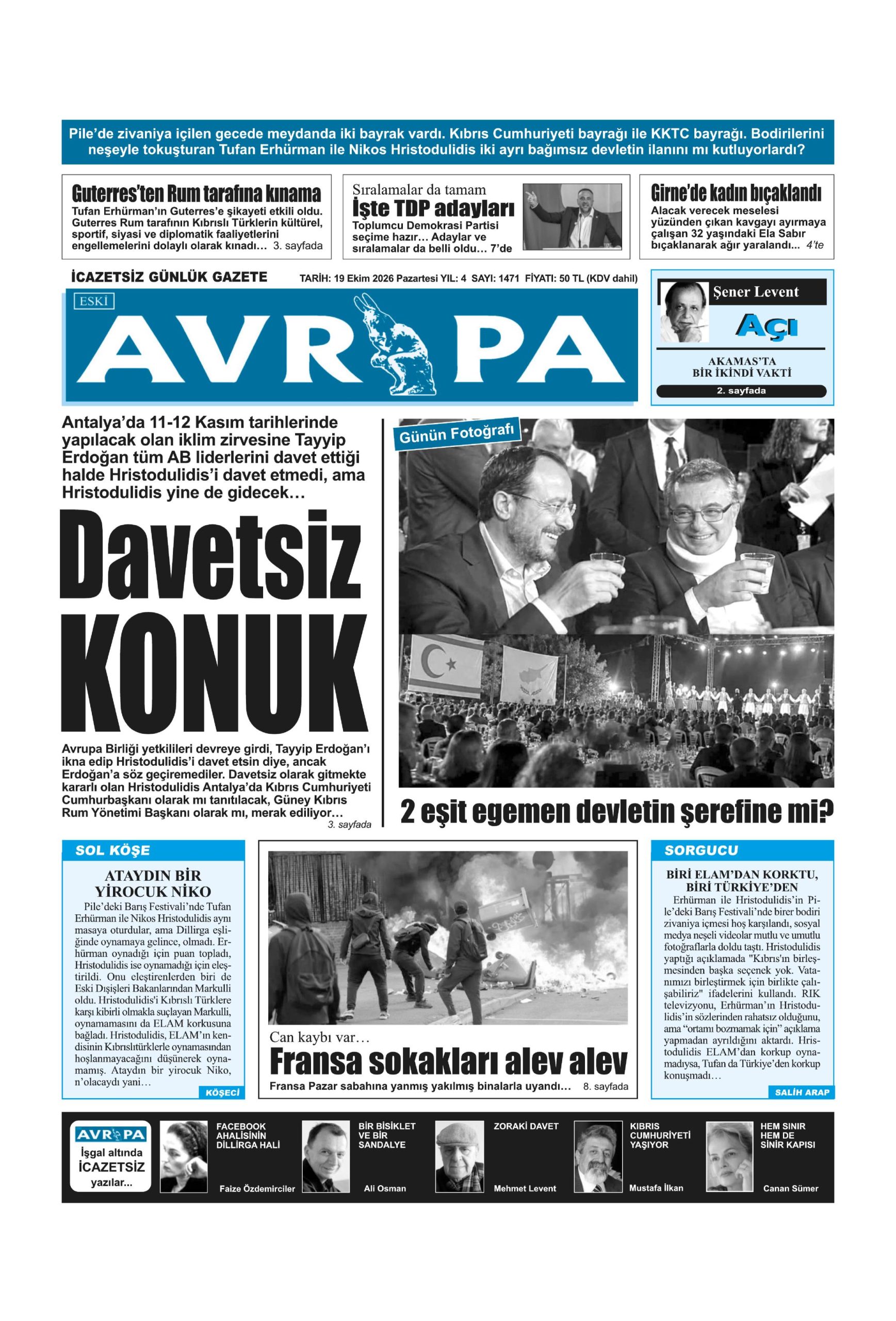
The newspaper Avrupa led with the headline An Uninvited Guest, reporting that Turkish President Recep Tayyip Erdoğan had invited all EU leaders to the climate summit in Antalya on 11 and 12 November but had not invited Christodoulides, despite efforts by EU officials to persuade him to reconsider.
According to the newspaper, Christodoulides remained determined to travel to Antalya without an invitation.
The report questioned whether he would be received as the president of the Republic of Cyprus or described using the term employed by Turkey for the Greek Cypriot administration in the south of the island.
The newspaper also published a photograph of Erhurman and Christodoulides clinking glasses of zivania at the Pyla peace festival. Alongside it was an AI-generated image of the village square featuring the flags of the Republic of Cyprus and the Turkish Cypriot administration.
The accompanying commentary questioned whether the two leaders, pictured celebrating together, were effectively celebrating the existence of two separate and independent states.
In another report, Avrupa claimed that a complaint made by Erhurman to UN Secretary-General António Guterres had produced results, arguing that Guterres had indirectly criticised the Greek Cypriot side over alleged obstacles to Turkish Cypriot cultural, sporting, political and diplomatic activities.
Halkın Sesi: ‘The wind of peace has turned’
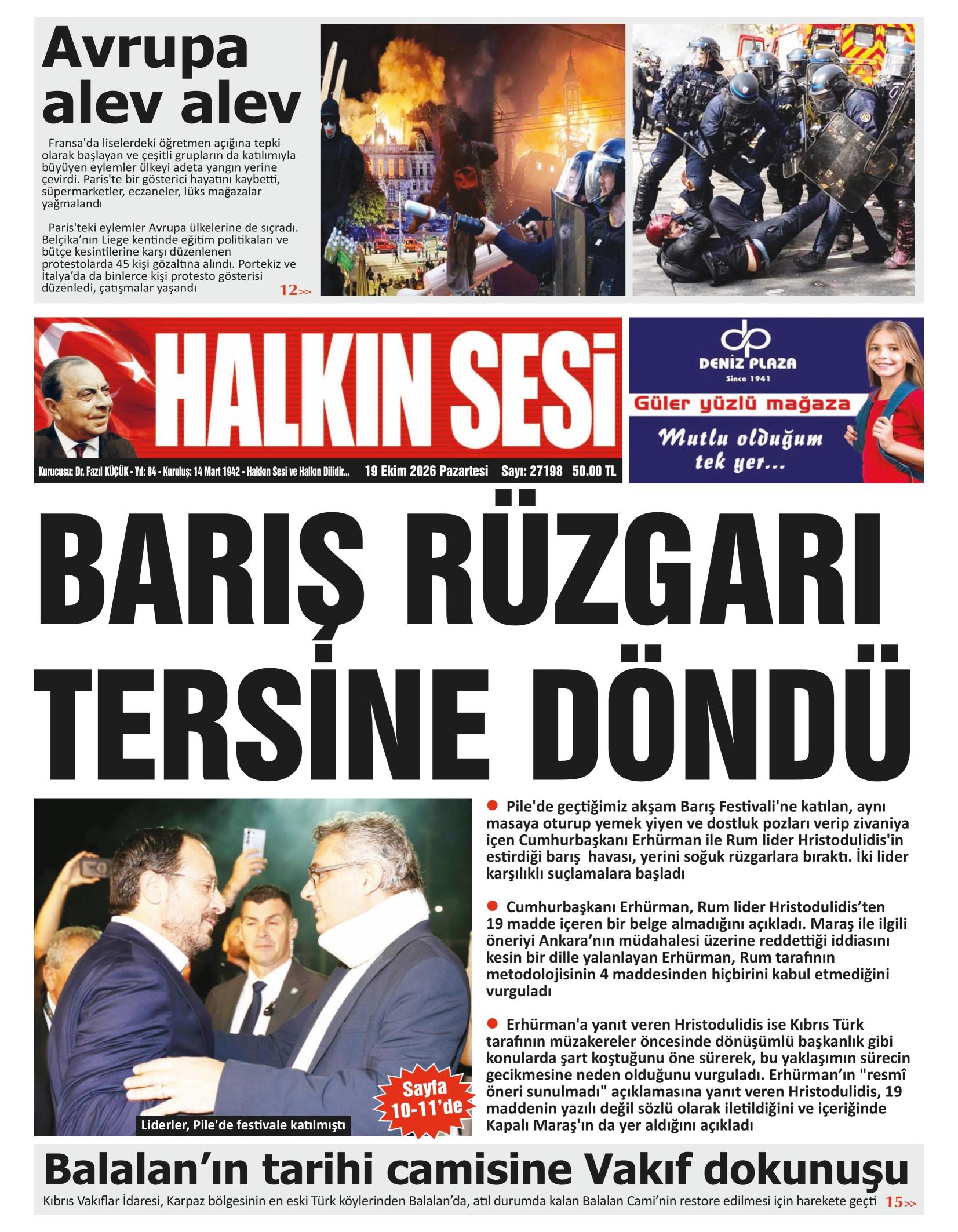
The newspaper Halkın Sesi published the headline The Wind of Peace Has Turned, reporting that the atmosphere of friendship and reconciliation at the Pyla festival had given way to renewed coldness and mutual accusations.
The newspaper highlighted the fact that Erhurman and Christodoulides had sat at the same table, shared a meal and toasted one another with zivania before disagreements resurfaced.
It also examined Erhurman’s interview with Politis, in which he said Christodoulides had not handed him a document containing 19 points. He also categorically denied rejecting the proposal following intervention by Ankara.
Erhurman further stated that he did not accept any of the four points in the negotiating methodology proposed by the Greek Cypriot side.
Christodoulides, for his part, clarified that the 19 points had been communicated verbally rather than in writing. He also argued that the Turkish Cypriot side’s insistence on a rotating presidency before negotiations began was causing delays in the process.
The differing accounts have highlighted the continuing disagreement over the conditions under which substantive negotiations could resume.
Star Kıbrıs: ‘I expect an answer from Christodoulides on rotating presidency’
The newspaper Star Kıbrıs focused on Erhurman’s expectation that Christodoulides would clarify whether he accepted the principle of a rotating presidency.
In his interview with Politis, Erhurman also denied rejecting the 19 points following intervention by Ankara. He said he was prepared to resume negotiations from where they had broken down at Crans-Montana, provided agreement could first be reached on the negotiating methodology.
The newspaper accompanied its report with a photograph of the two leaders at the Pyla peace festival.
In a separate article, headlined The Festival Held in Pyla After Six Years Generated Enthusiasm, the newspaper reported comments by Republican Turkish Party (CTP) leader Sıla Usar İncirli.
İncirli described the event as an important opportunity to rebuild trust between the two communities. She said Turkish Cypriots and Greek Cypriots needed to restore relations of confidence and stressed that the resumption of negotiations was essential to resolving the Cyprus problem.
She also warned that the prolonged failure to resolve the issue was depriving younger generations of the opportunity to realise their aspirations.
Hope for reconciliation amid persistent divisions
The coverage across Turkish Cypriot media reflects contrasting interpretations of the Pyla meeting. Some commentators have welcomed the leaders’ willingness to appear together at a bicommunal event, while others have questioned whether the symbolism will be followed by practical steps.
The central issue remains whether the two sides can overcome their differences over the negotiating framework and translate expressions of goodwill into concrete cooperation.
For now, the images of the leaders sharing a table and raising their glasses stand alongside renewed disputes over the terms of a settlement — leaving the question of whether Pyla marked a genuine turning point unresolved.