
With DISY’s leadership contest looming on 28 November, Giorgos Pamboridis appears determined to reach the ballot box, while Averof Neophytou would seemingly prefer to settle the result before anyone has to vote. A satirical look at political manoeuvring, party unity and the unlikely importance of pilotta.
Giorgos Pamboridis has made up his mind. On 28 November, he will be there. At the ballot box. Standing tall, unshakeable, armed with all his academic qualifications and the accompanying sheaves of certificates.
Whatever happens, he will not turn back. Even if someone tells him the date has changed, the ballot box is broken or the electoral assembly has been moved to Neo Chorio in Paphos, he will still turn up to vote. Even if he has to do it alone.
Averof Neophytou, meanwhile, has a problem. It is not that he fears Pamboridis. Averof does not fear elections, provided he knows in advance who is going to win. Ideally, that can be achieved by ensuring there is no opponent at all.
Somewhere along the way, however, his calculations went wrong. He believed that, following Annita Demetriou’s withdrawal, Pamboridis would also step aside, particularly if he listened to the thunderous warnings of Frixos Kouler mos: “Where do you think you’re going, you old fool? Are you determined to destroy your political career?”
Fouli’s tricks did not work. But, as everyone knows, the fox of Argaka is not so easily discouraged.
Those who know the former DISY leader describe him as a man of strategy, tactics, manoeuvres and blows delivered both above and below the table — below the belt and just above the ankles.
If political manoeuvring were an Olympic sport, he would have won gold without even entering the final. He would first have persuaded his opponents that competing was detrimental to the unity of the sport.
This time, however, he has come up against Pamboridis.
There are the four degrees, the high-end law firm, the wife who makes the best gemista and, of course, his contribution to society, given that he introduces himself as the father of Cyprus’s General Healthcare System, known as GeSY.
Pamboridis, as we know, does not appear particularly moved by DISY’s familiar soufflé of appeals for unity, consensus and the avoidance of introspection. We have established that the only recipes capable of moving him are Galatia’s.
So they pressure him. They squeeze him. They explain that the interests of the party must come first.
He remains unmoved.
As if he is going to back down in front of Fouli.
The drama
This is where Averof’s real drama begins. The fox is left wondering what he can do to make Pamboridis withdraw — not for his own benefit, heaven forbid, but for the good of the party.
Should he send a delegation of veteran DISY members to explain that it is wrong to divide the party?
Pamboridis would ask them for a written legal opinion, identify three legal contradictions and send it back with corrections.
Should he offer him a position in a future Council of Ministers?
Pamboridis would first ask who the president would be.
Should he suggest that he step aside for the good of the party?
He would reply that the best thing for the party would be to hold an election and elect him.
Should Averof stop answering his calls?
Possibly. But first, he would have to persuade everyone else to do the same.
Or perhaps Nicosia should be excluded from the election, given that Pamboridis appears to be strong in the capital?
At this point, even the most creative political strategist might begin to run out of options.
The degrees
There is, of course, the question of academic qualifications.
With four degrees, Pamboridis could analyse DISY’s constitution through four different academic disciplines.
According to our own records, Averof has a degree from a university on Long Island, which he chose because it was next to the restaurant where he worked as a busboy.
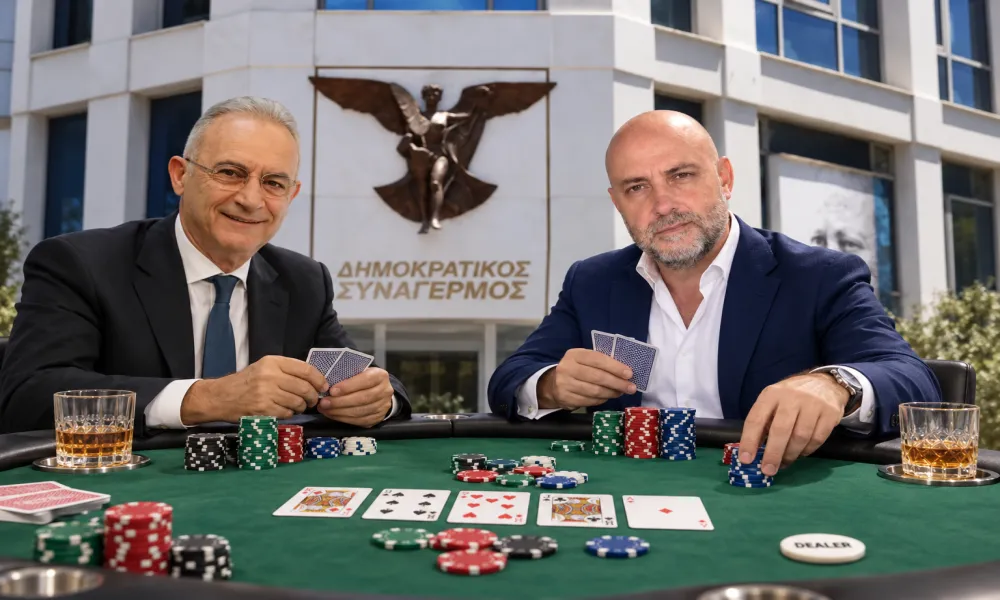
He also possesses two extremely valuable certificates: one in competitive pilotta and another in poker.
Let us be clear: we would never underestimate a good pilotta player. Indeed, we would argue that the game involves strategy — something that, in politics, can sometimes be worth more than four PhDs.
Pamboridis may know the law, but Averof knows when to declare kapo, leaving his opponent speechless.
Pamboridis may cite case law, but Averof can make his opponent believe he is losing when, in reality, he is holding a royal flush.
Tornaritis’ proposal
Some people, including Tornaritis, have called for the two men to meet and reach an agreement.
Imagine, then, what their next meeting might look like.
“Giorgos, my friend, think carefully. It would be a shame to divide DISY.”
“Averof, my friend, that is precisely why I want an election. Let the people decide.”
“But that is exactly what I’m saying. Let the people decide. We simply don’t want to make them go to the trouble of turning up to vote.”
“What do you mean?”
“Well, let us reach an agreement first.”
“And who would be the candidate?”
“Do we really have to discuss everything, Giorgos?”
And there, in a nutshell, lies the problem.
The difference
That is precisely where the two men differ.
Pamboridis wants to reach 28 November and count the votes.
Averof would prefer to reach 28 November having already counted the voters, the delegates, the undecided and, if possible, the beans before they are even put into the ballot box.
He might even try his ultimate weapon: offering Pamboridis a televised debate devoted exclusively to party unity, moderated by Averof himself.
If that fails, there is always pilotta.
“Come on, Giorgos, let’s play a game. Whoever loses withdraws.”
“I accept. But first, we must appoint an independent electoral commission.”
“But it’s only a game of pilotta!”
“Exactly. With you as my opponent, I want observers as well.”
And so the battle for the party nomination could end up becoming a clash between two entirely different schools of thought.
The Pamboridis school, according to which elections are held to identify the winner.
And the Averof school, according to which the ideal outcome is to have identified the winner before the election takes place.
One thing is certain: if Pamboridis holds his ground until the end, Averof will have to deploy the full range of his political skills.
And if neither pilotta nor poker does the trick, there remains one final option.
He could enrol at a university and acquire another three degrees.
There is just one problem: he would not have enough time before 28 November.
Unless, of course, he can persuade Pindarou that, in the interests of party unity, the election should be postponed until he graduates.