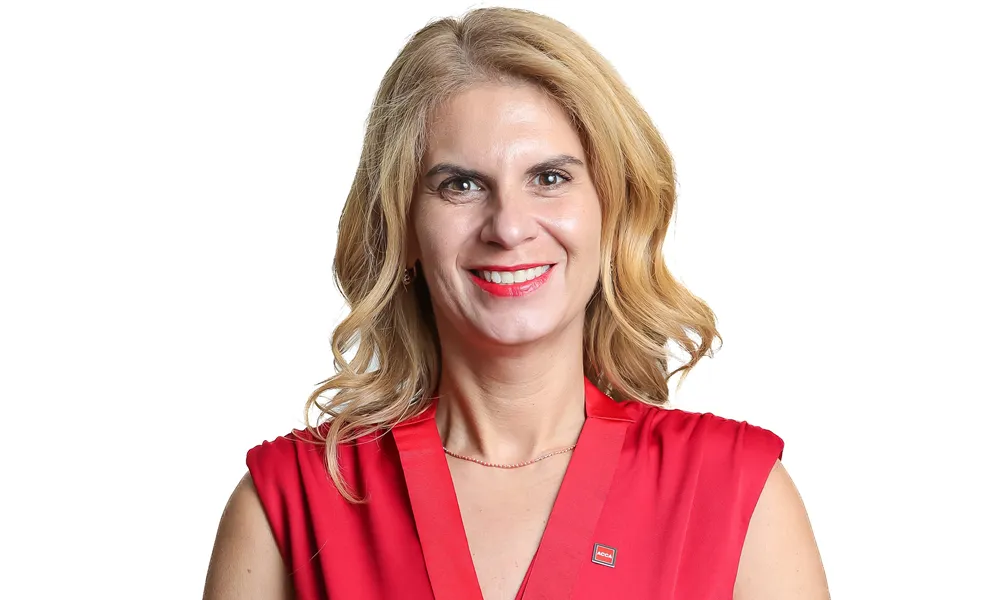
We met Cristina Gutu, Vice President of ACCA, during her visit to Cyprus for ACCA’s New Members Ceremony, an occasion that celebrates those who have successfully completed the demanding journey to ACCA membership and are taking their place in a global profession undergoing profound change. Her visit also included meetings with key stakeholders and policymakers from Government and Parliament, providing an opportunity to discuss the challenges facing the profession and the wider economy, from artificial intelligence and the future of skills to competitiveness, sustainability and trust.
For Cristina, the ceremony has particular significance. Much of her own career has been devoted to education, mentoring and helping the next generation of professionals develop their potential, something she describes as a personal passion. Against a backdrop of rapid technological change, she believes the profession is not becoming less relevant, but is being redefined, with human judgement, curiosity, ethics and the capacity for lifelong learning becoming increasingly important.
Cristina Gutu became Vice President of ACCA in November 2025 and is the first Vice President from continental Europe in ACCA’s history. She is a Director at KPMG Romania & Moldova, where she leads learning and development, and has extensive experience in audit, consultancy and professional education. An ACCA Council member since 2018, she is also a certified executive coach and accredited mentor, reflecting a long-standing commitment to mentoring, developing talent and giving back to the profession.
1. You became Vice President of ACCA in November 2025 and are the first Vice President from continental Europe in ACCA’s history. What does taking on this role mean to you personally and professionally?
It is both a great honour and a responsibility to help represent such a large, diverse and truly global professional community.
My own relationship with ACCA goes back many years. It has been an important part of my professional journey and has opened doors that, when I started my career in Romania, I could hardly have imagined. That is one reason why becoming ACCA Vice President has such personal significance for me.
Being the first Vice President from continental Europe is something I am very proud of, but I also see it as part of a broader message about opportunity and representation. I hope that young professionals, women and men alike, can look at journeys such as mine and recognise that leadership is attainable.
I have always believed that careers are not necessarily perfectly planned paths. They are often built through curiosity, hard work, lifelong learning and a willingness to embrace opportunities – sometimes before we feel completely ready for them.
2. Looking at ACCA today, at a time of major technological, economic and geopolitical change, how do you see the organisation’s role? Has ACCA’s mission changed?
ACCA's fundamental purpose remains as relevant as ever, but the environment in which our members operate is changing at extraordinary speed.
We are living through the transformation brought by artificial intelligence and digitalisation, while businesses are simultaneously dealing with geopolitical uncertainty, sustainability challenges, regulatory change and changing expectations from employees and society.
In that environment, ACCA's role goes far beyond providing a globally respected professional qualification. We have to help the profession anticipate change, build the skills it will need, maintain the highest ethical standards and continue contributing positively to economies and societies.
The accountant of the future will need technical excellence, but also curiosity, adaptability, critical thinking, communication skills and ethical judgement.
So I would put it this way: our role is not simply to prepare accountants for today's profession, but to prepare the profession for tomorrow.
3. Your visit to Cyprus combines the New Members Ceremony with meetings with important stakeholders and policymakers, including representatives of the Government and Parliament. What is the main message you are bringing to Cyprus?
The two parts of my visit are actually very closely connected.
At the New Members Ceremony, we are celebrating the future talent of the profession. In my discussions with policymakers and stakeholders, we are talking about the environment in which that talent - and Cyprus businesses more broadly - will operate in the years ahead.
ACCA wants to be a constructive long-term partner to Cyprus. As a global professional body, we can bring international experience, research and the perspective of our members on issues such as skills and talent, AI and digital transformation, sustainability, regulation, competitiveness and economic resilience.
But it is equally important that this is a two-way conversation. We want to understand the priorities and challenges Cyprus faces and explore where the profession can make a meaningful contribution.
4. What specifically is on the agenda in your discussions with the Cyprus Government and members of Parliament? Where can an organisation such as ACCA contribute to policymaking?
Professional accountants have a particularly valuable perspective because they see how policy translates into practice, in large organisations, SMEs, the public sector and across different industries.
Our discussions therefore cover some of the major questions facing Cyprus and other European economies: how we develop and retain talent, how businesses adopt AI and digital technologies responsibly, how we support SMEs, how we respond to sustainability challenges and how we ensure regulation is effective and proportionate.
ACCA can contribute international evidence and experience from our global membership and from our engagement with governments and institutions in many different markets.
The objective is not simply to advocate for the accountancy profession. It is to contribute constructively to policies that support competitiveness, good governance, strong public financial management and sustainable economic growth.
5. Cyprus is a small and very open economy with an important professional and financial-services sector. In an increasingly competitive international environment, what must Cyprus do to maintain and strengthen its position?
I believe Cyprus should compete on quality, trust and talent.
For a small, internationally connected economy, a highly skilled workforce, strong institutions, digital capabilities, international connectivity and high professional and ethical standards are enormously important competitive assets.
Reputation also matters. For any international business centre, trust and regulatory credibility are not simply compliance issues – they are economic assets.
At the same time, Cyprus's size can be an advantage. Smaller economies can often be agile and adapt quickly to technological, economic and regulatory changes.
So the opportunity is to combine that agility with investment in people, skills, technology and strong institutions. For Cyprus, trust and talent can be powerful competitive advantages.
6. Cyprus introduced significant tax reforms in 2026. From an international perspective, what are the characteristics of a tax system that supports competitiveness without compromising fairness and sustainable public finances?
I would not comment on individual elements of the Cyprus reform without looking at them in their full context, but internationally there are some principles that consistently matter.
Businesses value predictability, transparency, simplicity and stability because investment decisions are made over the long term. Governments, meanwhile, need sustainable revenues to finance public services, and taxpayers need confidence that the system is fair and effectively administered.
These objectives do not have to be contradictory.
Professional accountants can play an important role in this process because we often sit at the intersection between legislation, businesses and taxpayers. That gives the profession practical insight into how reforms work once they move from legislation into implementation.
Ultimately, a successful tax system needs to support economic activity while maintaining public confidence and fiscal sustainability.
7. Artificial intelligence is probably the biggest technological question facing your profession. Should a young person starting an accounting
qualification today worry that AI may eventually do much of the work accountants currently perform?
I understand why young people ask that question. AI will undoubtedly automate some activities and fundamentally change others. Routine and repetitive work will increasingly be performed by technology, and we should be realistic about that.
But I see this much more as a transformation of the profession than the disappearance of the profession.
AI can process enormous quantities of information very quickly, but professional value is not simply about processing information. It is about understanding context, asking the right questions, exercising judgement, challenging assumptions, communicating effectively and acting ethically.
Those human capabilities become even more important when technology becomes more powerful.
Our responsibility as a profession is therefore to help people develop new skills and to encourage lifelong learning. AI will change what accountants do, but it also gives us the opportunity to increase the value accountants bring.
8. If technology can analyse huge amounts of financial information almost instantaneously, what will distinguish a successful accountant five or ten years from now?
Technical knowledge will remain fundamental, but technical knowledge alone will no longer be enough.
Successful finance professionals will need AI and data literacy alongside critical thinking, adaptability, curiosity, communication skills, business understanding and strong ethical judgement.
I think curiosity is particularly important. Technology will continue changing, so none of us can assume that what we know today will be sufficient throughout our careers. We have to remain willing to learn, question and adapt.
The accountant of the future will increasingly be expected to interpret information rather than simply produce it. To identify risks and opportunities, challenge assumptions and help organisations make better decisions.
The accountant of the future will not compete with AI; they will need to know how to use it intelligently and responsibly.
9. Cyprus, like many European economies, is competing for skilled professionals. What does ACCA's experience tell you about what the younger generation now expects from employers?
Young professionals certainly want competitive remuneration, but increasingly they are looking for much more than that.
They want opportunities to learn and progress. They want meaningful work, exposure to technology, flexibility and organisations whose values they can understand and respect. They also want leaders who invest in their development.
That means employers need to think beyond recruitment. Attracting talent is only the first step; the bigger challenge is creating an environment where talented people want to stay, grow and contribute.
This is particularly important for Cyprus. In a knowledge-based economy, developing and retaining talented people is directly linked to national competitiveness.
And learning cannot stop when someone gains a qualification. One of the strongest lessons from my own career has been that professional development is a lifelong process.
10. Sustainability has become another major area of responsibility for companies and finance professionals. Is there a danger that sustainability reporting becomes simply another compliance exercise?
Yes, that danger exists, and it is something we should actively avoid.
Sustainability information should help organisations understand their risks, opportunities and long-term resilience. If it becomes simply another report produced to satisfy a requirement, then we miss much of its potential value.
Accountants have an important contribution to make because our profession already brings expertise in measurement, controls, governance, reporting and assurance. These skills can help organisations turn sustainability information into better decision-making.
At the same time, particularly for SMEs, proportionality is very important. Regulation needs to achieve its intended objective without creating unnecessary complexity and cost.
The goal should ultimately be better businesses and better decisions – not simply more reporting.
11. Accountants and auditors operate in a profession built fundamentally on trust. Following corporate failures and controversies internationally, how can the profession ensure that this trust is maintained?
Trust cannot be assumed simply because someone holds a professional qualification. It has to be earned continuously.
That means demonstrating competence, integrity, independence, professional scepticism and accountability in the decisions we make.
Technology can strengthen auditing and financial analysis, but it does not transfer responsibility from professionals to machines. If anything, the growth of AI makes questions of ethics, judgement and accountability even more important.
The public-interest dimension of accountancy must therefore remain central to our profession. People need to have confidence not only in the information we produce, but also in the professional standards and values behind it.
Ultimately, our reputation as a profession depends on what we do when difficult decisions have to be made – not only when circumstances are easy.
12. You have spoken very passionately about mentoring and giving back to the profession. Why is mentoring so important to you, and what responsibility do established professionals have towards the next generation?
Mentoring is very personal to me because I have experienced its power throughout my own life and career. My first mentors were actually within my own family, and later I was fortunate to encounter people professionally who challenged me, encouraged me and sometimes saw potential in me before I fully recognised it myself.
That is something I now feel a responsibility to pass on.
Mentoring is not about telling another person what career they should have. It is about listening, asking the right questions, helping people find their own voice and giving them the confidence to make their own choices.
I also believe leadership is not simply about how far you progress personally. At some point, it becomes about how many other people you help to progress.
The profession has given me extraordinary opportunities, and giving back, through mentoring, coaching, education and my work with ACCA, is one way of ensuring that the next generation has even greater opportunities than we did.
13. You are in Cyprus to welcome ACCA's newest members. If you had to give them one piece of advice as they begin this new stage of their careers, what would it be?
First, I would tell them to enjoy this moment and be proud of what they have achieved. Becoming an ACCA member requires commitment, discipline and resilience, and it deserves to be celebrated.
But I would also tell them that this is a beginning, not an end.
Remain curious. Keep learning. Embrace technology and change rather than fearing them. Seek out people who challenge and inspire you, and as your own career progresses, make time to mentor and support others.
And don't feel that you need to have your entire career mapped out today. Some of the most important opportunities may be ones you cannot yet imagine. Be willing to take opportunities that stretch you, even when you don't feel completely ready.
Your ACCA qualification can take you into business, entrepreneurship, financial services, advisory, the public sector, technology and leadership, all across borders.
14. Finally, when you look five or ten years ahead, what would you like ACCA's relationship with Cyprus to look like?
I would like ACCA to continue being a strong professional home for our members and future members in Cyprus, but also to deepen our role as a constructive long-term partner to the country.
That means continuing our dialogue with government, Parliament, regulators, universities, employers and the wider profession and bringing ACCA's international research and experience into discussions about skills, AI, sustainability, ethics and the future of finance.
But partnership also means listening. Cyprus is an internationally connected EU economy with its own experiences and strengths, and there is much that can contribute to the wider international conversation.
Ultimately, our shared objective should be to develop talented, ethical and forward-looking professionals who help businesses and institutions make better decisions.
We want ACCA to be not only a professional body in Cyprus, but a long-term partner in developing the talent, trust and capabilities that the country's economy will need for the future.