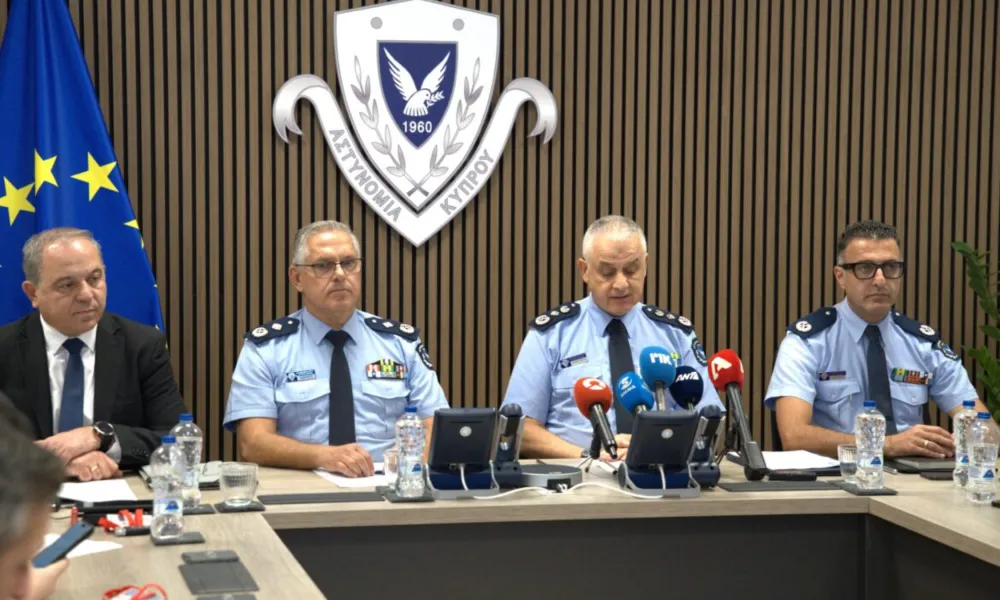

Cyprus Police have brought their fight against serious and organised crime under a single command, with the Directorate for Combating Organised Crime (DAOE, from its Greek initials) now operating at full capacity. The service was formally presented on Wednesday by Chief of Police Themistos Arnaoutis and the Directorate's head, Superintendent B Christos Andreou. According to police leadership, it is one of the most significant reforms of the "Police 2030" programme and has already recorded its first operational results.
A change in how police operate
The Chief of Police said the Directorate is not just an administrative reorganisation. He described it as a substantive change in the way police tackle organised crime.
"We are not changing structures to change organisational charts. We are changing the way we operate in order to become more effective in ensuring the safety of citizens and the country," he said.
He explained that criminal organisations now operate with greater flexibility. They exploit technology, build international connections and are active across multiple areas of illegal activity. For this reason, the new service aims to do more than solve individual cases. Its goals are to dismantle entire criminal networks, cut off their financial power and prevent their activity.
Structure and operating model
The Directorate brings key police operational capabilities under unified command. It links intelligence gathering, data analysis, operational investigations, financial investigations, technology and international cooperation.
It also draws on the experience and expertise developed by the Drug Law Enforcement Unit (YKAN), extending that work across the full spectrum of serious and organised crime.
The four sub-directorates
Presenting the structure, Christos Andreou said the service consists of four sub-directorates.
The Intelligence and Special Operations Sub-directorate is responsible for collecting, managing, evaluating and analysing intelligence on serious and organised crime.
The Drug Law Enforcement Sub-directorate (YKAN) is tasked with combating illegal drug trafficking and dealing.
The Organised Crime Investigation Sub-directorate investigates and solves organised crime cases throughout the Republic of Cyprus.
The Strategic Analysis, International and European Relations Sub-directorate handles strategic threat assessment and the development of the national strategy against organised crime.
From individual cases to dismantling networks
According to the Directorate's head, the new service shifts the operational focus away from investigating single criminal acts. Its aim is the comprehensive mapping and dismantling of criminal networks.
This approach looks at how the organisations are structured, how they are connected, how they are financed and what financial gains allow them to keep operating.
Intelligence Led Policing plays a central role. Operational decisions are based on intelligence analysis, risk assessment and the early identification of emerging threats and trends.
Organised crime in Europe: the figures
Data presented during the briefing showed the scale of the problem at European level.
According to the European assessments presented, there are currently 731 of the most threatening criminal networks in Europe. Together they have more than 400,000 members from 118 different nationalities.
Approximately 85% of these networks use legal business structures to support or conceal their criminal activity.
Cooperation with Europol and the Hellenic Police
Particular emphasis was placed on international cooperation, described as a core pillar of the Directorate's work.
The Directorate works closely with Europol and takes part in the European EMPACT actions. It also maintains operational cooperation with the Hellenic Police, other European police authorities, and relevant international organisations and authorities in third countries.
Measuring success
Christos Andreou said the Directorate's real test will be its work and the results it delivers.
"The success of the DAOE will not be judged by the creation of a new structure. It will be judged by its results. By the extent to which our work contributes to a safer Cyprus and to the better protection of citizens," he said.
According to the police, the official launch of the Directorate is a further step in the modernisation of the force. Its stated aim is to counter modern forms of organised crime more effectively and to strengthen the security of citizens and the Republic of Cyprus.