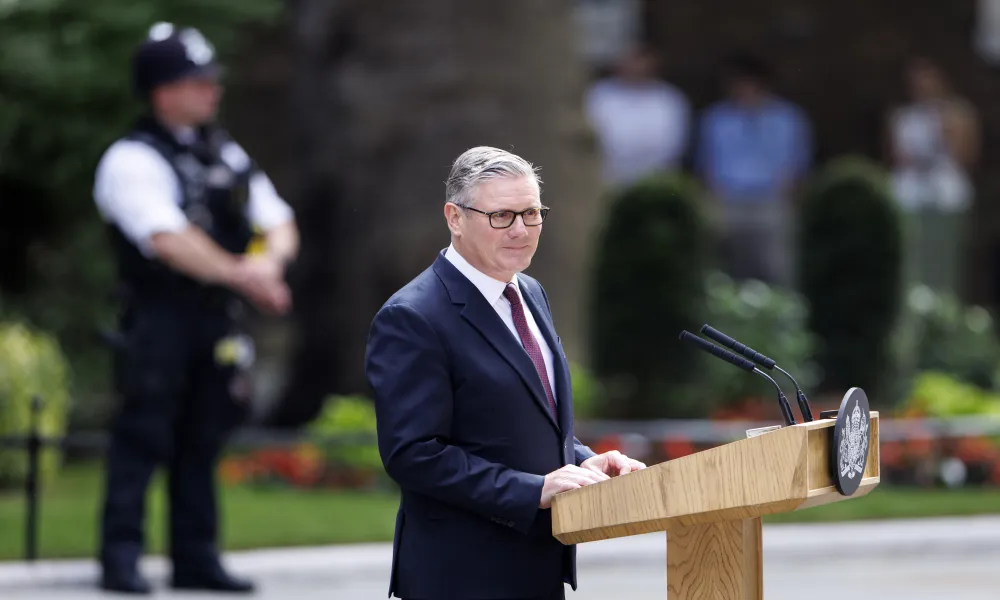

Keir Starmer's announcement that he is stepping down as Labour leader has set in motion a clearly defined succession process, one that must produce a result within weeks. The mechanics of how Britain chooses its next prime minister are straightforward in outline but consequential in every detail.
The threshold candidates must clear
No one enters this contest easily. Any candidate wishing to replace Starmer must first secure the backing of at least 20 per cent of the parliamentary Labour Party. With Labour currently holding 403 seats in the House of Commons, that figure translates to a minimum of 81 MPs, including the candidate themselves. That is not a small ask. It is a threshold designed to ensure that only figures with genuine, broad-based support within the parliamentary group can advance to the next stage.
Beyond the parliamentary hurdle, candidates must also demonstrate a defined level of support from local Labour Party branches across the country and from affiliated trade unions. The combination of these requirements means that outsider candidacies, or bids mounted without significant groundwork already in place, are effectively ruled out from the outset.
What happens if more than one candidate qualifies
If multiple candidates clear all the qualifying thresholds, the contest moves to a full membership vote. Every Labour Party member and registered supporter would be eligible to participate. The winner of that vote becomes Labour leader and, as the leader of the party commanding a majority in the House of Commons, automatically becomes prime minister.
This is the scenario that would produce the most visible and extended public contest, with candidates setting out their visions for the party and the country over the weeks between the close of nominations and the announcement of a result.
What happens if only one candidate qualifies
The rules also allow for a significantly quieter outcome. If only one candidate succeeds in meeting all the qualifying criteria, no membership ballot is held. That candidate is confirmed as Labour leader and becomes prime minister without a contest. It is a provision that concentrates considerable power in the hands of MPs, trade unions and local party structures, since their collective decisions at the nomination stage could effectively determine the outcome before any wider membership vote takes place.
The timeline
Starmer stated that he has requested the party's governing body to set nominations opening on 9 July. The submission window would close before parliament rises for its summer recess on 16 July. Should a contest proceed to a membership vote, Starmer said it must be concluded before parliament returns from recess, currently scheduled for 1 September.
That gives the Labour Party approximately six to seven weeks to complete the entire process, from the opening of nominations to the confirmation of a new leader. It is a compressed but workable timetable, and one clearly designed to avoid the kind of prolonged leadership vacuum that has caused damage to British political parties in the recent past.
Starmer indicated he would remain in office as prime minister throughout the process and pledged to offer his successor full and unequivocal support. He said he would do everything possible to ensure the transition of power takes place with order and stability.
Who is likely to stand
The field has not yet formally taken shape, but Andy Burnham has emerged as the immediate front-runner. The former Mayor of Greater Manchester returned to parliament last week after winning the Makerfield by-election with a substantial majority over the Reform UK candidate. That result, in a seat that has become fiercely contested territory, was widely read as a vindication of Burnham's decision to re-enter Westminster politics and an endorsement of his political positioning. He was expected to take his seat on Monday.
Burnham has run for the Labour leadership twice before, in 2010 and again in 2015. His years leading Greater Manchester gave him a profile that extends well beyond Westminster and a reputation for connecting with voters in parts of England that Labour has struggled to hold in recent years.
The weight of the moment
Whoever emerges from this process will become Britain's seventh prime minister since 2016, a number that speaks to the political volatility of the past decade. The succession process now under way is, by design, swift and structured. Whether it produces a clear contest or a single uncontested candidate, the outcome will shape British politics for years to come.
Source: APE-MPE and BBC