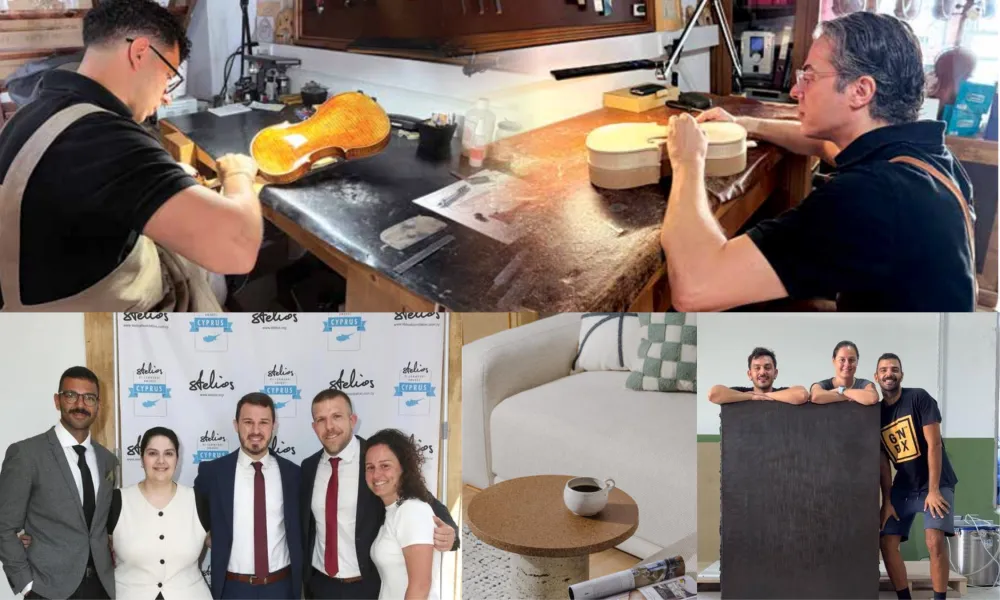
It is 2026, the debate over the Cyprus problem is at boiling point, and the need to strengthen confidence-building measures is once again in the spotlight. Only the two sides are struggling to find common ground. At the same time, independent initiatives run by ordinary people are not only achieving cooperation, they are thriving, offering something to society and the economy alike. Such initiatives are also supported in Cyprus by the Stelios Philanthropic Foundation, through cash prizes and by giving visibility to bicommunal business ideas. Politis chose to profile two of this year's winners, two very different businesses that, at their core, prove something self-evident. When the two communities work together, the result is beautiful, productive, and opens up new possibilities.
The art of violin making
Few people go into the specialised craft of violin making, but those who do, do it with devotion and skill. Michalis Pantelidis opened his workshop on Katsonis Street, in central Nicosia, in 2005, bringing with him knowledge gained in the historic city of Cremona, the world capital of the violin. For the past five years, he has worked alongside Arif Cebeci, making new violins and restoring old ones.
Michalis played the violin from a young age, but always preferred making things with his hands, particularly wooden boats. As a final year student, influenced by his sister who was already studying in Italy, he reasoned that "someone has to make the violins," and ended up in the Italian city of Cremona. There he learned the Renaissance craft dating back to the 16th century, and brought it back with him to Cyprus.
Arif's story is "similar," as he puts it. Influenced by the director of the music school he attended, he discovered violin making, was captivated by it, and decided to pursue it professionally. He studied in Turkey and, on returning to Cyprus, started out in his own garage. Through mutual friends, he crossed paths with Michalis, and their successful collaboration began.
Coexistence in an inherently solitary craft
The craft of building violins "requires a degree of isolation and concentration," Michalis explained, though as an art, "it's extremely important to have another pair of eyes nearby too," he added. Laughing, he recalled the years before working with Arif, when he would finish a violin and want to ask someone whether they "saw what he saw," often waiting for his annual visit to Italy and to his "maestro." Given how few violin makers there are, he noted, it matters to have two professionals in one workshop.
Creating with respect
"A violin is a violin, whether it plays classical or traditional music," Michalis says, clarifying that specialised electric violins belong to a different category altogether. Their workshop works on the classical string family quartet, violins, violas, cellos, and occasionally repairs double basses, which require more space. Beyond building instruments, the two violin makers also restore old ones. One of the jobs they are proudest of was the restoration of a 1785 violin by Giovanni Battista Guadagnini, valued at €4 million. "These instruments aren't just musical tools, they're historical works of art," Michalis said, adding that "every intervention has to respect the work of the original creator."
They also recently managed to bring a Stradivari violin and a Guarneri violin to Cyprus, and organised an exhibition where Cypriot musicians had the chance to play these great instruments. "Everyone was very excited, because it's very rare to have such instruments in your hands," Michalis said, explaining that it was a good opportunity to compare and understand what makes a violin "truly great" and where that greatness comes from. As he described it, violin making is passed down from older to younger "maestros." Cremona is known as the capital of the violin and was the birthplace of the historic violin makers Antonio Stradivari and Nicolò Amati, considered the "masters" of the craft, which is why, as Michalis stressed, it is the duty of those who follow to "respect" their work. "We try to preserve the traditional craft," even though it is more demanding and time consuming. This way, the instrument develops its character naturally over time, its life bearing witness to the life of the musician who plays it. "Every violin is different," he added, each has its own personality, and reflects the level of skill of its maker.
For Arif, the magic lies in creating something from nothing. Although he studied music and enjoys playing, he always felt uncomfortable in front of an audience. Working in a workshop is different, "you close the door, you smell the wood, you touch it and you create something beautiful," a feeling he finds difficult to describe.
Building a violin from scratch takes an estimated 300 hours of concentrated work and requires a great deal of patience, with no shortcuts. "A great violin isn't made in a hurry, you have to pay attention to every detail," Michalis stressed. In reality, to keep the business viable, they also rely on repair work, making the balance between craftsmanship and business one of their biggest challenges.
The award
As a business, Michalis and Arif have this year received an award from the Stelios Philanthropic Foundation in Cyprus for bicommunal businesses for the third year running. As they explain, it matters that their art and craftsmanship are recognised as a substantial contribution to the economy, and the Foundation recognises their business model. People often think of the arts as a hobby, Michalis said, when in reality they can contribute to the economy and are worth the financial investment.
Coexistence on a divided island
"Ordinary people have nothing to divide between them," Michalis said, describing the situation as "quite absurd." The political situation simply "makes our lives harder," he explained. Crossing points, bureaucracy and division create obstacles that "ordinary people don't need," he added.
Arif agrees, and believes that while the two communities do coexist, practical difficulties remain. As he described it, in the northern part of the island it is far harder to order materials and supplies because of restrictions, while taxes imposed by Turkey drive up costs dramatically. This was one of the reasons he could not keep his own workshop in the northern part of Nicosia, where he still lives today. Every day, to get to work, just a few kilometres away, it takes him hours to cross the checkpoint. The shortage of materials also cuts off Turkish Cypriots' access to products, including violins. Asked whether things would be different if it were left up to ordinary people, Arif said it "would have been resolved decades ago."
From olive waste to the table
Beyond independent initiatives, unexpected professional partnerships are also born through UN confidence-building programmes. Pit2Table was born out of a UNDP programme, where for three months inventive minds from across the island joined forces to develop their business ideas. Two independent ideas are now working in synergy, developing their products together.
Furniture from olive pits
Pit2Table makes use of all the waste from olive presses and turns it into surfaces for furniture. The idea started with Mustafa Afşaroğlu, Buğra Ebeler and Yağmur Fellahoğlu during the Covid pandemic. Mustafa, drawing on his earlier work in design as well as memories from childhood, when his family gathered olives for olive oil, thought that all the material left over from the process could be turned into something useful. The idea matured through their participation in UNDP's confidence-building programme. During the programme, they met Katerina Loizou and Angelos Evangelou, who were taking part with their own project. The process brought them close, and beyond the friendships that formed, Katerina and Angelos brought the Pit2Table team "what it was missing," as Mustafa told Politis, through their knowledge of materials.
In 2025, the company became a reality, with their product already gaining recognition. "The market is becoming more receptive," Mustafa explained, particularly when it comes to design and sustainability. The challenges lie in the production chain, since construction companies still tend to prefer established materials like laminate, which are also cheaper. Even so, their product has been presented in Copenhagen, Paris, London and New York. Buğra described how the team started out making the surfaces by hand, gradually building up a workforce and machinery, with the goal of automating production so they can focus fully on design.
Significant recognition came from European Commission President Ursula von der Leyen herself, who congratulated the creators at an exhibition in Brussels. "It was surreal," Buğra described, "hearing her talk about your work," adding that this kind of recognition "validates what we're trying to achieve."
A bicommunal partnership
The products are made in the northern part of the island, at the original workshop, but the waste material comes from both Turkish Cypriot and Greek Cypriot olive producers. The finished product crosses the buffer zone under the green line trade regulation, and enters the market of the Republic of Cyprus, from where it is exported internationally. The bureaucracy involved is considerable, since it must pass through the relevant services on both sides. "The cooperation goes beyond design and production," Mustafa explained, since it also involves the practical challenges of communicating with producers, as well as coordinating with government agencies and the distribution chain. "It takes hard work, and it's mostly the kids who put it in," Katerina commented, referring to Mustafa, Buğra and Yağmur. Among the biggest difficulties they face is importing materials and machinery, since costs in the northern part of the island are significantly higher, Buğra explained. Despite the difficulties, "we decided we couldn't wait for the perfect moment," he added. Asked whether such initiatives could bring us closer together, Angelos replied that "if you want to see differences, you'll see differences." Mustafa, on the other hand, believes that when people share a common purpose, differences lose their significance. The programme "helped a lot in getting to know each other and working together," Katerina added. "Encounters like this normalise cooperation and push people to focus on what they have in common rather than on their divisions." Interaction is key, Buğra commented, because spending time together, "you start noticing the similarities more than the differences," otherwise "it's very easy to get trapped in political narratives and historical disputes." "The more opportunities we have to work together, the easier it becomes to see that we're all just people," he added.
Leather from... prickly pears
Katerina and Angelos run their own product, Velo, where they use the waste from Cyprus's beloved prickly pear fruit to create a leather substitute for fashion products, such as wallets.
It is worth noting that during the UNDP competition, both ideas were awarded prizes. Although they have no plans to merge the two companies, they continue to work closely together, and there are even future plans to launch a joint product that, as they told Politis, will combine both.