
The government has hailed Cyprus’ Presidency of the Council of the European Union as one of the most substantive and productive presidencies of recent years, with President Nikos Christodoulides announcing at the closing ceremony, held at the Filoxenia Conference Centre, that both the Deputy Ministry for European Affairs and the European affairs units within ministries will be maintained in order to preserve the expertise gained during the six-month term.
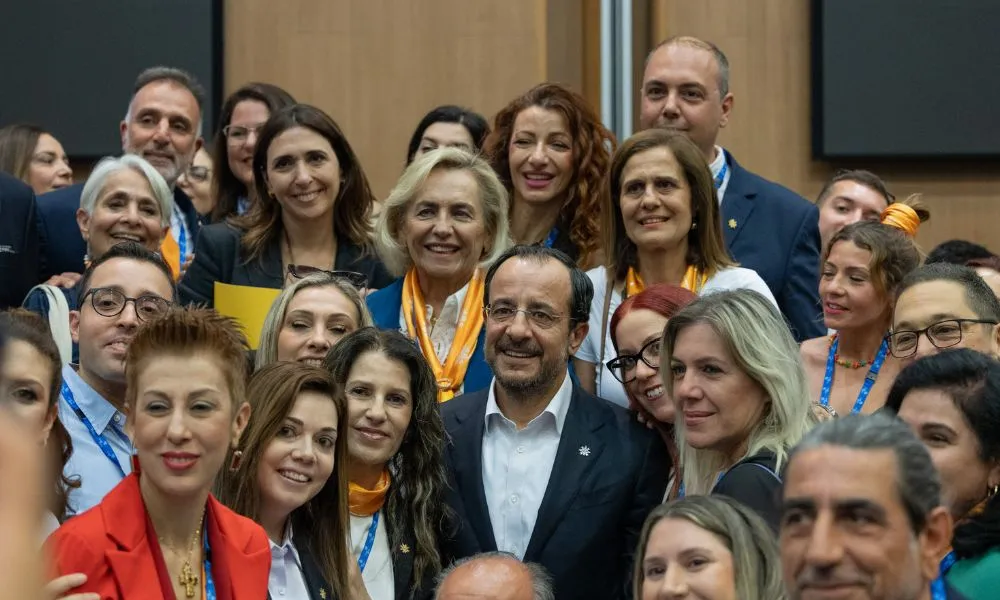
Addressing hundreds of civil servants, diplomats, volunteers and partners who contributed to the successful implementation of the Presidency, President Christodoulides attributed its success to long-term preparation, professionalism and the collective effort of everyone involved.
He said that behind every successful summit, agreement and positive assessment were individuals who worked with dedication, enabling Cyprus to meet the demands of a particularly challenging task.
Christodoulides stressed that Cyprus demonstrated that, despite its small size and despite remaining the only European Union member state under occupation, it is capable of successfully assuming a leadership and coordinating role within the Union.
He added that the Cypriot Presidency operated with confidence and determination, achieving tangible results even amid intense geopolitical developments and multiple international crises.
“A collective effort”
The President made special reference to Deputy Minister for European Affairs Marilena Raouna, thanking her for coordinating the overall effort. He also thanked Foreign Minister Constantinos Kombos, members of the Council of Ministers, public service officials, staff of Cyprus’ Permanent Representation in Brussels, members of the security services and volunteers who supported the Presidency.
Raouna described the Presidency as proof that effectiveness, preparation and credibility matter more than the size of a country.
She said Cyprus established itself as a reliable mediator, contributing to progress on major European dossiers covering defence and security, competitiveness, EU enlargement, the protection of minors online and the new Multiannual Financial Framework.
Presenting the six-month review, she noted that approximately 1,600 meetings were held in Brussels, more than 300 events took place in Cyprus, 19 informal ministerial meetings were organised, and the country hosted its first-ever informal European Council summit.
More than 30,000 visitors participated in Presidency-related meetings and events.
She also highlighted the creation of an effective coordination mechanism between government ministries and the Permanent Representation in Brussels, describing it as an important legacy for the future management of European affairs.
Foreign Minister Constantinos Kombos, for his part, described the Presidency as a national mission completed successfully.
He said the positive assessment of the Cypriot Presidency came from European partners themselves and from EU institutions.
Despite the major international crises that marked the six-month period, Cyprus met heightened expectations and leaves behind a stronger international profile, greater expertise and a more influential presence at European decision-making centres, he added.