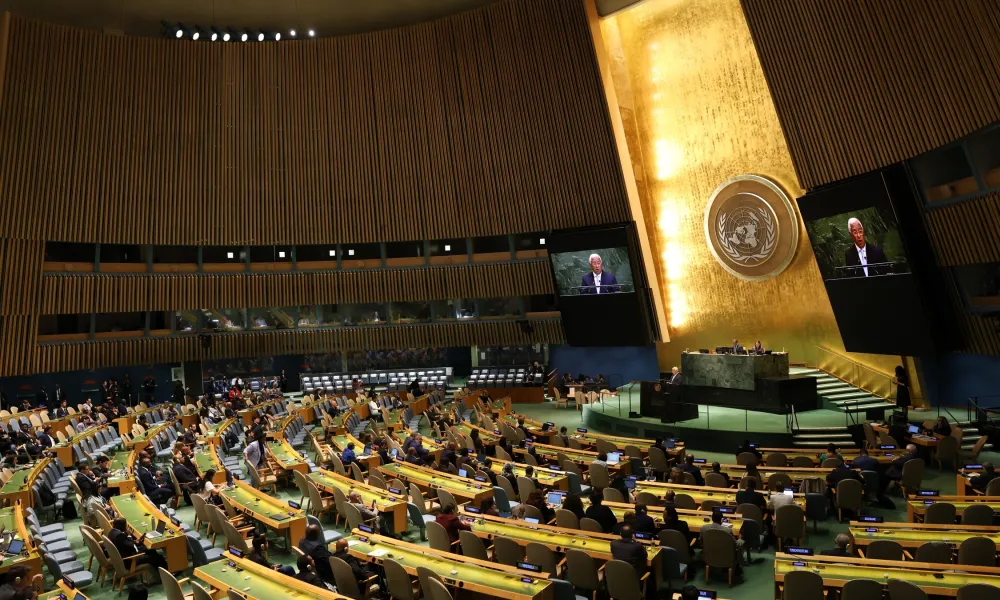



By 418 to 218, with 30 abstentions, the European Parliament approved the Return Regulation on 17 June, the most far-reaching overhaul of EU deportation policy in nearly two decades. The moment the tally was announced, right-wing MEPs leapt to their feet, some pumping their fists, and began chanting "send them back." From the other side of the chamber, the response came back almost immediately: "shame on you."
The European Parliament that approved the Return Regulation is not the same body that negotiated the bloc's 2008 Returns Directive. The 2024 elections delivered a record number of nationalist and far-right MEPs, and on migration, a new majority has now found its footing, one built not on the traditional centrist coalition of the European People's Party, Socialists and Democrats and Renew Europe, but on an alliance between the EPP, the European Conservatives and Reformists, Patriots for Europe and Europe of Sovereign Nations. EPP leader Manfred Weber has repeatedly rejected the prospect of formal alliances with far-right parties, while simultaneously treating their votes as essential for tougher migration legislation.
The legal framework
The Return Regulation is designed to replace the EU's 2008 Returns Directive at a moment when, by the European Commission's own figures, only around 28% of migrants ordered to leave the EU are actually returned to their home countries. The new law sets out to close that gap through a set of measures that have drawn sharp legal and humanitarian criticism at every stage of their development.
The maximum detention period for irregular migrants awaiting deportation rises from six months to two years, with a possible six-month extension and an unlimited duration for those considered a security risk. Entry bans, currently set at five years in most cases, rise to ten, with lifetime bans possible for those deemed a threat. The law also introduces a harmonised European return order, a standardised deportation decision recorded in the EU's Schengen information systems, meaning a rejection issued in one member state can be acted upon by authorities in another.
Perhaps the most contentious provision creates a framework for offshore "return hubs," detention centres in third countries outside the EU, to which rejected asylum seekers can be transferred even if they have no connection to the country in question. Several EU member states, including Austria, Denmark, the Netherlands, Greece and Germany, are already moving forward with plans. Italy has established its own outsourced facilities in Albania. Potential partner countries reportedly under consideration include Rwanda, Libya, Mauritania, Uzbekistan and Ethiopia.
The law also allows authorities to search the homes and premises of irregular migrants, a provision that critics have consistently compared to the enforcement raids conducted by US Immigration and Customs Enforcement. Until now, deportation orders have been automatically suspended while legal challenges are pending. Under the new regulation, courts will decide on a case-by-case basis whether to halt a removal.
"The era of deportations has begun"
Malik Azmani, a Dutch MEP from the Renew Group who served as the European Parliament's rapporteur on the regulation, framed the result in terms of closing a gap in the EU's migration architecture. "While we have secured Europe's main entrance with the Pact on Migration and Asylum, we have now also protected the back door," Azmani said at a press conference after the vote. Asked about the chanting that followed the result, Azmani answered: "It's up to them how they want to yell and scream. It's not my type of politics, it's not how I am as a politician," he told reporters.
Those further to the right were less restrained. Charlie Weimers, Swedish MEP and vice-chair of the ECR, declared that "the era of deportations has begun." François-Xavier Bellamy, the French EPP MEP whose tougher counter-report formed the basis of Parliament's negotiating position, welcomed what he described as the end of a failed era. "For years, Europe sent the worst possible message: 'even if you had no right to stay, chances were high that nothing would happen'. That era is now ending," Bellamy said.
EU Migration Commissioner Magnus Brunner praised the agreement, saying the new rules give authorities more control over who can come to the EU, who can stay and who needs to leave. Manfred Weber defended the vote, saying it showed that European solutions to combat irregular migration are possible. In Austria, FPÖ leader Herbert Kickl welcomed the chanting itself as a show of political force. "The fact that 'send them back' was shouted in the plenary hall shows one thing above all: pressure from the right is having an effect. An important step, but by no means the end of the road," Kickl wrote on social media.
"Disgraceful"
The reaction from the centre-left and left was immediate and, in places, unusually raw. Javi López, a Socialist and vice-president of the European Parliament, described the plenary session as "disgraceful." "As if people were parcels. Families. Minors. Deported to third countries. This is the Europe they are imposing," López wrote on social media.
Ana Catarina Mendes, vice-president of the Socialists and Democrats, said the regulation "risks normalising legally questionable practices that would have been unthinkable in the EU only a few years ago." French Green MEP Mélissa Camara went further, saying that "the European Parliament, led by an EPP and far-right majority, has committed the unforgivable and historic error of abandoning the rights and dignity of people in exile by approving a text driven by a single principle: xenophobia." Camara also announced that the regulation would be challenged in national courts and before the Court of Justice of the European Union on grounds of breaching the Charter of Fundamental Rights, as well as EU and international treaties.
Ilaria Salis, an Italian MEP for the Green and Left Alliance, called the scenes in the chamber "horrifying." "The human depravity of a certain political faction truly seems to know no bounds: rejoicing over the deportation of innocent people," Salis wrote on social media. "Rejoicing not because someone's life is improving, but because someone else's, considered different, inferior, less deserving of rights, is getting worse." Salis described this as the manner in which fascism enters democratic institutions, warning that if the trajectory continued, "it will be the turn of more and more people, the working class, activists, and dissidents."

"Human rights black holes"
The political confrontation in Strasbourg came after months of sustained criticism from human rights organisations and international legal experts. Sixteen UN Special Procedure mandate holders, including the Special Rapporteur on the human rights of migrants and the Working Group on Arbitrary Detention, issued a formal communication urging the European Parliament to amend the proposal, concluding: "We urge the European Parliament to amend the Commission's proposal to ensure the respect of human rights norms and standards, including the principle of non-refoulement; prohibition of arbitrary detention, torture and ill-treatment, and racial discrimination; the due process and right to an effective remedy; and economic and social rights."
Amnesty International assessed that return hubs cannot be implemented in a human rights compliant manner, arguing that previous attempts to externalise asylum or return responsibilities to third countries had produced a predictable pattern of human rights violations, including arbitrary detention, risks of torture and inhuman treatment, and situations of indefinite limbo for those transferred.
The European Council on Refugees and Exiles said the regulation "operates by perpetuating coercion, expanding detention lengths and grounds, weakening procedural safeguards and opening the door to serious violations of fundamental rights," and noting that concerns raised by legal experts, UN special rapporteurs, the Council of Europe Commissioner for Human Rights and civil society organisations had been "systematically ignored."
A law in search of a partner
Whether the legislation will translate into significantly higher deportation numbers remains an open question. Supporters believe it could deter irregular migration and improve return rates substantially. Some EU diplomats are more sceptical, questioning whether it will affect many people at all in practice. The regulation still requires formal adoption by the Council of the EU and publication in the Official Journal before it enters into force. Return hub provisions take effect immediately upon publication, while most other measures apply one year later. That formal adoption could come at the Council's meeting at the end of June.
There is also a political context that complicates the triumphalism on the right. Irregular border crossings into the EU fell by 40% in the first four months of 2026 compared to the same period in 2025, according to Frontex, the EU's border agency. In Germany, asylum applications in May 2026 fell to their lowest level for that month since 2012, excluding the pandemic year of 2020. The Return Regulation was drafted and pushed through at a moment when the numbers it is meant to address were already declining, a fact that critics say exposes the legislation's primary purpose as political rather than operational.
Sources: Al Jazeera, The Guardian, Euronews, EUobserver, InfoMigrants, Agence Europe, Brussels Signal, RTE, Oxford Law Blogs (Border Criminologies), Global Detention Project, European Council on Refugees and Exiles (ECRE), Amnesty International