
Fifty-two years after the Turkish invasion, declassified records from the United States, the United Nations and the UK House of Commons are shedding new light on the dramatic hours leading up to the greatest tragedy in modern Cypriot history.
A Cyprus News Agency (CNA) investigation based on primary sources, including American and British diplomatic cables, UN Security Council records, House of Commons debates, Foreign Relations of the United States (FRUS) documents, Washington Special Actions Group (WSAG) minutes, UNFICYP archives and declassified conversations between US officials, paints a picture of international powers that largely understood where events were heading.
The final hours before the landing
On the afternoon of 19 July 1974, four days after the coup against President Archbishop Makarios, the crisis had become international.
In Nicosia, the administration of Nikos Sampson was attempting to consolidate power, while the military junta of Dimitrios Ioannidis in Athens continued to insist that events were an internal Cypriot matter.
At the same time, Turkish Prime Minister Bülent Ecevit had effectively decided that if the pre-coup situation was not restored, Turkey would intervene militarily.
For Washington and London, the primary concern had become preventing a war between two NATO allies, Greece and Turkey.
During an emergency UN Security Council meeting, Makarios accused the Greek junta of organising the coup and said Greek officers commanding the National Guard had carried it out.
He also revealed that weeks earlier he had requested the withdrawal of Greek officers from Cyprus. "I told them that I considered the danger from Athens greater than the danger from Turkey."
Addressing the Security Council, Makarios declared: "The events in Cyprus are not an internal affair of the Greek Cypriots. The Turks of Cyprus are also affected. The coup of the Greek junta is an invasion, and the consequences will be suffered by the entire people of Cyprus, Greeks and Turks alike."
Ankara signals its intentions
Declassified American documents show Turkey had already communicated its position.
On 17 July, US Ambassador William Macomber reported a meeting with Ecevit, who described the coup as a violation of the 1960 Treaty of Guarantee and attributed it directly to the Greek junta.
Ecevit warned that unless an "acceptable situation" was restored, Turkey would intervene militarily.
He said that if intervention became necessary, it would have to happen within days or risk becoming "more bloody".
He also travelled to London seeking joint action with Britain as the other guarantor power.
According to American records, Turkey's stated objectives included restoring constitutional order, removing Greek officers from the National Guard and ensuring Turkish Cypriot access to the sea.
Washington's dilemma
US government records show that by the evening of 19 July, Washington had concluded that a Turkish intervention was highly likely.
The main American priority was preventing a Greek-Turkish war that could damage NATO cohesion during the Cold War.
Secretary of State Henry Kissinger reaffirmed that the United States recognised Cyprus as a "single, sovereign and independent state" and opposed changes to its constitutional structure.
At the same time, Washington acknowledged a complicated reality: it still regarded Makarios as the legitimate president but also recognised the practical difficulties of restoring him without outside intervention.
One State Department cable stated: "We do not accept the Sampson regime."
Yet it also acknowledged: "The regime is already in power and it would be imprudent to seek its removal before an alternative emerges."
Pressure on Britain
Britain faced growing calls to act under the Treaty of Guarantee.
Debates in the House of Commons included proposals ranging from diplomatic intervention to placing the National Guard under temporary UN supervision.
However, the government of Harold Wilson was unwilling to participate in military action.
Ecevit's efforts to secure a joint British-Turkish intervention ultimately failed, leaving Turkey free to proceed alone.
Washington counts down
During a crisis meeting of the Washington Special Actions Group on 19 July, attended by senior State Department, Pentagon and CIA officials, discussions centred on the expectation that an invasion was imminent.
The declassified minutes reveal that American attention was directed largely toward evacuating US citizens and managing diplomatic relations among Athens, Ankara and London.
Deputy Defence Secretary William Clements reported that an American amphibious force, including five vessels, 1,800 Marines and 14 helicopters, had been ordered closer to Cyprus.
He stressed that the ships were moving solely to assist with civilian evacuations, not military intervention.
Knowledge of the coming invasion
A CIA assessment presented that evening concluded that Turkish forces were fully prepared for a landing near Kyrenia.
US intelligence believed Ankara intended to seize Kyrenia, Famagusta and a corridor connecting the two, thereby strengthening Turkey's bargaining position.
The focus of American discussions, however, remained preventing a Greek-Turkish war and ensuring the safety of US nationals.
As midnight approached, American and British documents recorded that the Turkish invasion fleet had already left the southern coast of Asia Minor and was heading toward Cyprus.
Operation Attila had effectively begun.
"They are landing"
One of the most revealing documents is a telephone conversation between Kissinger and Defence Secretary James Schlesinger during the night of 19-20 July.
Kissinger informed him that Turkish forces had already begun landing operations. "They are landing," he said.
The discussion also touched on what became known as the "Clerides solution", under which Glafcos Clerides, as Speaker of the House, would assume the presidency through constitutional succession.
However, Kissinger himself acknowledged that its chances of success were limited.
During the same conversation, Schlesinger observed that Turkey would settle for nothing less than a portion of the island.
Kissinger replied that if that was the objective, efforts might have to focus on a form of "double enosis", effectively a partition of Cyprus.
The invasion begins
Shortly before 5am on 20 July, hopes of a diplomatic solution evaporated.
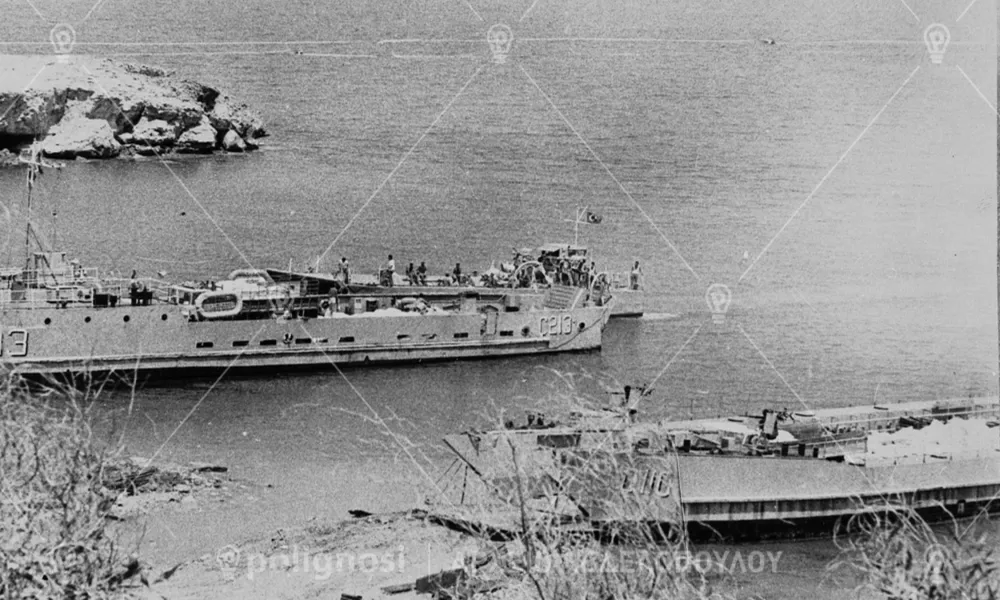
The Turkish invasion fleet reached Cyprus' northern coastline as Operation Attila began with air strikes, amphibious landings at Pentemili, west of Kyrenia, and parachute drops north of Nicosia.
Turkey announced that it was acting under Article 4 of the Treaty of Guarantee, arguing that the intervention aimed to restore constitutional order following the coup.
Diplomacy gives way to war
The UN Security Council later adopted Resolution 353, calling for an immediate ceasefire, an end to foreign military intervention, the withdrawal of foreign troops not authorised by international agreements and negotiations among Greece, Turkey and the United Kingdom.
By the time the resolution was approved, however, Turkish forces had already established a beachhead in the Kyrenia area.
The documents examined by CNA suggest that major powers recognised well before dawn on 20 July that the crisis was moving towards invasion.
Rather than mounting a determined effort to prevent it, their final diplomatic initiatives unfolded while military operations were already under way.
When the sun rose on 20 July 1974, diplomacy had given way to force.
Within hours, the Turkish invasion had created a new reality whose consequences continue to shape Cyprus more than half a century later.
Source: CNA