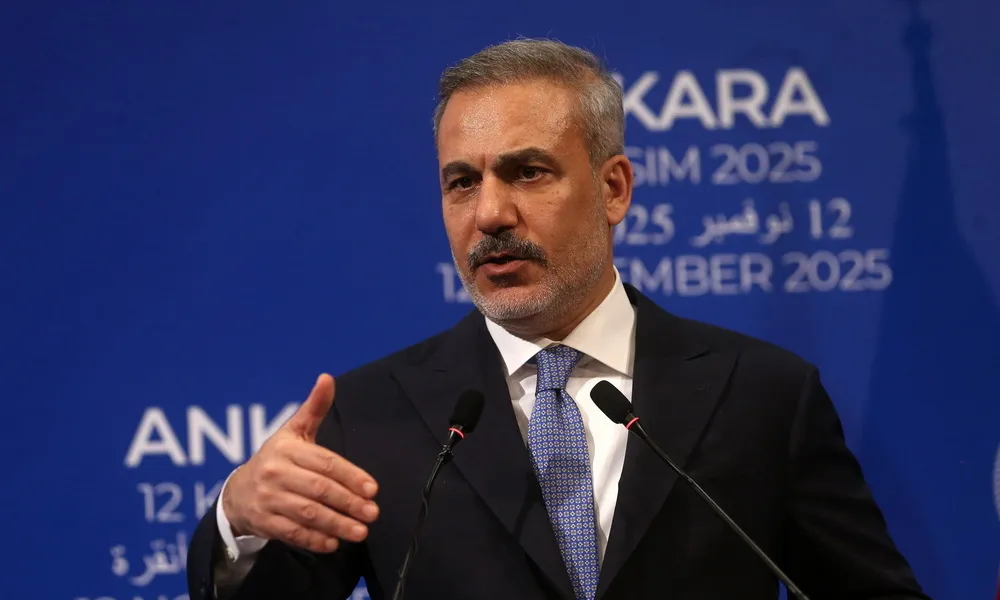
Turkish Foreign Minister Hakan Fidan’s Moscow visit came at a time when the international system is undergoing a profound redistribution of influence. The United States remains the dominant military power, but its ability to shape regional outcomes has diminished. Russia continues to project influence despite the costs of the Ukraine war, while China steadily expands its global reach. At the same time, countries such as Türkiye, India, Pakistan, Saudi Arabia, Brazil and Indonesia are seeking greater autonomy and influence, no longer content with adapting to decisions made elsewhere.
Türkiye is among the most ambitious of these middle powers. Located at the crossroads of Europe, the Black Sea, the Caucasus and the Middle East, it has sought to transform geography into geopolitical leverage. Ankara maintains working relations with Moscow while remaining a NATO member, supports Ukraine while keeping channels open to the Kremlin, and opposes regional escalation with Iran while preserving ties with both the West and Gulf states. The objective is clear: to become not merely a bridge between competing blocs, but a regional power capable of shaping events in its surrounding geography.
Yet middle-power influence depends not only on military capabilities and geography. It also rests on institutional credibility. As concerns about democratic governance and judicial independence grow, Türkiye faces increasing questions about whether its domestic political trajectory is undermining the very influence it seeks to project abroad.
Moscow and strategic autonomy
Fidan’s meetings with President Vladimir Putin, Foreign Minister Sergey Lavrov and Security Council Secretary Sergei Shoigu reflected the logic of Türkiye’s pursuit of strategic autonomy. Ankara and Moscow are neither allies nor natural partners. They have supported opposing actors in Syria, Libya, the South Caucasus and Ukraine. Russia remains the principal challenger to the NATO security architecture of which Türkiye is a member.
Despite these differences, both sides have developed a functional relationship based on compartmentalization. Energy, trade, tourism, nuclear cooperation and regional diplomacy continue regardless of disagreements elsewhere. This approach is driven less by trust than by necessity. In an increasingly fragmented world, Ankara sees dialogue with Moscow as an essential component of its broader balancing strategy.
The challenge is that strategic autonomy carries costs. The more Türkiye seeks to operate between competing power centers, the more vulnerable it becomes to pressure from all sides. Balancing NATO expectations, Russian sensitivities, European criticism and regional crises requires constant diplomatic adjustment. The Ukraine war illustrates both the advantages and limits of this approach.
Ukraine and the Black Sea
Since the start of the war, Türkiye has played a unique role. It has supported Ukraine, maintained dialogue with Russia, facilitated prisoner exchanges and hosted negotiations. This has strengthened Ankara’s reputation as one of the few actors capable of engaging both sides.
Yet the war is becoming increasingly difficult to manage from a distance. Recent attacks affecting shipping and maritime infrastructure in or near Turkish waters have underscored the growing risks for Ankara. The Black Sea is no longer merely a theatre of confrontation between Russia and Ukraine. It is also Türkiye’s northern strategic frontier.
This explains why maritime security featured prominently in the Moscow discussions. Ankara wants to prevent the conflict from spilling into critical shipping routes and energy corridors that underpin its economic and strategic interests. Moscow seeks to protect its own infrastructure and supply lines. While their motivations differ, both sides recognize that uncontrolled escalation in the Black Sea would carry consequences far beyond the battlefield.
For Türkiye, the objective is not neutrality for its own sake. It is stability. The country’s ability to maintain influence depends on preventing conflicts in its immediate neighborhood from becoming unmanageable.
Iran and the new Middle East
The recent U.S.-Iran conflict and the diplomatic breakthrough that followed have opened another arena in which Türkiye seeks to exercise influence. From the outset, Ankara argued against military escalation, not out of sympathy for Iran’s regional agenda, but because a prolonged war on its eastern flank would have directly threatened Turkish interests.
A wider conflict risked disrupting energy flows, undermining trade routes, destabilizing Iraq and Syria, triggering new refugee movements and jeopardizing Türkiye’s ambition to become a central connectivity hub linking Europe, the Middle East, the Caucasus and Asia. For Ankara, preventing regional war was therefore a strategic necessity rather than a diplomatic preference.
If the emerging U.S.-Iran understanding survives, it could create significant opportunities for Türkiye. Reopened trade routes, reconstruction projects and reduced tensions in the Gulf would all benefit Turkish economic interests. Yet the post-war regional order remains uncertain. Gulf states, China, Russia, Europe and the United States will all seek influence over Iran’s reintegration into the regional economy.
This is one reason why Ankara continues to coordinate closely with Moscow. Both countries share an interest in ensuring that regional transitions are not shaped exclusively by external actors. Fidan’s emphasis on regional ownership reflects Türkiye’s desire to participate in designing the new Middle Eastern balance rather than merely adapting to it.
Syria, Cyprus and the Eastern Mediterranean
Syria remains the clearest example of Türkiye’s regional power ambition and its limits. Ankara has become an unavoidable actor in northern Syria, but it has not been able to impose a final settlement. Russia preserved its influence in Damascus, but it too has not been able to stabilize the country on its own terms. The result is a long, uncomfortable bargaining process in which Türkiye and Russia compete, coordinate and restrain each other at the same time.
This pattern is not limited to Syria. In Cyprus and the Eastern Mediterranean, Türkiye increasingly views regional developments through a wider strategic lens. Cyprus is no longer treated merely as a frozen intercommunal dispute. It is linked to maritime jurisdiction, military access, energy routes, EU-Türkiye relations and the balance of power in the Eastern Mediterranean. Ankara’s support for the Turkish Cypriot side, its concern over Western defense arrangements with the Greek Cypriot administration, and its emphasis on Northern Cyprus as a strategic position all reflect this broader calculation.
Yet here too, Türkiye’s foreign policy faces a credibility challenge. Ankara argues that regional problems must be solved through political equality, security guarantees and realistic compromise. But its persuasive power is weakened when critics can point to democratic erosion at home. A country that asks others to recognize political equality and legitimate representation abroad must also show that political competition at home is not being shaped by courts, police operations and executive pressure.
The democratic deficit
This is where the latest European Parliament report and the crisis surrounding the Republican People’s Party (CHP) become relevant to Türkiye’s regional ambitions. The report’s criticism of judicial pressure on opposition figures and discussion of possible sanctions against Justice Minister Akın Gürlek reflect a broader perception in Europe that democratic standards in Türkiye continue to deteriorate even as strategic cooperation remains necessary.
Ankara rejects such criticism as politically motivated and insists that judicial processes are independent. Yet the debate is no longer simply about sovereignty. It is about legitimacy.
The May 21 court ruling annulling the CHP’s 2023 congress and effectively removing Özgür Özel from the party leadership intensified these concerns. The main opposition party, strengthened by its success in the 2024 local elections, suddenly found its leadership structure reshaped through judicial intervention. Government supporters view the case as a matter of legal accountability. Critics see it as an attempt to influence the balance of political competition ahead of the next electoral cycle.
The broader concern is not limited to one court ruling. It is whether the opposition can function independently of pressures exerted through judicial and administrative mechanisms. A political system in which the boundaries of opposition politics are increasingly defined by state institutions inevitably raises questions about democratic pluralism.
The core contradiction
The contradiction facing Türkiye is increasingly difficult to ignore. Ankara seeks to become a leading regional power capable of influencing developments from Ukraine and the Black Sea to Iran, Syria and the Eastern Mediterranean. It wants to mediate conflicts, shape regional orders and promote strategic autonomy in a multipolar world.
At the same time, its domestic political trajectory is generating growing criticism from European institutions, international observers and domestic opponents. The more Türkiye emphasizes its regional leadership role, the more attention is paid to the quality of its democratic institutions.
This does not diminish Türkiye’s importance. The country remains one of the most influential actors in its neighborhood. Moscow needs dialogue with Ankara. NATO values its strategic position. Regional developments across the Middle East, the Black Sea and the Eastern Mediterranean are impossible to understand without considering Turkish interests.
But influence and leadership are not identical. Influence can derive from geography and power. Leadership requires legitimacy, predictability and institutional strength. If democratic erosion continues and opposition politics becomes increasingly constrained, Türkiye’s regional ambitions may rest on a weaker foundation than its policymakers assume.
Fidan’s Moscow visit demonstrated Türkiye’s diplomatic reach and strategic ambition. The domestic controversies unfolding simultaneously highlighted the vulnerabilities that accompany that ambition. The future of Türkiye’s role as a regional power may ultimately depend not only on its success abroad, but also on the resilience of its institutions at home.