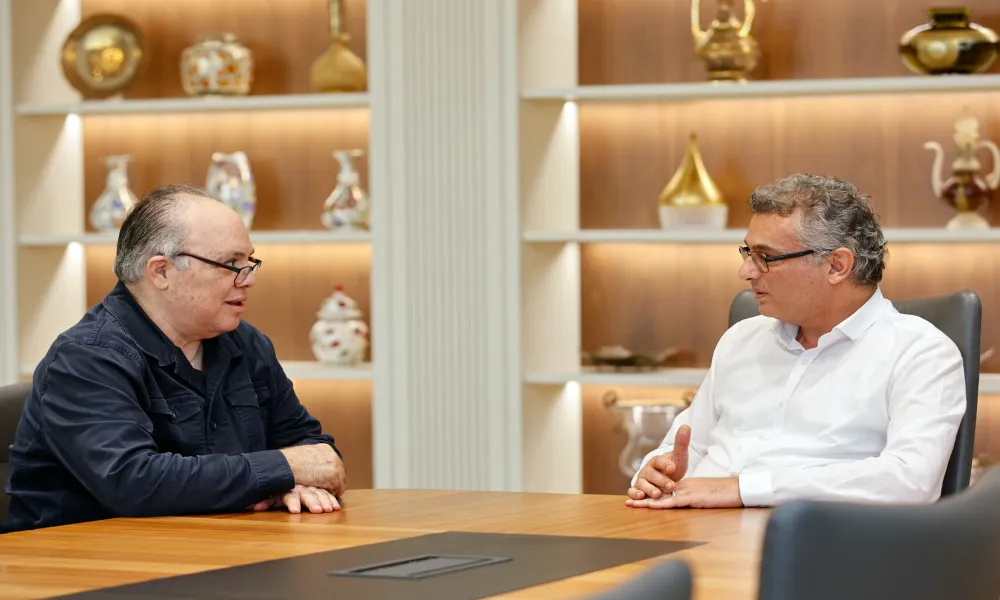
In an interview marked by clear political barbs and revealing positions, Turkish Cypriot leader Tufan Erhürman lays his cards on the table on the Cyprus issue, challenging key claims of the Greek Cypriot side. He states that he never received a written document containing the 19 proposals of President Nikos Christodoulides, categorically denies that he rejected a proposal on Varosha following intervention by Ankara, and insists that the Greek Cypriot side has not accepted any of the four points of his methodology.
Mr Erhürman sets acceptance in principle of a rotating presidency as a necessary precondition before the resumption of substantive negotiations, rejects linking it to the issue of guarantees and attributes the stalemate over the opening of new crossing points to the shifting demands of the Greek Cypriot side.
At the same time, he avoids specifying the form of the settlement he seeks, arguing that “content is more important than labels”, while declaring himself ready to continue intensive cooperation with Nikos Christodoulides, with priority given to the CBMs proposed by António Guterres.
Interview by Andreas Paraschos
According to the government, President Nikos Christodoulides presented a document containing 19 points/proposals on the Cyprus issue. This package reportedly focuses on substantive issues, methodology as well as Confidence Building Measures, with the aim of preparing the ground for the resumption of the process and for a new informal expanded conference under the auspices of the UN Secretary General.
The proposals first came to light in mid-September 2026, following a meeting between Christodoulides and Erhürman. However none of the Greek Cypriot political party leaders confirmed the existence of a written 19 point document during the meeting in the National Council on 30 September 2026. The government itself, as well as the Government Spokesperson Konstantinos Letymbiotis, remained silent neither confirming nor denying the existence of such a document.
Have you received such a 19 point document from Nikos Christodoulides either directly or through the United Nations?
As you know, in principle I refrain from, out of diplomatic courtesy, sharing with the media what was said or proposed by my counterpart in our meetings. However, this does not prevent me from saying that I have not received such a written document from my counterpart either directly or indirectly.
As was the case in our previous meetings, he mentioned various issues in our last meeting. We exchanged views on them as we exchanged views on the issues that I raised. If he shares publicly what these issues are, then I will also be able to comment on them without undermining my own principle.
Let us, however, not lose sight of the exercise we are engaged in… The point here is not the number of proposals that each side comes up with. We are not in a contest whereby the one who puts forward the greatest number of proposals wins! Nevertheless, within the course of the last 11 months after my election, I have also put forward various mutually beneficial proposals, beginning with my initial 10-point CBMs.
The fact of the matter is that we have little time left before the end of the Secretary General’s term in office. During his visit to the island, he proposed that we work on several CBMs. I accepted almost all of them and said that I am ready to further discuss the issue of crossing points. It seems the reason why the UNSG picked those specific proposals was the fact that he considered they had a greater likelihood of success.
We must, therefore, concentrate on reaching an agreement on those proposals he left with us as our homework and try to move forward. Is there any reason to further complicate matters? Given the task ahead of us and the amount of time available, it is not productive to proceed by multiplying issues to resolve.
I want us to focus, without any distraction, on the CBMs proposed by the UNSG in a holistic manner so that we can achieve maximum progress. I am ready to continue to engage intensively with Nikos towards this end. In the meantime, however, first and foremost, we expect to see the trust-undermining actions discontinue.
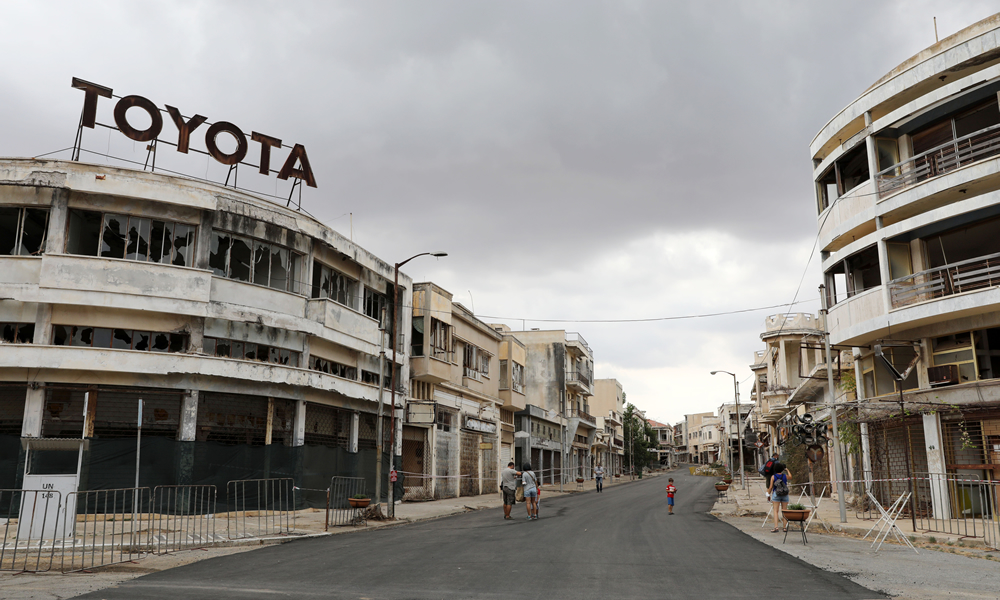
Return of Varosha
Phileleftheros reported on Sunday, 4 October 2026, that Nikos Christodoulides proposed the return of Varosha under UN administration in exchange for the operation of the port of Famagusta under the supervision of the European Commission. The government refrained from denying the report, while the Director of the President’s Press Office stated that the content of the proposals was not being made public in order to protect the ongoing process. According to the newspaper Avrupa, the Turkish Cypriot leader rejected the proposal following intervention from Ankara, despite initially reacting positively to it. Was such a proposal made to you? And did you indeed reject it following intervention from Ankara?
You are referring to news items regarding the claims that such a proposal was made and that I have rejected. So again, I have to stick to my principle and not comment on what my counterpart reportedly said in our meetings.
But everyone knows that this issue has been around for decades and the views of the parties are well-known. The real question to ask, I believe, is whether initiating a public discussion on this issue, particularly at this point in time, would be helpful to achieve progress on much less complicated CBMs that we have been working on for a while.
Is it really possible to believe that two leaders who have failed to open even a single crossing point in 11 months will be able to resolve such sensitive and important issues in the remaining 2.5 months?
Nevertheless, I can give you a much more straight answer whether I have first accepted such a proposal and then rejected it after an intervention, which is a clear “No”. Nothing can be further from the truth. If this is yet another attempt to portray as if the counterpart of the Greek Cypriot leadership is not the Turkish Cypriot leadership, but Türkiye, this is not only wrong and misleading, but is yet another trust-undermining action.
Rotating presidency
According to Politis, Nikos Christodoulides considered three of the four conditions set by Tufan Erhürman regarding the framework for the resumption of negotiations on the Cyprus issue to be acceptable.
What Nikos Christodoulides reportedly accepted was: That the process should be result-oriented. That the process should not be open-ended, so as to avoid endless delays. That there should be clarity regarding what happens the day after another possible failure, so that it is clear what will follow if the new effort collapses.
The Greek Cypriot side did not accept the condition concerning sovereign equality, arguing that this would go beyond the agreed United Nations framework and the basis of a bizonal, bicommunal federation.
Why did you not accept moving forward on the basis of at least the three conditions from your own proposal that Christodoulides was prepared to accept?
First of all, let me clarify that the Greek Cypriot side is yet to accommodate any of the points of my methodology. Therefore, the claim that three out of four points have already been accommodated is wrong and misleading.
For instance, the first point of my methodology concerns political equality. And the issue of rotating presidency constitutes one of its main pillars. I have so far not heard the Greek Cypriot leader say: “I accept, in principle, the rotating presidency.” The precise modalities that will apply within the context of rotating presidency will for sure be the subject of negotiations. It is merely the principle of it that needs to be accepted at this moment in time.
Moreover, the four points in my methodology cannot be described as conditions. It is the codification of the UN Secretary-General’s repeated assessment that “this time must be different”.
We have devised this methodology learning from past failed experiences to ensure that they are not repeated. Therefore, it is aimed at considerably increasing the prospects of achieving a settlement at the end of a new process. It entails matters relating to procedure and not substance. The Secretary-General himself acknowledged the need to agree on a methodology during the press statement he delivered at the end of his recent visit to the island.
The crossing points
On 29 July, Nikos Christodoulides said that he was ready to open additional crossing points. Yet no new crossing points have opened, apparently because you have not agreed. What is the truth about this issue? To many people, it looks as though they are being taken for a ride. Who is actually preventing the opening of new crossing points?
Since the 5+1 meeting in New York, there is a real opportunity to open four crossing points. The four crossing points that we are talking about since New York comprise Haspolat/Mia Milia, Akıncılar/Luricina, Kiracıköy/Athienou-Gaziler/Piroi and Eylence/Aglantzia.
Yet, due to the fact that the goal post moves each time we believe we are about to finalize the matter, we have not been able to open a single crossing point to this date. Requests for last minute additions to or removals from the package naturally do not help.
Despite this, I have put forward various alternatives to address the Greek Cypriot side’s demands and help us advance on this issue. In this context, we offered that we construct a new road in the north to be financed by us for the route between Gaziler/Piroi and Eylence/Aglantzia. But it was not accepted, citing property ownership. To address this issue as well, I offered him that any such claim could be remedied through the Immovable Property Commission (IPC). This was not accepted either. Then, we proposed that a new road be constructed in the south. Upon my initiative, I was assured that the EU would be ready to finance it. I also suggested that the two leaders jointly appeal to the EU to secure this funding. This could have brought an additional symbolic value to this CBM. Unfortunately, it was again rejected. To my surprise, instead of considering any of my proposals, my counterpart chose to insist on his position.
Nevertheless, I am committed to continue to work sincerely on this all too important CBM within the agreed framework as I know that it would have a direct positive impact on the daily lives of both Turkish Cypriots and Greek Cypriots.
Content, not labels
A bizonal, bicommunal federation, or something else? What exactly is the solution you are seeking today?
I believe that, following what had happened and had been said in Crans-Montana, using labels will not help us achieve our main objective, which is a mutually agreed, just and viable solution. I have been saying this even before my election last October. Content is more important than labels. Often labels can be misleading. Content will reveal the kind of solution that we will reach.
We must concentrate on the way that will lead us first to fully-fledged negotiations where we will be able to discuss in great depth and detail matters relating to content.
Focusing on labels has not delivered a settlement to this date. Only agreeing on content that will take into consideration the legitimate rights and concerns of both Turkish Cypriots and Greek Cypriots will pave the way for a solution that would ensure security and prosperity for future generations on our island.
The crux of the matter is whether the Greek Cypriot leadership is finally ready to share power and prosperity on the island with the Turkish Cypriots. This is why political equality constitutes the first point of my methodology. The mere fact of having a label in 2004 and 2017 didn’t take us to a solution. What is important is not the label, but the content. Unless we agree on the content, using labels will not bring us to the desired destination.
Do you believe that there will have to be genuine give-and-take if substantive negotiations resume?
Genuine give and take is one method employed in conflict resolution. It can take place at any stage of dialogue. This applies to the process of confidence building we are currently engaged in as well. We, however, cannot approach everything as a give and take process. Not everything is quid pro quo. My guiding principle is to adopt a win-win mentality which does not see the negotiations as a zero-sum game.
Could a rotating presidency in exchange for ending or fundamentally changing the system of guarantees constitute a reasonable trade-off within an overall settlement?
I do not think there can be a linkage between the issue of rotating presidency and the issue of security and guarantees. These two are quite different both in form and content. Whereas the issue of political equality, together with its indispensable components, belongs to procedure as highlighted in my methodology, the latter concerns substance. This is exactly the reason why I have not included the issue of security and guarantees in my methodology. Naturally, it doesn’t mean that this issue is not very important for Turkish Cypriots, particularly in the light of the recent developments in our region, as well as the insistence of the Greek Cypriot side to conclude military agreements with third parties without the consent of the Turkish Cypriots. On the contrary, the issue of security and guarantees is of utmost importance for my people.
Let me explain once again why the issue of political equality belongs to procedure and not substance. We need to understand that the lack of will on the part of the Greek Cypriot side to share power and prosperity with the Turkish Cypriots is the fundamental reason why all previous efforts have failed. This has translated itself in the negotiations as the Greek Cypriot side’s unwillingness to accept political equality, including rotating presidency. To ensure that this time will be different, as also suggested by the UN Secretary-General, this issue, at least in principle, should be satisfactorily addressed before the start of negotiations. This will enable us to engage in a results-oriented process which will finally lead us to a solution, unlike in 2004 and 2017. Therefore, political equality is not a matter of give-and-take, it is the very essence of the matter. If we cannot agree on the essence of the matter, we will not reach a solution. I do not want to start a process that will once again dash the hopes of Turkish Cypriots and Greek Cypriots who seek a solution; rather, I want to start a process that will lead us to a solution this time.
Is Turkey genuinely ready for a settlement of the Cyprus problem, or does Ankara link Cyprus to other issues and demands, such as EU–Turkey relations, energy and broader regional interests?
This question could best be addressed to its intended recipient, namely Türkiye, since I cannot speak on behalf of Türkiye, but everybody knows that Türkiye did its best both in 2004 and 2017.
On the other hand, trying to establish a linkage between the solution of the Cyprus issue and the EU-Türkiye relations, which have their own dynamics and modalities, would only further complicate the two distinct processes. Furthermore, it should not be forgotten that the Greek Cypriot side, together with Greece, is already in the EU, while the Turkish Cypriot side and Türkiye are not. Under such circumstances, creating such a linkage would be more counterproductive.
I hope that these two very different processes move forward in their own course and yield results. Progress on both processes, even if they are not intrinsically linked, can surely help generate a positive dynamic.