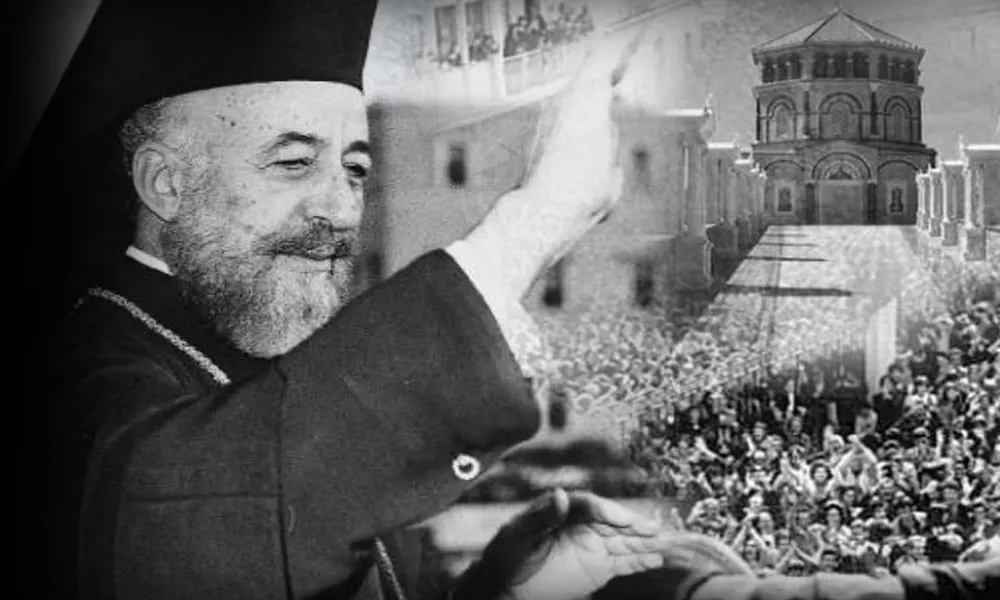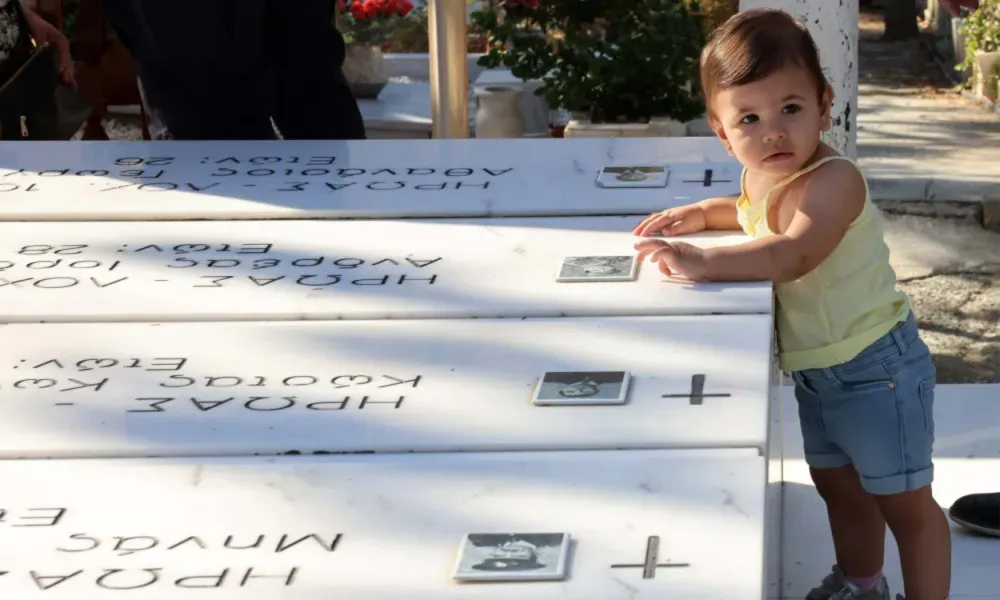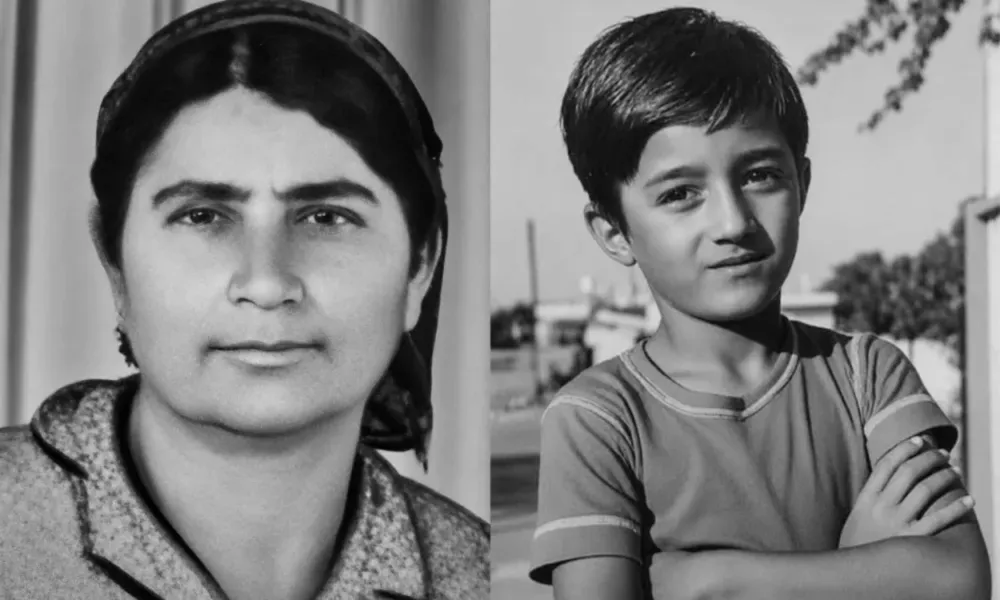

Today marks 52 years since the morning of 15 July 1974, when the Athens Junta and its appointees in Cyprus carried out a coup against the elected President of the Republic of Cyprus, Archbishop Makarios III. The primary objective was to remove Makarios from power, since the Junta regarded him as an obstacle to its plans for Cyprus.
The violent overthrow of Archbishop Makarios was not a sudden or unforeseeable event. On the contrary, it was the culmination of a long conspiratorial course directed by specific centres of power.
"Not like lightning out of clear skies"
The Hellenic Parliament and the House of Representatives of Cyprus, through the Cyprus Files, have investigated the events behind the 1974 coup and the subsequent Turkish invasion. The conclusion of the Cyprus Files states that the tragic events of July 1974 did not fall "like lightning out of clear skies", nor did they constitute the first link in the long chain of what makes up the Cypriot tragedy.
According to the findings of the two Parliamentary Investigative Committees, years before the events of July 1974, military and civilian individuals in Greece and Cyprus fell under the influence of foreign intelligence agencies, including those of the US and NATO. These agencies systematically promoted the idea that Archbishop Makarios, the democratically elected President of Cyprus, fiercely opposed NATO and was the "Castro of the Mediterranean". Driven by this flawed mindset and acting without any sense of responsibility, these individuals plotted to create a treacherous division among the Greek Cypriots, as well as among the Greek officers serving in the Cypriot National Guard and ELDYK. Wherever they could, they fuelled a deadly hatred against President Makarios.
A conspiracy years in the making
The plots against Makarios started as early as 1965. When the military dictatorship took power in Greece, these actions became far more aggressive. Guided by the Junta, plans began to take shape to assassinate Makarios and overthrow his government in a coup.
Tension had long prevailed in relations between Makarios's government and the junta government of the colonels in Greece. This tension deepened as a result of three major events: the 1967 military coup in Greece, the bloody events in the Turkish Cypriot village of Kofinou in late 1967, and the withdrawal of the Greek army division from Cyprus shortly afterwards.
The National Guard, which since 1964 had constituted the official military force of the Republic of Cyprus following the withdrawal of Turkish Cypriots from the country's military forces in 1963, was staffed by officers of the Greek army who, together with their Cypriot colleagues and volunteers, took on the organisation and training of its personnel. For this purpose, the Greek Division was transferred to Cyprus and the Supreme Military Command of Cyprus Defence (ASDAK) was created, initially headed by Georgios Grivas. Grivas resigned the ASDAK leadership in 1967 but returned to Cyprus in 1971 to lead EOKA B, an organisation that demanded the continuation of EOKA's work.
EOKA B's slogan was the union of Cyprus with Greece, which found resonance among a section of the island's Greek Cypriot community, a section that the Greek junta government methodically and systematically turned against Makarios's policy. The possibility of a coup was loudly discussed, especially after the assassination attempt on Makarios in 1970, and the Junta was conducting behind-the-scenes manoeuvres to prepare the coup weeks before it occurred.
The letter that sealed the confrontation
On 1 July, the Cabinet of Makarios's Government decided to reduce military service in the National Guard to 14 months, from the 18 set in 1964 by the law establishing the force, and to reduce the number of Greek officers serving in it.
On 2 July 1974, in a letter to Greek General Phaedon Gizikis, Makarios accused the Greek government of involvement in conspiracies against him and of supporting EOKA B, and demanded the recall to Greece of 650 Greek officers serving in the National Guard.
The eve of the coup
On 14 July, Makarios was at the presidential country residence in Troodos. Meanwhile, in Greece, the Junta held a meeting of the chiefs of the armed forces, where the final details for launching the attack, mainly against the Presidential Palace, were definitively decided.
On the night of 14 July, according to testimonies, junta officers in various National Guard camps put their units on secret alert, while in some cases they isolated or confined conscript soldiers suspected of resisting.
Returning to Nicosia early on the morning of 15 July, on his way to the Presidential Palace, Makarios passed by the camp where preparations for the coup were already under way. Nothing, however, was noticed by his entourage.
"Alexander has entered the hospital"
On the morning of 15 July, units of the National Guard, equipped for the execution of the coup by the Junta and under the orders of National Guard chief of staff Brigadier Michael Georgitsis, received instructions to attack the Presidential Palace. The coup was launched with the code phrase "Alexander has entered the hospital".
The start of the coup was officially notified to Athens at 8:17am, via an urgent and highly secret message sent by Georgitsis to the Office of the Chief of the Armed Forces. Just three minutes later, at 8:20am, the coordinated assault of tanks, armoured vehicles and commando forces against the Presidential Palace began, striking first the entrance and then the eastern exit on Demosthenis Severis Avenue. At the Presidential Palace, Makarios was receiving a group of children from the Greek community of Egypt.
Armed men from EOKA B joined the National Guard forces in the attack. Surrounded by explosions and gunfire, Makarios managed to escape. He and two of his bodyguards slipped out through an unguarded western door, crossed the garden and fled towards Kykkos Monastery for safety.
Nicosia under fire
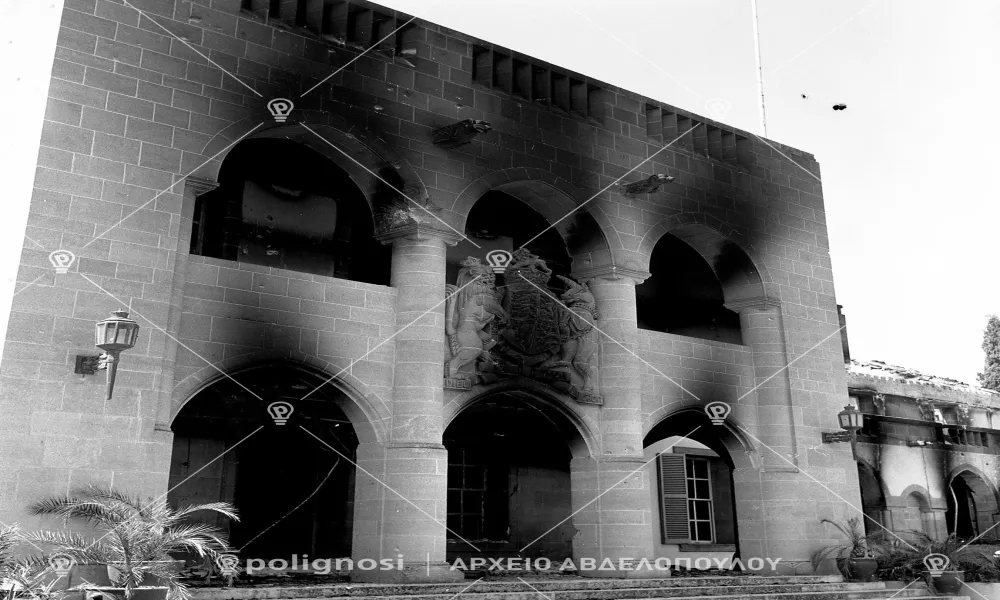
It took about an hour and a half for the attackers to capture the Presidential Palace, leaving several people dead. However, this was not the only target. To crush any resistance, the attackers launched synchronised strikes across key locations in Nicosia and other towns and villages. They attacked the Police Headquarters, the Tactical Reserve Corps camp, the Cyprus Broadcasting Corporation (CyBC), Nicosia International Airport and the Archbishopric.
Tanks and gunmen filled the streets to control key areas, and citizens were ordered to stay inside their homes under a curfew. Groups of reservists who had been preparing for this eventuality tried to fight back, but they were too few to stop the coup. The Archbishopric building put up the strongest and longest resistance against the attackers. During the fierce fighting, the building caught fire, heavily damaging the historic icons and paintings inside. It finally surrendered to the coup forces later that afternoon.
"Makarios is dead"
One of the very first targets was CyBC. The coup forces captured the radio station and immediately began repeating a continuous broadcast: "This morning, the National Guard stepped in to stop Greeks from fighting Greeks. The National Guard is now completely in control. Makarios is dead."
At the same time, the attackers announced the members of their new temporary government, which they named the "Government of Salvation". They appointed Nikos Sampson as its leader, a controversial figure chosen as a last resort only after three judges and politician Glafcos Clerides had all refused the role.
"I am Makarios. I am alive!"
Meanwhile, Makarios had safely reached Paphos. From the Free Radio Station of Paphos, he delivered a famous live address to the public:
"Greek Cypriot People! You know the voice you are hearing. You know who is speaking to you. I am Makarios. I am the leader you voted for. I am not dead. I am alive! I am right here with you, fighting by your side. The Greek military dictatorship's coup has failed. I was their target, and as long as I live, the Junta will not control Cyprus. They want to destroy and divide our island, but they will fail. Resist them in every way. Do not be afraid. Join the official, legal forces of the state. The Junta must not win. Now, we fight for everything!"
Using a British military aircraft and travelling via Malta, Makarios reached London, where on 17 July he met British Prime Minister Harold Wilson and Foreign Secretary James Callaghan. The United States called for support of Cyprus's independence and urged all states to do the same, even as US Secretary of State Henry Kissinger rejected a proposal to support the overthrown Makarios government.
Five days later, the invasion
Just five days after the coup, on 20 July, Turkey, taking advantage of the situation and invoking the security of the Turkish Cypriots as a pretext, invaded the island, imposing de facto its partition. It occupies to this day 37% of the territory of the Republic, having sown devastation and destruction in violation of fundamental rules of international law.