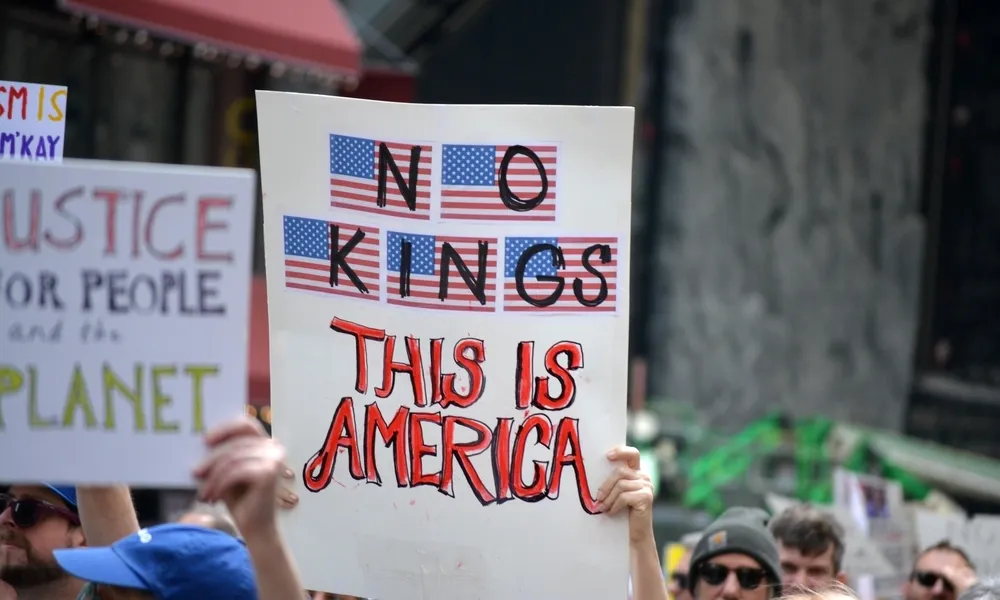

Mass protests swept across the United States on Saturday, with thousands of demonstrations organised under the “No Kings” movement, targeting President Donald Trump’s immigration policies, the ongoing war with Iran and what organisers describe as an erosion of democratic norms.
According to reporting from Reuters, the Associated Press and The Washington Post, more than 3,000 protests took place across all 50 states, from major urban centres to smaller towns and rural areas. It marks the third nationwide mobilisation by the same movement in less than a year since Trump returned to office.
A nationwide and expanding movement
Demonstrations were recorded in cities including New York, Washington, Atlanta, Minneapolis, Philadelphia and Boston, with turnout ranging from several hundred to tens of thousands.
In New York, large crowds gathered in Manhattan, where actor Robert De Niro, a long-time critic of Trump, addressed demonstrators, warning that the current administration represents a threat to democratic institutions and civil liberties.
Protests were particularly strong in Minnesota, especially in Minneapolis and St Paul, where organisers claimed turnout reached as high as 200,000. The area has become a focal point following recent immigration enforcement operations and controversial police actions.
Organisers also pointed to a notable increase in participation outside major metropolitan areas, with a significant share of demonstrators coming from smaller communities, suggesting a widening geographic base of dissent.
Key demands: immigration, war and civil liberties
Across the country, protesters carried signs reading “No Kings, No ICE, No War”, reflecting the core grievances driving the movement.
Demonstrators voiced opposition to intensified immigration enforcement carried out by Immigration and Customs Enforcement (ICE), including raids and deportations, which have drawn criticism from civil rights groups and legal advocates.
The war in Iran, now entering its second month, also featured prominently, with anti-war messaging visible across protests. Many participants linked the conflict to broader concerns about US foreign policy and military escalation.
Veterans’ organisations, including groups such as Common Defense, were actively involved, with some members warning that the US is being drawn deeper into a prolonged conflict without clear objectives.
Tensions over security and policing
Protests in Minneapolis carried additional weight following recent incidents involving federal agents and immigration operations. Demonstrators called for accountability and justice, citing concerns over the militarisation of law enforcement and the impact on migrant communities.
Speakers and participants repeatedly referred to fears that constitutional protections are being undermined, with some describing the current political climate as “not normal” and requiring sustained public response.
Trump absent from protests
While protests were taking place nationwide, President Trump spent part of the day at his private golf club in Florida, a detail widely noted in US media coverage.
The contrast between the scale of mobilisation and the president’s absence became part of the narrative surrounding the protests, reinforcing criticism from opponents that the administration is detached from growing public discontent.
International echo and political implications
Solidarity protests were also reported in several European countries, including Greece, Italy, France and Spain, reflecting the international dimension of opposition to US policies, particularly the war in Iran.
Analysts cited by US outlets note that while such protests do not immediately translate into electoral shifts, their scale and frequency point to sustained political pressure. The recurring mobilisation suggests that opposition to the administration is becoming more structured and potentially more influential in the run-up to future political contests.
As the war continues and domestic tensions remain high, the protests signal a widening front of resistance that extends beyond traditional political and geographic boundaries.