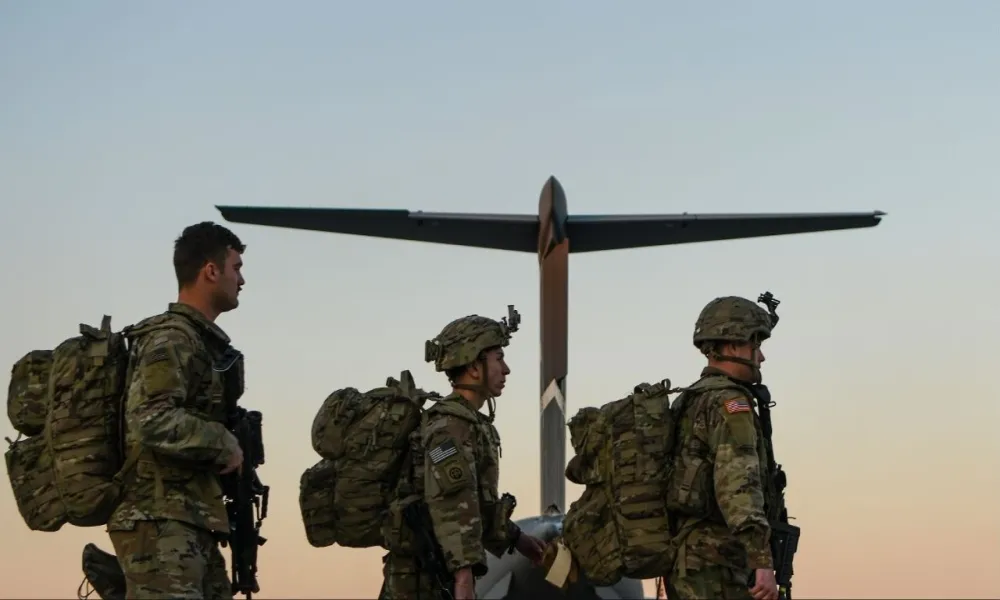

The US Pentagon is preparing for ground operations that could last several weeks, as the war in Iran enters its 30th day with no clear signs of de-escalation, particularly following the involvement of Yemen’s Houthi forces.
According to the Washington Post, citing US government sources, the planned operations are not expected to take the form of a large-scale ground invasion. Instead, they are likely to involve targeted incursions on Iranian territory by special forces and other conventional units.
The developments come as US military presence in the region has been reinforced, including the arrival of the USS Tripoli, confirmed by the US military.
At the same time, the Israeli army reported that another missile was launched from Yemen towards Israel in the early hours of the morning. The Iran-aligned Houthi rebels had already claimed responsibility for two missile launches against Israel the previous day, marking their first direct involvement in the conflict.
Concerns are also rising following new threats from Iran’s Revolutionary Guards, who warned they could target American universities in the Middle East in retaliation for what they claim was the destruction of two Iranian universities in US and Israeli air strikes.
Global economic ripple effects
The war continues to trigger disruptions across global markets and industries. Iran’s Revolutionary Guards announced missile and drone strikes targeting aluminium facilities in Bahrain and the United Arab Emirates, claiming links to US military supply chains. Aluminium Bahrain (Alba) confirmed damage to its facilities, with two workers injured, while Emirates Global Aluminium (EGA) reported significant damage to a plant in Abu Dhabi and six injuries.
In Asia, Taiwan has decided to freeze liquefied petroleum gas (LPG) prices for April, prioritising key industrial inputs such as ethylene and propylene for domestic use. Pakistan’s Foreign Minister Ishaq Dar said Iran has allowed the passage of an additional 20 Pakistani-flagged vessels through the Strait of Hormuz, averaging around two per day.
Meanwhile, India’s major ceramics hub in Morbi has been severely affected by LPG shortages linked to the conflict. More than 400 factories have suspended operations, leaving tens of thousands of workers out of work. The region accounts for 90% of India’s ceramic production and employs nearly one million people.
Shipping costs are also rising sharply due to security risks in the Strait of Hormuz. War risk insurance premiums have surged from below 1% of a vessel’s value to as high as 10%, with the cost of a single transit reaching tens of millions of dollars.