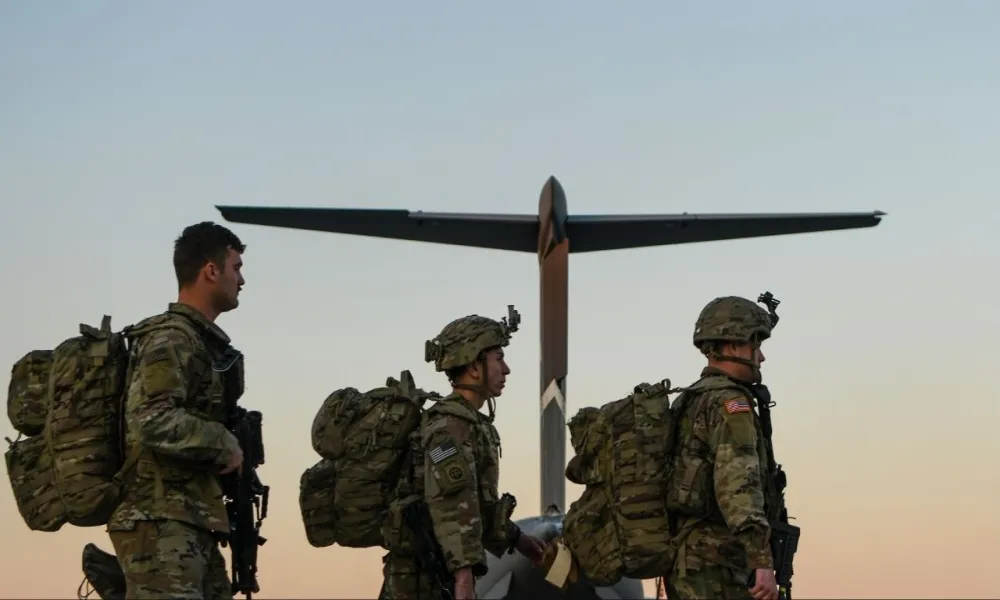
The decision by Donald Trump’s administration to withdraw 5,000 troops from bases in Germany has reignited debate over the strategic value of the American military presence in Europe.
The announcement, which came days after remarks by German Chancellor Friedrich Merz describing the United States as having been “humiliated” by Iran, has prompted renewed scrutiny over what Washington stands to lose from such a move.
According to a report by The Guardian, the US military presence in Germany dates back to 1945, when American forces were stationed there following the defeat of Nazi Germany and the establishment of occupation zones. While troop numbers declined in the years that followed, their strategic importance grew during the Cold War, when Germany became a central hub for defending Western Europe against the Soviet Union.
Today, the United States maintains around 36,400 troops in Germany, based on data from the US military’s personnel records. These forces are spread across more than 20 bases nationwide.
Role of US bases
Over time, these installations have evolved from static defensive positions into key logistical and operational hubs supporting US military missions in regions including Iraq, Afghanistan and, more recently, Iran. The bases play a critical role in coordinating American military activity worldwide.
Not a new threat
The prospect of withdrawing troops from Germany is not new. During his first term, Trump threatened a similar move in 2020, citing Berlin’s defence spending levels and its backing of the Nord Stream 2 gas pipeline. That plan ultimately stalled amid political and logistical challenges, as well as resistance from Congress.
The real cost
Experts cited in the Guardian report warn that any large-scale troop withdrawal would create significant logistical and strategic complications, making it harder for the US to conduct military operations globally.
Jeff Rathke of the American Institute for Contemporary German Studies stressed that US bases in Germany are not a “charitable contribution” to Europe, but a core component of Washington’s global strategy. Without them, many missions would become far more difficult, if not unfeasible.
While the US could redistribute forces to other European countries such as Italy, United Kingdom and Spain, analysts caution that reductions at key hubs like Ramstein and Stuttgart would carry a high strategic cost. Such changes could weaken US influence and reduce its ability to respond swiftly to international crises.
Source: protothema.gr