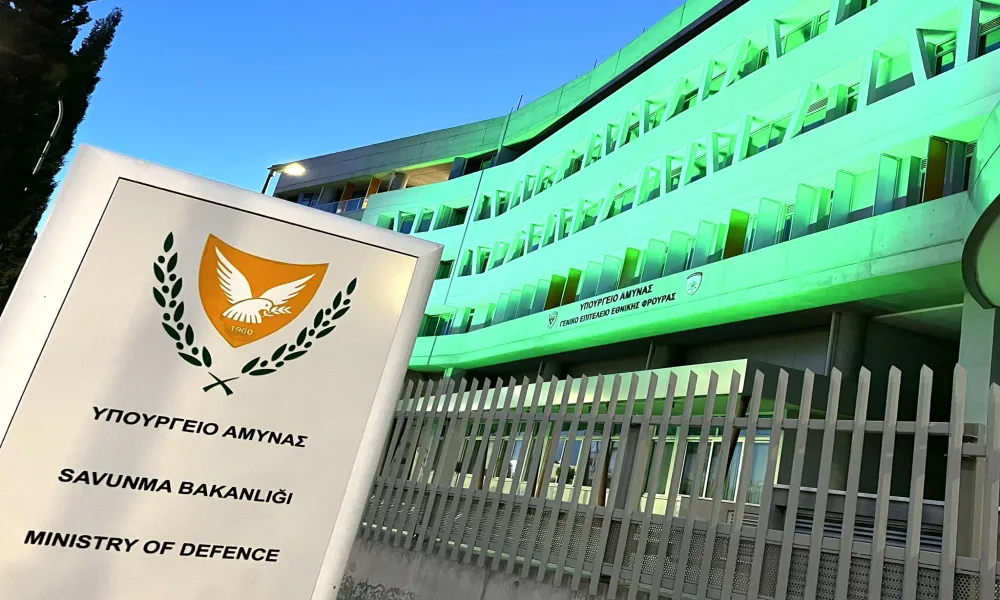
Cyprus continues to fall behind European defence spending standards despite an increasingly unstable regional environment, according to a new study by Aristos Aristotelous, head of the Cyprus Centre for Strategic Studies. The report, released on Wednesday, evaluates defence expenditure trends for 2026 to 2036.
Total defence spending for 2026 is estimated at €624 million, equivalent to 1.65% of GDP based on a projected €37.8 billion economy. Aristotelous notes that although absolute spending has risen since 2020, defence as a share of GDP has declined. In 2020, the defence budget was significantly lower in nominal terms but still reached 2% of GDP. Since then, the figure has remained stuck near 1.5%.
Cyprus remains well below its own target of 2%, below the EU average of 1.74% for 2024 and below the expected 2% EU-wide level for 2025. Brussels is already pressing member states to raise spending beyond 3% and potentially closer to 5% in line with certain NATO benchmarks. Aristotelous stresses that Cyprus also trails countries with far fewer security threats, including North Macedonia at 2.25% and both the Netherlands and Norway at 1.94%.
He argues that Cyprus is spending less than what its strategic environment demands, leaving deterrence capacity structurally weak. Spending on defence capability upgrades follows a downward trajectory. In 2024 the budget for equipment and armament programmes was €181 million, or 0.50% of GDP. That figure falls to €179 million in 2025 and €176 million in 2026. Aristotelous warns that this creates a widening gap between operational needs and available resources, especially given the ongoing occupation and heightened regional volatility.
Based on recent EU decisions, Cyprus could draw as much as €1.18 billion from the SAFE mechanism between 2026 and 2030. After withholding 15% for domestic defence industry requirements, the annual amount available would reach €306 million. If this is combined with the average annual €176 million allocated to defence capability, the total funding for equipment could reach €482 million per year, or €2.4 billion by 2030. Including the remaining categories of defence spending, the total allocation for the sector could approach €4.2 billion during the same period.
Even this expanded envelope does not allow Cyprus to converge meaningfully with the 2% target. Aristotelous adds that access to US military equipment will remain politically restricted since Washington is unwilling to provoke Ankara by shifting the regional balance. The replacement of Russian-made systems presents an additional challenge. The study estimates that full replacement could cost more than €7 to €8 billion and possibly beyond €9 billion depending on scope and pace, creating serious fiscal constraints.
The study outlines three alternative planning scenarios for 2026 to 2036, each representing varying levels of commitment to a long-term deterrence model. Aristotelous notes that smaller states with elevated threat profiles, such as the Baltic countries, demonstrate that deterrence depends not on the size of armed forces but on strategic clarity, sustained funding and consistent political determination. These countries, many with economies comparable to or smaller than Cyprus, maintain defence spending above 2% while investing in air defence, surveillance and network-based capabilities.
The key requirement for Cyprus, he argues, is not to replicate foreign models but to adopt an achievable deterrence framework supported by stable financing and long-term national planning.
Source: CNA