Even before reaching cinemas, Christopher Nolan's Odyssey had already become one of the year's most talked-about film events.
The controversy surrounding the casting, the absence of Greek actors from leading roles, the inclusion of performers from different ethnic backgrounds, the use of IMAX as the film's primary format, and the decision by one of contemporary cinema's most influential directors to tackle Homer's epic were enough to ignite intense public debate.
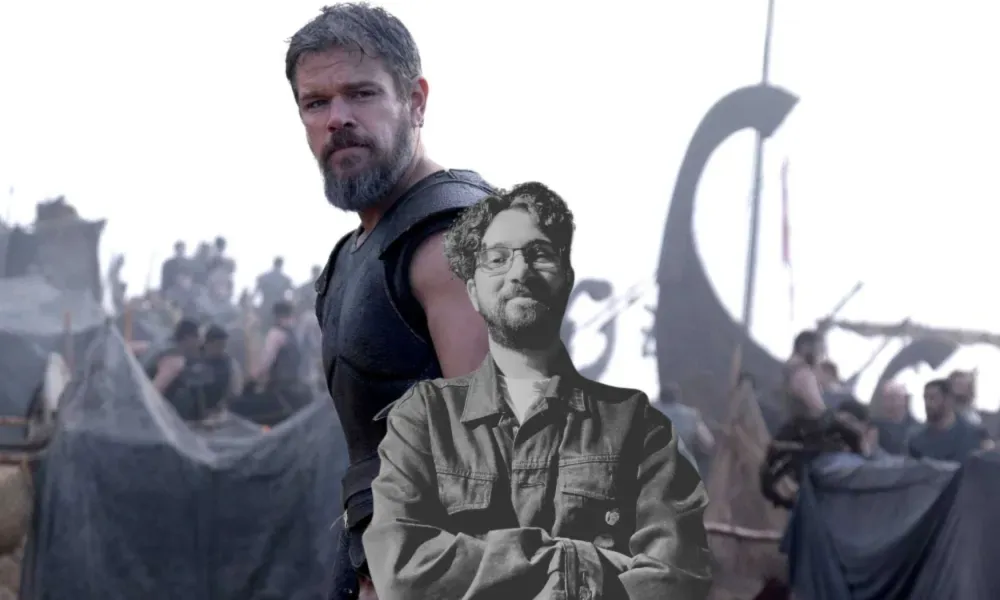
Having seen the film ahead of its official release, Yiannis Kantea-Papadopoulos explains to Politis why, in his view, the discussion surrounding Odyssey extends far beyond reactions to its interpretation of Homer. Instead, he argues, it encompasses both its contemporary cinematic reading of the epic and Nolan's ambitious technological experiment with IMAX.
A film critic and contributor to Klik, Kantea-Papadopoulos has previously worked with Athinorama, is a member of the Hellenic Film Academy and the Panhellenic Film Critics Association, and has collaborated with major film institutions including the Thessaloniki International Film Festival and the Drama International Short Film Festival.
"Veiled Racism"
The announcement of the film's cast provoked strong reactions from the outset.
The absence of Greek actors from major roles and the participation of actors from different ethnic backgrounds sparked a broader debate over who has the right to tell a story considered a cornerstone of ancient Greek literature.
Kantea-Papadopoulos believes the discussion quickly drifted away from the film itself.
"I believe that the more serious portion of these reactions concerns neither Homer nor the film itself. To a large extent, we're talking about a form of veiled, and sometimes open, racism, or prejudices that many people refuse to move beyond."
As he explains, much of the criticism emerged before anyone had actually seen the film and was based on fragments of information rather than the work itself.
"When someone has a problem with an actor's racial background or identity before they've even seen the film and understood how that character functions within the story, then the discussion is no longer about cinema."
For him, the real question is not whether an American director can adapt Homer for the big screen, but whether he does so with artistic integrity and respect for the original text.
"If we accept that ancient Greek tragedies have been staged in theatres around the world for decades, then I don't see why the same cannot apply to The Odyssey. Homer's epics are foundational works of Western literature and civilisation. Why shouldn't we feel honoured that one of the most important directors of our era is bringing them to the cinema?"
He makes particular reference to Lupita Nyong'o, who found herself at the centre of public debate.
According to him, her performance effectively silences those who questioned her casting before seeing the film.
"She's flawless. She was obviously going to be flawless even before the film. We're talking about an Oscar-winning actress who has consistently made carefully chosen career decisions, and in this film she's remarkable. I won't say more because audiences need to see it for themselves and understand why she was chosen."
The Director
For Kantea-Papadopoulos, the real discussion begins once viewers put the controversy aside and focus on Nolan's cinematic vision.
Although he admits he was initially surprised by Nolan's decision to adapt The Odyssey, the finished film changed his mind.
"It convinced me that Nolan was ultimately the right person to tell this story."
According to him, several recurring themes in Nolan's work connect naturally with the structure of Homer's epic.
"The most obvious is the narrative itself. Both Homer and Nolan employ non-linear storytelling, stories within stories and multiple narrative layers unfolding simultaneously."
The similarities, he argues, go beyond narrative structure.
"Almost all of Nolan's protagonists are tasked with carrying out a mission of existential importance while the world around them is changing or collapsing. There is always this need to restore some form of order within chaos."
Taking the comparison further, he identifies another, less obvious connection: that between Odyssey and Oppenheimer.
"Oddly enough, The Odyssey has a great deal in common with Oppenheimer. In both stories we follow an exceptionally capable individual. In one case, a scientist who creates the atomic bomb; in the other, a king and military strategist who conceives the idea of the Trojan Horse, leading to the fall of Troy. Both are forced to confront the consequences of their actions. Both face the reality that an act which ends a war also unleashes immense destruction and permanently changes the world they inhabit."
For him, this represents the film's greatest achievement.
"Nolan does not approach The Odyssey as just another mythological adventure. The gods are there. The mythical creatures are there. The action sequences are there. But those elements are not the film's purpose. At its core lies a profound existential and moral inquiry. In my opinion, that is what truly honours the original work."
A Blockbuster With an Art-House Identity
According to the critic, this interpretation is precisely what distinguishes Odyssey from most contemporary big-budget productions inspired by antiquity.
As he notes, the film not only renews interest in Homer but also transforms the way modern cinema approaches the epic.
"And not only for international audiences, but for us as well. We often take these works for granted because we studied them at school. In a sense, we lose touch with what makes them truly extraordinary."
He admits that he never expected a film adaptation to make him rediscover Homer's epic.
"I didn't expect that watching this film would make me feel awe again for a story I theoretically know so well. Yet that's exactly what Nolan achieved. He doesn't simply reproduce a familiar narrative. He renews interest in the work itself and makes us ask once again why The Odyssey still matters nearly three thousand years later."
In his view, this is perhaps the film's greatest difference from most Hollywood productions based on ancient history.
"I would describe it as a blockbuster with an art-house identity. And this was something Nolan himself has spoken about. He wanted to make The Odyssey as a genuine blockbuster because previous cinematic attempts either had very limited budgets or failed to capture the scale of the epic. What is fascinating is that a story nearly three thousand years old now stands at the forefront of commercial cinema. And it seems audiences are responding."
He admits that the film won him over far sooner than he expected.
"It doesn't have to work very hard. It wins you over almost from the first minute," he says, adding that he wants to watch it again as soon as possible.
IMAX as an Artistic Choice
Technology is another element that, in Kantea-Papadopoulos' view, sets Odyssey apart.
For him, Nolan's decision to shoot the entire film on IMAX film was not driven by a desire for spectacle but by a deeper understanding of cinema itself.
"For Nolan, it isn't merely a technical choice. It's an artistic choice. He belongs to that small group of filmmakers who see their role not only as storytellers but also as people who must help advance the medium itself."
He compares Nolan's approach to that of other pioneering filmmakers.
"James Cameron did it with Avatar, giving new momentum to 3D cinema. Steven Spielberg did it with the technological innovations he introduced into his productions. Nolan continues that tradition. At a time when the future of movie theatres is often questioned, he chooses to make a film like The Odyssey using the most demanding and visually ambitious tools cinema currently possesses. That alone is a statement."
That ambition extended to the production itself.
According to the critic, entirely new IMAX cameras were developed for the project, featuring specially designed housings to reduce mechanical noise during filming.
"We're not simply talking about using IMAX cameras. New cameras were built from the ground up for The Odyssey, with specialised casings designed to eliminate the sound of the film reel during shooting. This is a production that didn't merely use existing technology; it invested in advancing it."
"What's even more impressive is that despite the complexity of such a demanding undertaking, filming finished ahead of schedule, saving money in the process. That demonstrates how exceptionally organised the entire production was."
While acknowledging that most viewers will not have access to a true IMAX screening, he believes this does not diminish the film's impact.
"The important thing is for people to see it in a cinema. If they watch it on the big screen, the battle is already won. Anywhere else, the experience will inevitably be incomplete."