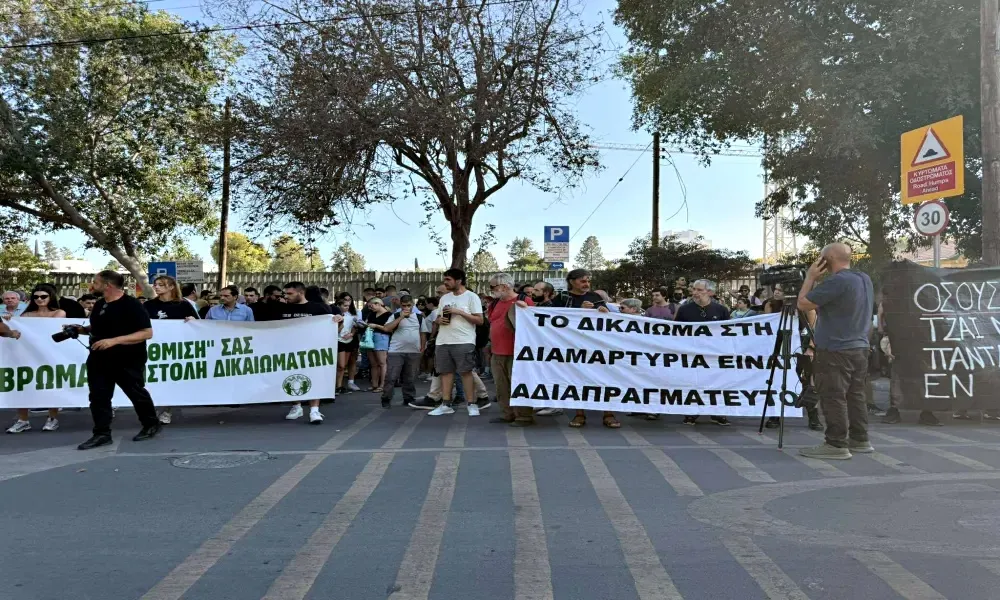
Parliament on Thursday voted to approve the “Public Gatherings and Parades (Amendment) Law of 2026” with 29 votes in favour and 13 abstentions from AKEL MPs. The legislation aims to align existing laws with recommendations outlined in a recent legal opinion by the Organisation for Security and Co-operation in Europe (OSCE).
At the same time, the House rejected amendments proposed by AKEL.
The bill, tabled by Nicosia MP Irini Charalambidou, was revised following consultations with the Ministry of Justice and Public Order, the Republic’s Legal Service, and academic experts before reaching the plenary session.
Key changes in the law
The revised law clarifies that appointing an organiser for a gathering or parade is not mandatory. If an organiser is appointed, they bear no liability for the acts or omissions of participants.
Isolated acts of violence that can be contained do not automatically render a gathering non-peaceful, nor are they grounds for its dissolution. The law reaffirms the state’s obligation to safeguard the right to peaceful assembly.
Several terms have been removed from the legislation, including “emergency gathering,” the minimum threshold of 20 participants, and references to “public morals” and “constitutional order” as reasons for imposing restrictions. The definition of “public space” is also limited, excluding interior spaces of buildings.
The information an organiser must provide to the Police Chief has been restricted, and the law now explicitly states that failure to notify or provide all required information does not affect the legality of a gathering or parade, nor does it incur penalties for the organiser.
The Police Chief must communicate any restriction orders to the organiser and the relevant local authority at least three days before an event, informing the organiser of the right to appeal. Restrictive measures are limited to those absolutely necessary, and the risk level of the gathering or parade must be considered.
Police is required to maintain an updated registry of decisions taken under the law, promoting transparency and accountability.
OSCE concerns
MP Irini Charalambidou described the revised legislation as a corrective measure to protect fundamental human rights, stressing that freedom of peaceful assembly and expression are core features of a pluralistic society. She noted that the OSCE had confirmed concerns in a 32-page legal opinion, which highlighted deficiencies in the previous law. Charalambidou expressed gratitude to the President of the Legal Committee and the technical experts who helped improve the legislation, stating: “Today we succeed in changing a law that did not honour the Republic of Cyprus.”
Independent socialist MP Kostis Efstathiou emphasised that laws affecting individual freedoms should be interpreted in a way that promotes liberty rather than restriction. He said he had opposed the previous version of the law but welcomed the revisions, which he said now substantially facilitate the exercise of personal freedoms.
Improved but still problematic
AKEL MP Giorgos Koukoumas criticised the original legislation as undemocratic and incompatible with international conventions. While he acknowledged that the new law represents an improvement, he argued that some problematic elements remain, particularly regarding spontaneous gatherings and the broad definition of organisers.
DEPA parliamentary representative Alekos Tryfonidis underlined the party’s commitment to public order and citizens’ safety while respecting constitutional rights to peaceful assembly and free expression. He noted that the law’s revisions respond to OSCE recommendations and demonstrate Parliament’s capacity to correct legislation while balancing security and individual freedoms.
Other MPs, including Alexandra Attalidou and DIKO’s Panikos Leonidou, highlighted that the amendments address prior ambiguities and set clear boundaries for public assemblies, ensuring both order and the right to peaceful demonstration.
AKEL MPs Aristos Damianou and Andreas Pasiourtidis reiterated concerns about shortcomings in the original law and the rejection of their previous amendments, while ELAM MP Sotiris Ioannou and DISY MP Nikos Tornaritis defended the revised legislation, arguing it strikes the right balance between freedom of expression and the rights of citizens not participating in demonstrations.