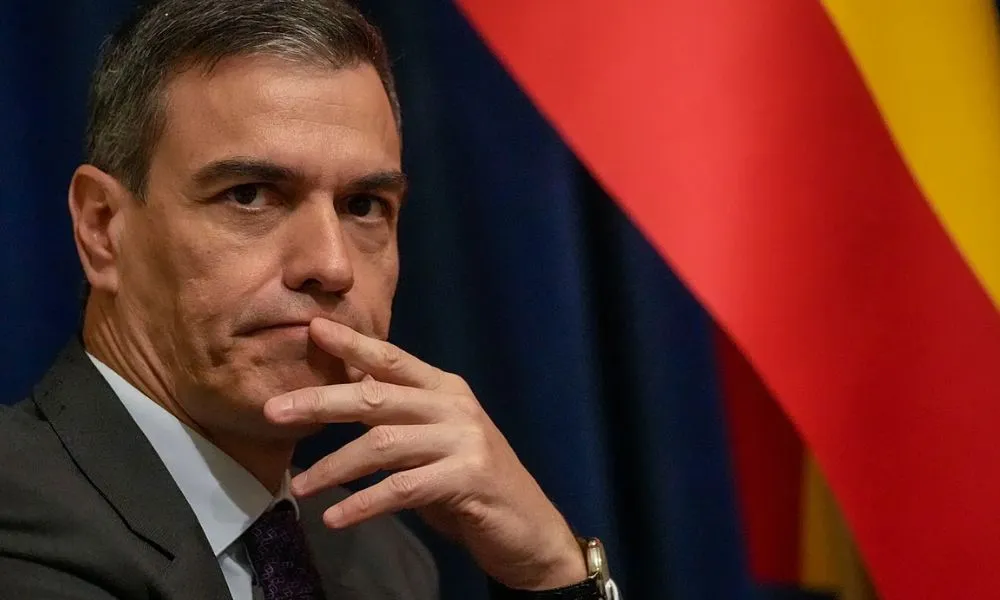

Spain has unveiled a sweeping set of measures aimed at tightening control over social media platforms, with a strong focus on protecting minors and ending what the government describes as a culture of digital impunity. The proposals, presented by Prime Minister Pedro Sánchez in Dubai, include criminalising algorithm manipulation and holding senior platform executives legally responsible for illegal content.
Five regulatory measures announced in Dubai
Speaking at the World Governments Summit in Dubai, Spanish Prime Minister Pedro Sánchez outlined five measures intended to regulate the operation of social media platforms in Spain. The stated objective is to curb abuses by large digital companies and ensure a safer online environment.
Sánchez described social media as “a failed state where laws are ignored and crimes are tolerated”, framing the measures as a response to systemic shortcomings in platform governance.
Social media has become a failed state.
— Pedro Sánchez (@sanchezcastejon) February 3, 2026
If we want to protect our children there is only one thing we can do: take back control.
Las redes sociales se han convertido en un Estado fallido.
Si queremos proteger a nuestros hijos, solo tenemos una opción: recuperar el control. pic.twitter.com/1MvCNxiLys
Ban on social media use for under-16s
Under the first measure, Spain will prohibit access to social media platforms for users under the age of 16. Digital platforms will be required to implement effective age-verification systems.
According to Sánchez, minors will not be permitted to open accounts even with parental consent. He said the aim was to protect young people from what he described as a “digital Wild West”.
Measuring and addressing online hate
The second measure introduces a system to monitor and quantify hate and polarisation on digital platforms. The proposed “hate and polarisation footprint” would track how platforms contribute to division and the spread of hate speech.
Sánchez said this tool would form the basis for future sanctions, arguing that the dissemination of hate should carry legal, financial and ethical consequences for platforms.
Legal liability for platform executives
The third measure αφορά changes to Spain’s legal framework to establish personal liability for senior platform executives.
According to the prime minister, chief executives and senior managers could face criminal responsibility if illegal or hate-based content is not removed from their platforms. The measure is intended to address repeated violations occurring within digital services.
Criminalisation of algorithm manipulation
The fourth measure targets algorithmic practices. Manipulating algorithms or amplifying illegal content would be classified as a criminal offence.
Sánchez stated that claims of technological neutrality could no longer be used as a defence, arguing that certain actors and platforms actively promote disinformation and harmful content for profit.
Investigation into Grok and other platforms
The fifth measure concerns investigations into Grok, owned by Elon Musk, as well as TikTok and Instagram.
Sánchez said the Spanish government would work with the public prosecutor to investigate and prosecute alleged offences linked to the generation and circulation of sexualised images, including images involving women and minors. He stressed that Spain would show zero tolerance and defend its digital sovereignty against external pressure.
Reaction from Elon Musk
The announcements triggered a strong reaction from Elon Musk, owner of X, formerly Twitter. Musk reposted video footage of Sánchez’s speech and used personal insults against the Spanish prime minister, referring to him as a “totalitarian fascist” and a “tyrant”.
Dirty Sánchez is a tyrant and traitor to the people of Spain 💩 https://t.co/B3oyHrBYpR
— Elon Musk (@elonmusk) February 3, 2026
In subsequent posts, Musk continued his criticism, using derogatory language and emojis. The proposed investigation into Grok, which is also under scrutiny by France, the United Kingdom and the European Union, directly affects Musk’s interests.
Sánchez is the true fascist totalitarian https://t.co/b2U17fEwa7
— Elon Musk (@elonmusk) February 3, 2026
Musk has previously defended hate speech on X as an expression of freedom of speech. The proposed Spanish legislation, which would introduce legal liability for platform executives over illegal content, would have direct implications for platform owners and senior management.
Broader political context
Musk had already criticised Sánchez prior to the social media proposals, particularly in relation to the Spanish government’s plan to legalise the status of around 500,000 migrants. He has amplified claims suggesting electoral manipulation, which the Spanish prime minister rejected.
Responding to Musk, Sánchez said: “Mars can wait, humanity cannot.”
Mars can wait. Humanity can’t. https://t.co/Oc4qAYtd3f
— Pedro Sánchez (@sanchezcastejon) January 29, 2026