
Minimum wages across Europe show striking disparities as of January 2026, ranging from well over €2,000 in several western countries to below €1,000 in more than half of European states. While headline figures reveal wide gaps, comparisons based on purchasing power narrow these differences and alter country rankings.
How many workers are affected
Around 12.8 million workers across 22 EU countries earn a minimum wage or less, according to estimates by Euronews Business based on data from Eurostat. This means minimum wage decisions directly affect millions of households.
As of January 2026, around one third of minimum wage earners saw no increase compared to July 2025. In four countries, minimum wages did not rise at all over the past year.
Monthly minimum wages in nominal euro terms
Among EU member states, monthly gross minimum wages range from €620 in Bulgaria to €2,704 in Luxembourg. When EU candidate countries are included, Ukraine records the lowest level at €173, followed by Moldova at €319.
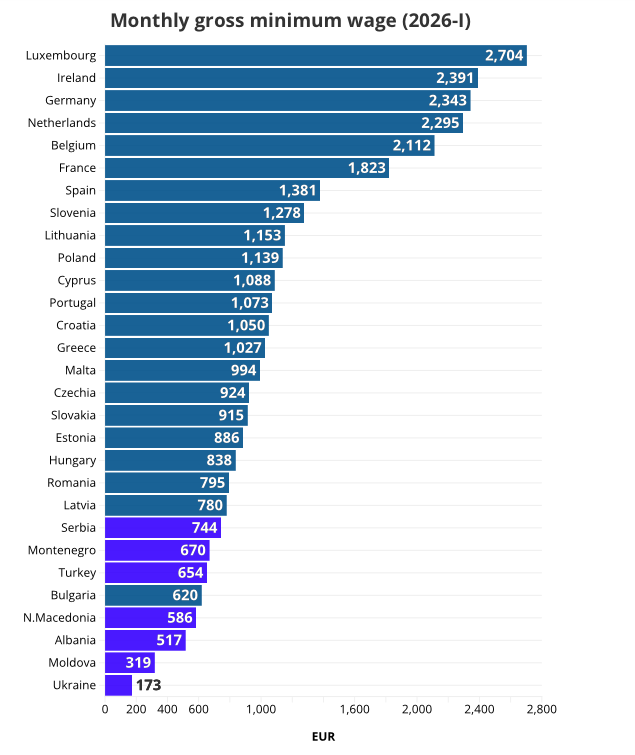
Five countries report minimum wages above €2,000 per month. These are Luxembourg, Ireland at €2,391, Germany at €2,343, the Netherlands at €2,295 and Belgium at €2,112.
Below this group, France stands at €1,823, while Spain records €1,381, illustrating notable differences even between neighbouring countries.
Eurostat minimum wage groupings
Eurostat groups minimum wages into three bands: above €1,500, between €1,000 and €1,500, and below €1,000.
Spain, Slovenia, Lithuania, Poland, Cyprus, Portugal, Croatia and Greece fall into the middle category, where differences between countries are relatively limited.
Countries below €1,000 per month
Out of 29 countries examined, including 22 EU member states and seven candidate countries, 15 record minimum wages below €1,000 per month. All EU candidate countries fall into this lowest group, alongside several eastern European EU members.
Examples include Czechia at €924, Hungary at €838, Romania at €795, Turkey at €654 and Albania at €517. Three candidate countries report higher minimum wages than Bulgaria.
Geographical patterns in minimum wages
Nominal minimum wage data highlight a clear geographical divide across Europe, with generally higher wages in western countries and lower levels in eastern Europe.
Purchasing power standards and real value
Comparisons based on purchasing power standards, or PPS, provide a different perspective by accounting for differences in living costs. PPS uses an artificial currency unit designed to represent the same basket of goods and services in every country.
Once adjusted for purchasing power, wage gaps narrow significantly. Across the 22 EU countries, minimum wages range from 886 PPS in Estonia to 2,157 PPS in Germany.
How rankings change under PPS
Although rankings shift slightly when PPS is applied, the top nine countries remain the same in both nominal euro and PPS terms.
Apart from Albania, EU candidate countries generally perform better in PPS comparisons, with higher real purchasing power than several EU member states. Romania shows the largest improvement, rising from 20th place in euro terms to 12th in PPS. North Macedonia moves from 26th to 20th, while Serbia rises from 22nd to 17th and Turkey gains three positions.
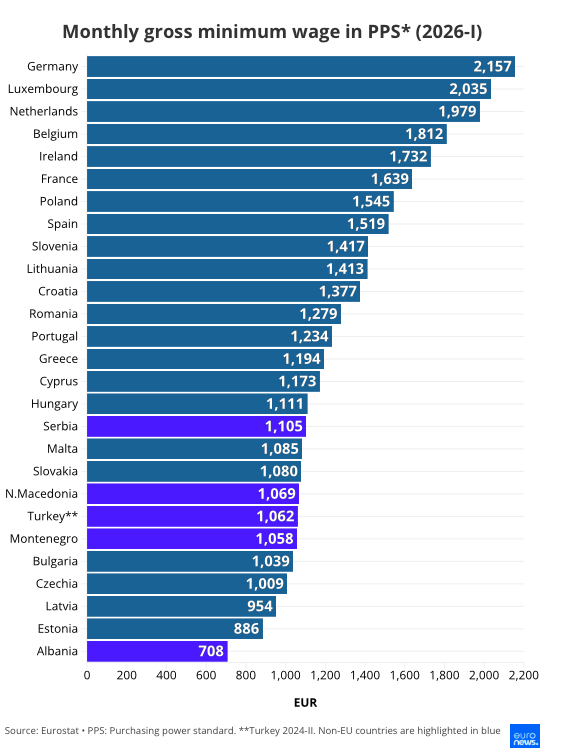
By contrast, Czechia and Estonia experience the largest declines, each falling eight places in the PPS ranking.
Countries without a statutory minimum wage
There is no statutory minimum wage in Italy, Austria, Sweden, Denmark or Finland.
Where minimum wages did not increase
Between July 2025 and January 2026, minimum wages remained unchanged in Belgium, Estonia, Greece, Spain, Luxembourg and Slovenia. Bulgaria, Hungary, Lithuania and Slovakia recorded the largest increases, each exceeding 11% over the same period.
Between January 2025 and January 2026, minimum wages also remained unchanged in Estonia, Spain and Slovenia. In Romania, the minimum wage stayed the same in national currency but declined slightly in euro terms over both periods.
Economic factors behind wage differences
Experts from the European Trade Union Institute note that higher productivity underpins sustainably higher wages. Economies with stronger industrial or financial sectors tend to achieve greater productivity, supporting higher minimum pay levels.