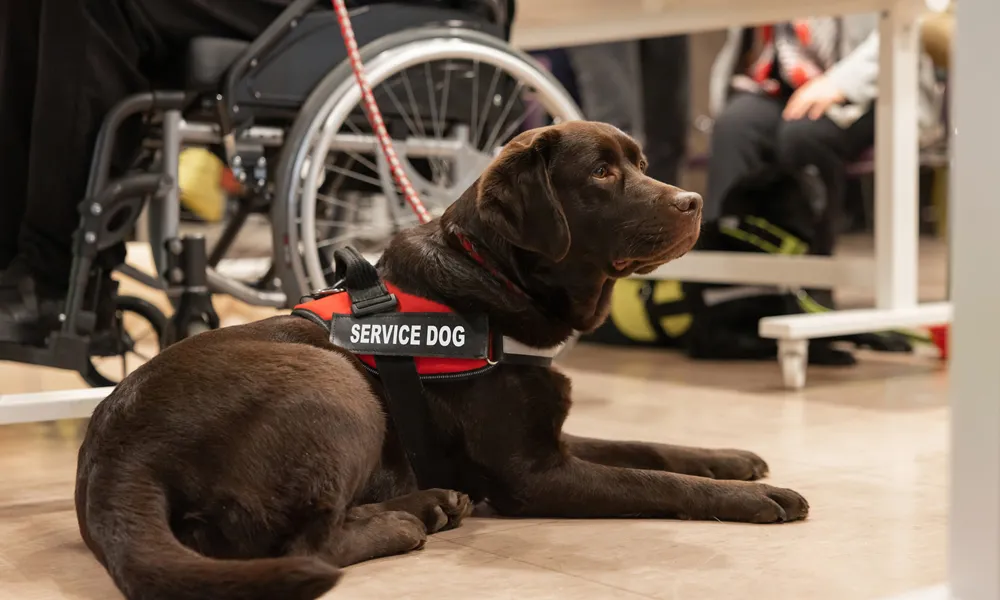
Fines of thousands of euros are foreseen for anyone who denies access to public or private spaces or means of transport to persons with disabilities accompanied by an assistance dog. Also, for the first time, a comprehensive framework will be established regulating the training and certification of assistance dogs, as well as the obligations of their handlers, from insurance to compliance with animal welfare rules.
These provisions are included in a bill tabled in Parliament by Green Party MP Charalambos Theopemptou, which aims to fill a longstanding institutional gap and transform the right to use an assistance dog from an informal practice into a clearly regulated and enforceable obligation for the state, service providers, and society. The proposal introduces specific control mechanisms, complaint procedures and defined sanctions, while also laying the foundations for the official recognition of assistance dogs through a registry, examinations and licensed training schools.
What qualifies as an assistance dog
According to the proposal, an assistance dog is defined exclusively as a dog that has been specially trained to perform functions directly related to the handler’s disability and has successfully completed a certification process. The proposal is not limited to guide dogs for the blind but also covers other forms of disability, such as mobility or sensory impairments, with precise categories to be defined through regulations.
A central element of the proposal is the creation of an Electronic Registry of Assistance Dogs, maintained by the competent authority through the Veterinary Services. The Registry will include, among other things, the handler’s details, the dog’s identification details (microchip), the category of assistance dog, the date of successful examination, and insurance details for civil liability.
The handler will be issued an identification card with a QR code, allowing immediate verification of certification while granting access only to strictly necessary data.
Who trains and who supervises
The proposal provides that assistance dog training schools must be licensed by the competent authority, training programmes must be approved based on internationally recognised standards, and regular and extraordinary inspections will be conducted both on schools and examiners. At the same time, foreign certifications may be recognised if they meet equivalent training and evaluation criteria.
Examinations and duration of certification
The certification process includes theoretical and practical examinations assessing:
• obedience and basic behaviour of the dog,
• its ability to perform specific tasks related to the handler’s disability,
• its behaviour in public spaces and transport,
• its health and safety condition.
The certification is valid for three years and is renewable after re-examination.
Right of access
The proposal clearly enshrines the right of an assistance dog handler to access, without additional charge, all public and private spaces open to the public, as well as all means of transport. Refusal of access is permitted only exceptionally and strictly for documented public health or safety reasons, provided that an alternative means of service is offered.
Obligations of the handler
Alongside rights, the proposal sets out the handler’s obligations, who must:
• ensure the health and welfare of the dog,
• maintain valid civil liability insurance,
• comply with legislation on dogs and animal protection.
Fines and complaints
The bill establishes a specific mechanism for submitting and examining complaints in cases of violations of assistance dog handlers’ rights.
According to the proposal, complaints are submitted to the competent authority via telephone or an electronic system. The complaint is registered within two working days and undergoes a preliminary assessment within ten working days to determine whether grounds for investigation exist.
If the complaint is deemed valid, the competent authority investigates and issues a reasoned decision within 60 days of submission, with a possible extension of up to 30 days in complex cases. The complainant is informed in writing of developments and outcomes.
In cases of violations, the bill provides for administrative fines. For unjustified refusal of access to a handler with an assistance dog, a fine of up to €4,000 is imposed, which may rise to €8,000 in case of repeat offence. A fine of up to €5,000 is also foreseen for a false declaration or misleading use of an assistance dog identity.
Decisions must be fully reasoned and specify the amount of the fine, payment terms, and the right to appeal.
Senekis proposal goes to plenary
The bill by Charalambos Theopemptou adds to a broader parliamentary debate on disability rights and assistance dogs. On Monday, the House Human Rights Committee completed the article-by-article discussion of a bill by DIKO MP Christos Senekis, which amends the Persons with Disabilities Law and enshrines the right of persons with disabilities accompanied by assistance dogs to access public and private spaces and transport.
As noted during discussions, over 2,000 visually impaired people live in Cyprus, yet only five currently have assistance dogs – a situation attributed to the absence of a regulatory and enforceable framework.
This article was originally published in Greek in Politis