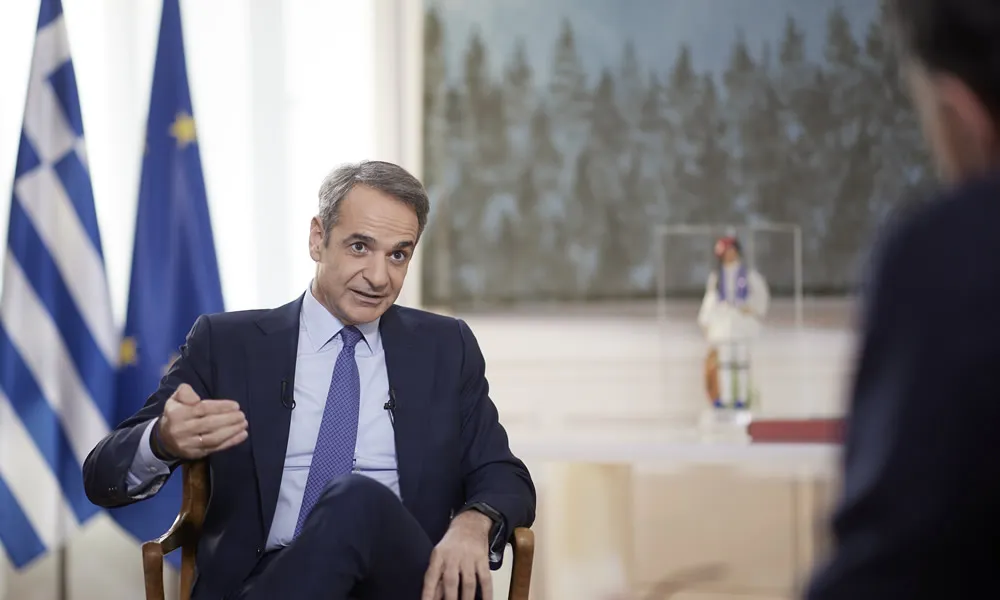
Speaking to SKAI on Monday evening, Greek Prime Minister Kyriakos Mitsotakis confirmed that his meeting with Turkish President Recep Tayyip Erdoğan will be held next week in Turkey.
He stressed that Athens and Ankara can talk without the need for a mediator. At the same time, he underlined that since the Athens Declaration there have been significant gains such as a reduction in violations, better cooperation on migration and strengthened communication channels.
EEZ main difference between the two
In the interview, the Greek PM clarified that the main difference between the two countries remains the delimitation of the Exclusive Economic Zone (EEZ) and continental shelf in the Aegean and Eastern Mediterranean.
He noted that as long as Turkey adds issues such as “grey zones” and demilitarisation to the agenda, progress becomes difficult.
“The major issue, our big difference with Turkey, is one and only one: the delimitation of maritime zones, the EEZ and the continental shelf, in the Aegean and the Eastern Mediterranean. As long as Turkey adds other issues to this ‘menu’, you understand that moving further in this direction is something I consider difficult in the current circumstances,” he said.
Regional conference with Turkey?
Referring to Turkish Foreign Minister Hikan Fidan, Mitsotakis said: “Nevertheless, I take Mr Fidan’s statement as a positive recognition that Turkey may possibly consider some of its long-standing positions and not emphasise them with the same intensity as in the past.”
He added that Greece would be willing to develop more initiatives in the wider region. “We could look at the issue of a broader regional conference that would also involve Turkey. We are neighbours, ‘condemned’ by geography to coexist, and there must consistently be open channels of communication,” Mitsotakis said.
Casus belli remains, EU funding does not
Regarding Turkey’s continuing stance that a possible Greek extension of its territorial waters in the Aegean Sea is a casus belli (cause for war), the Greek PM clarified: “As long as the casus belli exists, Turkey cannot benefit from European funding. And despite the doubts of some that our stance had real value, it was proven in practice that we achieved this goal.”
Turkey’s NAVTEX
Regarding Turkey’s standing maritime notice (NAVTEX) over waters it considers within its jurisdiction, and the statement that it will not allow any kind of research without coordination, Mitsotakis said Greece does not need to ask permission from anyone.
He also reiterated that Greece wants to create an electrical interconnection between the Greek islands in the Aegean. “I think some entrenched positions are sometimes repeated almost mechanically by Turkish bureaucracies. But in any case, I believe that if President Erdoğan truly wants to leave this chapter in the past and allow us to focus on the future, if this desire exists, then I would obviously be willing to enter into this discussion substantively. If you ask me how likely this is, I do not consider it very likely in the present circumstances,” he stressed.
Territorial waters
Finally, on the possibility of extending territorial waters around Crete or on the mainland, Mitsotakis noted that under his government Greece has already extended its territorial waters in the Ionian Sea. “Greece has grown in the last six years and the right to extend up to 12 nautical miles, as enshrined in International Law, is an inalienable right of Greece, which will be exercised when we judge that conditions are most appropriate.
“Of course, I must point out that for decades Greece had not exercised this right at all. We did it for the first time in the Ionian. I do not want to speak more publicly on this issue, other than to repeat that it is a unilateral right of our country, which certainly does not require anyone else’s approval to be exercised.”
On the other hand, “we must have a sense that when we talk about the Aegean and freedom of navigation, this is obviously not an issue that concerns only Greece and Turkey. But I do not want to say more on this matter,” he added.
Turkish media’s differing views on tête-à-tête
Meanwhile, ahead of the Erdoğan-Mitsotakis meeting in Ankara, pro-government and opposition media have adopted different approaches regarding the content and stakes of the tête-à-tête, reports CNA.
According to pro-government A Haber, the central message of the meeting will be the continuation of dialogue and cooperation on a “kazan-kazan” (win–win) basis, with Ankara emphasising that it does not seek tension with Athens. The Turkish broadcaster reports that developments in the Eastern Mediterranean, regional issues and partnerships being pursued by the Greek side will be on the agenda, while making special reference to the NAVTEX in the Aegean, which Turkey considers to fall within its lawful rights.
A Haber states that Erdoğan will convey to the Greek PM a message of dialogue without concessions but also without provocations, stressing that a policy of tension harms both countries.
By contrast, opposition newspaper Sözcü raises the tone, linking energy developments with the summit. The newspaper speaks of a “gradual takeover of the Mediterranean by Greece,” claiming that Athens, “with the full support of the United States,” is proceeding with hydrocarbon explorations south of Crete and off the Peloponnese. Sözcü connects Greek moves to agreements involving the American companies Chevron and Exxon Mobil.
Source: SKAI, CNA