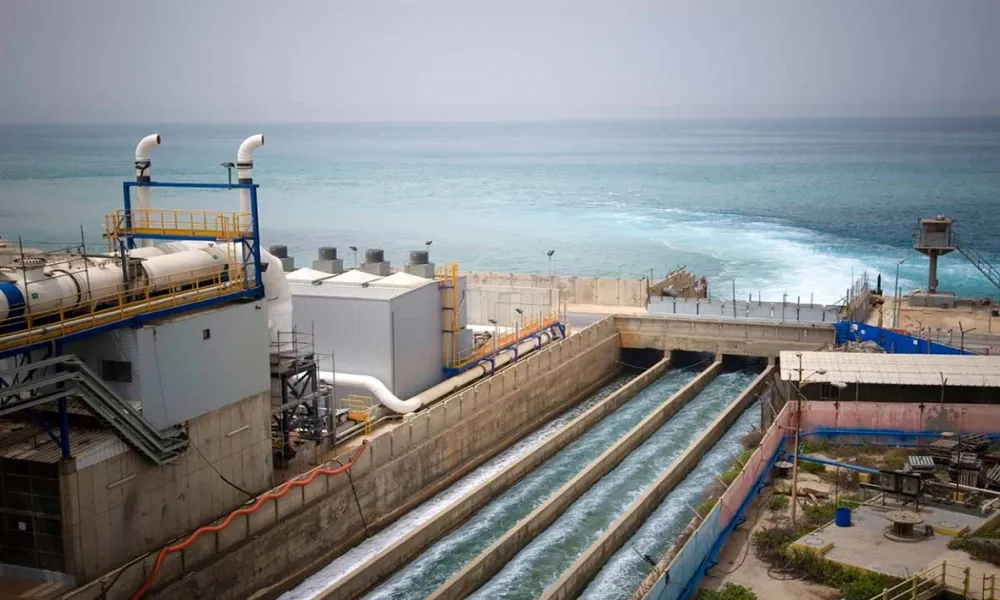

As long as the war in the Middle East continues, delays will persist in fully implementing government plans to tackle wildfires and water shortages ahead of the summer season. The conflict has left two firefighting helicopters stranded in Jordan, unable to travel to Cyprus. At the same time, the mobile desalination plant on the Garyllis river in Limassol, with a capacity of 10,000 cubic metres per day, has yet to come online. The contractor is an Israeli‑owned company.
As Agriculture Ministry permanent secretary Andreas Grigoriou told parliament on 24 March, installation work has begun, but key equipment still needs to be shipped from Israel. Officials now expect the unit to be operational in May. Most of the equipment is already installed, according to information, but some components – including containers – and contractor staff remain stuck in Israel due to the war.
Firefighting aircraft
Eight firefighting aircraft – four helicopters and four aeroplanes – are already at operational readiness. From 1 May, three additional aeroplanes are expected to join the fleet, raising the number of primary aircraft to eleven. If the Jordanian aircraft eventually arrive, the total will rise to thirteen. Helicopters from the National Guard, the Police and the British Bases can also be deployed as secondary assets.
During the Informal European Council on 23-24 April, the new European Firefighting Hub in Cyprus is scheduled to be inaugurated at Paphos airport. A European official in Brussels recently said the new hub “will have a dual role – operational and training,” serving as a centre of excellence for training, exercises and knowledge‑sharing. The initiative follows the announcement made by European Commission President Ursula von der Leyen in her State of the Union address last September.
Desalination works
The mobile desalination unit at Limassol Port, with a capacity of 10,000 cubic metres per day, began full operations yesterday. Updating the public on its water supply planning, the Agriculture Ministry said this is the third unit to become fully operational after the Moni unit (around 15,000 m³/day), which came online in July 2025, and the Kissonerga unit (12,000 m³/day), also operational since July 2025.
With these additions, the number of functioning desalination plants has increased from five in previous years to eight today. Once the Garyllis unit is added, the total will rise to nine.
Bridging projects through to 2027
The ministry’s planning for 2026-2027 includes the following desalination projects:
- Completion of the mobile unit in Episkopi – 15,000 m³/day
- Mobile unit in Vasilikos – 20,000 m³/day
- Mobile unit in Mazotos – 40,000 m³/day
- Floating unit in Germasogeia – 20,000 m³/day
According to the current schedule, the 2025-2027 projects will add a total daily capacity of 157,000 cubic metres. Combined with the 235,000 m³/day provided by the five permanent plants, system capacity will rise by 66%.
Meeting 80% of drinking water needs
Until 2023, the five permanent desalination plants covered roughly 70% of the domestic water needs supplied through the Government Water Supply Systems. This rose to nearly 75% in 2025 and has now reached 80%. With ongoing projects, officials expect coverage to approach 100% by early 2027 through interim bridge solutions, enabling full reliance on desalinated water for drinking needs and the preservation of dam reserves for irrigation.
The ministry stresses that public water awareness and an end to over‑consumption – a long‑standing issue – are also crucial parts of this strategy.
This overall planning is part of a broader approach aimed at strengthening water supply, expanding infrastructure and managing demand, to gradually increase the system’s resilience and ensure long‑term water security.
Permanent units planned through 2029
The mobile desalination units will meet water supply needs until the Water Development Department delivers four new permanent plants incorporating renewable energy sources:
- Dhekelia – 80,000 m³/day
- East Limassol – 60,000 m³/day
- Agia Thekla (Ayia Napa) – 30,000 m³/day
- Polis Chrysochous – 10,000 m³/day