Electoral analyst Nasios Oreinos told Politis that 2011 marked a turning point after which Cyprus experienced a significant shift in voting behaviour. Since then, he explained, new phenomena have emerged: declining party loyalty, rising abstention, tactical voting, and the rise of the hidden vote. In previous years, he noted, there were virtually no citizens unwilling to state their voting intention. He also estimated that the party landscape will change after the May elections, with smaller parties struggling to enter the new Parliament due to the unusually high number of political forces polling in double digits.
The decline of the major parties
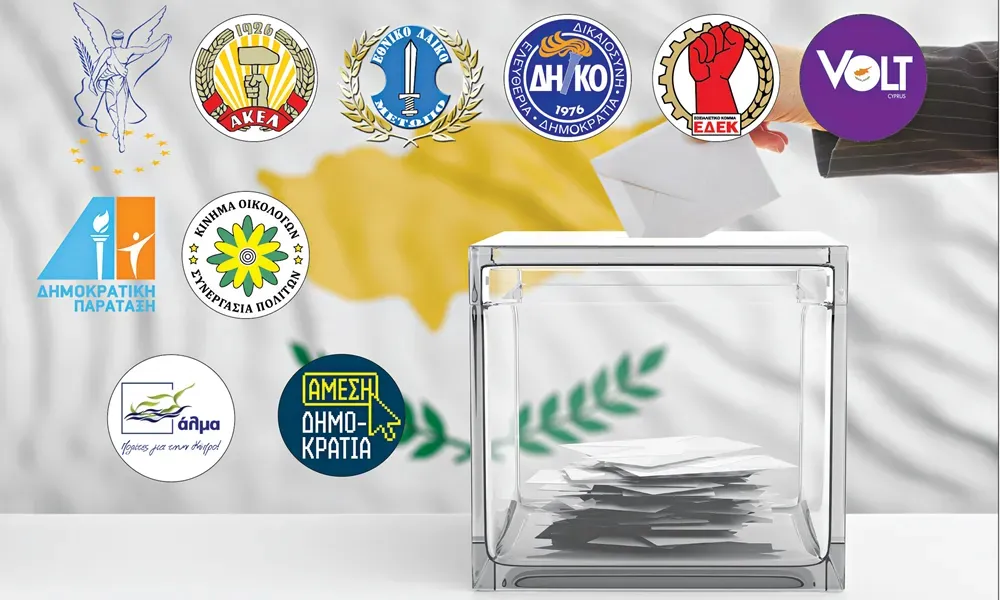
“In the 2011 parliamentary elections,” Oreinos said, “the four traditional parties, DISY, AKEL, DIKO and EDEK, received 92 percent of the valid vote.” By 2016 this had fallen to 77 percent, and by 2021 to 68 percent. Current data, he added, suggest that the combined strength of these parties in the 2026 elections may not exceed 60 percent. “This means political space is opening up for other forces.”
A shifting party landscape
According to Oreinos, the two new formations, ALMA and Direct Democracy, are set to reshape Cyprus political map. He said ALMA could even finish third, noting that the two‑point gap with ELAM in a recent Sigma poll might be bridged by hidden support. He also did not rule out higher‑than‑expected results for Direct Democracy, recalling that a recent Politis poll gave the party of Feidias Panayiotou 9.5 percent.
The challenge for smaller parties
Regarding smaller parties that appear unlikely to cross the 3.6 percent threshold, Oreinos outlined two scenarios. At present, he said, the parties polling in or near double digits – AKEL, DISY, ELAM, ALMA, DIKO and Direct Democracy – are far more numerous than in previous elections. In earlier contests, only three parties reached double figures. As a result, the share of the vote available to smaller parties will be smaller, and if the larger parties manage to consolidate support, the smaller ones will struggle to enter Parliament, with any success likely to be marginal.
In the second scenario, if smaller parties manage to keep the major parties’ percentages lower, more than one minor party could enter Parliament. However, Oreinos stressed that current data point more strongly to the first scenario, though nothing is certain. “The picture will be clearer in May,” he said.
He also recalled that in 2011, 15 percent of the vote failed to elect an MP – the highest figure in Cyprus’s electoral history. Several small parties fell short, including the Hunters (3.27 percent), Anna Theologou’s Generation Change (2.82 percent) and Solidarity (2.31 percent).
Declining party loyalty
Oreinos noted that after 2011, traditional parties began losing voters. “Until 2011, in parliamentary elections, the major parties’ percentages were rising. After 2011, they began to fall.”
Asked why this decline began, he pointed to events such as the Mari explosion. “AKEL’s percentages dropped,” he said. This was followed by the deposit haircut and austerity measures, which negatively affected all traditional parties. These events, combined with new behavioural trends, explain the rise of voter disaffection and the emergence of the ‘punishment vote’, which mainly benefited ELAM.
The hidden vote
Oreinos explained that the hidden vote has two forms. First, citizens who refuse to state their voting intention in polls. Before 2011, he said, not a single respondent declined to answer. Second, voters who claim they will vote for one party but intend to vote for another. This also constitutes hidden voting.
He cited the 2021 parliamentary elections, where some respondents said they would vote for AKEL but ultimately chose another party. Another example was the 2024 European elections, where many who claimed to be undecided or refused to answer ultimately voted for Feidias Panayiotou.
Referring to the recent Prime Consulting poll for Sigma, he suggested that part of the 7.5 percent who did not answer may be hiding support for ALMA and Direct Democracy. Hidden support for other parties, he said, is likely to be smaller.
Tactical voting
Oreinos said that after 2011, tactical voting also began to appear. He cited the 2019 European elections, where EDEK was boosted to prevent ELAM from winning a seat. He also mentioned tactical support for Stavros Malas in the 2013 and 2018 presidential elections, enabling him to reach the second round, where DISY’s Nicos Anastasiades was considered more likely to defeat him than rivals Giorgos Lillikas or Nikolas Papadopoulos.
Disillusionment and emotion
Asked about the persistent anger among voters since 2011, Oreinos attributed it to events such as the Mari explosion, the financial crisis and the deposit haircut. He noted that polls consistently show high dissatisfaction with the President, Parliament and the opposition. However, the 80 percent dissatisfaction with the opposition does not specify which parties it concerns, as detailed figures were not released.
He stressed that today around nine in ten citizens feel negatively about politics – either angry or disappointed. Emotion, he said, is the strongest driver of voting behaviour because voters cannot control it. It pushes them towards alternative political choices or abstention.
Negative sentiment, he added, is another post‑2011 phenomenon. Disappointment and anger have risen steadily, contributing to the punishment vote. Abstention has also surged since 2011, reaching double digits in all types of elections.
Corruption
“In the 2016 parliamentary election polls, corruption was not a voting criterion,” Oreinos said. “It appeared in the 2021 polls and today it is at high levels.” In the Sigma polls, 19 percent of citizens said they would vote based on which party would combat corruption – and this was before the videogate scandal. “We will therefore see shifts towards parties perceived as capable of tackling corruption.”
The reliability of polling samples
Responding to criticism from some parties about polling quality, particularly the claim that only one in ten people respond to surveys, Oreinos said parties often look for excuses to explain unfavourable results so as not to appear like a wasted vote.
He argued that the criticism is unfounded. “If I make ten calls and two people answer, among the remaining eight some will not vote at all, so I can assume abstention will be higher than polls show.” But if five of the eight abstain, he added, it does not mean the remaining three would behave differently from the two who did respond.
He used a swimming pool analogy to explain sampling: in summer, someone tests the water by dipping a foot in one spot, not several, because the temperature is the same throughout. “In the same way,” he said, “I choose a sample of 1,000 people, as long as it is representative across party preference, age, gender and district.”