
Just days before Monday’s meeting on the Cyprus problem, the United Nations Secretary-General’s personal envoy expressed optimism to Politis that an agreement could be reached on four crossing points. The outcome, however, fell short even of that limited objective.
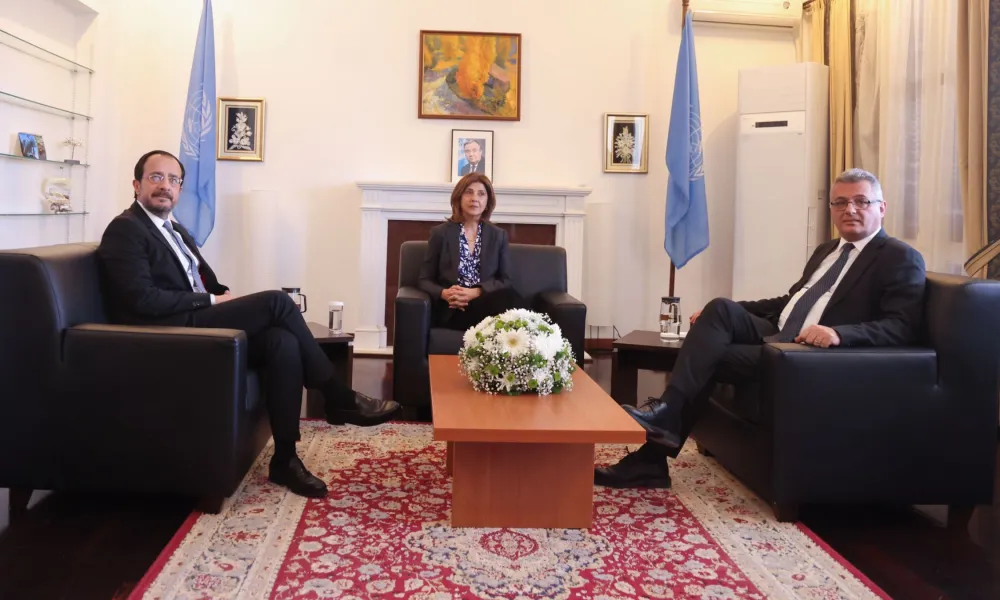
Monday’s trilateral meeting added another chapter to the long history of the Cyprus issue without substantially altering the landscape. The two leaders met to meet, the United Nations kept the process on life support, and the fundamental disagreements remained firmly in place. In short, there was no demining, either literally or politically.
Limited progress on confidence-building measures
Mine clearance, which formed part of the confidence-building measures package under discussion, was left out of any agreement. Of the four crossing points for which a deal was being sought, agreement was reached on only two.
When even practical measures, often regarded as the easiest areas in which to find common ground, encounter such obstacles, the scale of the distance separating the two leaders from any genuine willingness to negotiate becomes apparent.
All this comes as United Nations Secretary-General António Guterres approaches the end of his term, with María Ángela Holguín making it clear that she will step aside if meaningful progress is not achieved.
Expectations fail to materialise
Only days before the meeting, Holguín had expressed optimism to Politis about an agreement on all four crossing points.
“It is something that gives a little energy to people,” she said, explaining the importance she attached to such an outcome given the evident fatigue within public opinion.
Holguín invested political capital in securing practical agreements as a final effort to revive public expectations for progress. The result, however, fell short even of that modest ambition.
Disagreements remain unresolved
Beyond confidence-building measures, the basis of the talks, the methodology and the conditions for restarting negotiations remain points of disagreement.
Holguín herself had noted that the two leaders failed to respond to her appeal to discuss methodology, while neither side had advanced discussions on substance. She identified the greatest obstacle as domestic politics and the absence of political will on both sides.
The political minefield
This political minefield is not a natural phenomenon. It is shaped and maintained through choices, conditions, prerequisites and political calculations made by the leaderships.
Their decisions determine the course of the process, but the consequences extend far beyond the negotiating table. The leaders lay the mines, but it is the citizens of both communities who walk across the terrain.
Alongside them walks the prospect of peace.