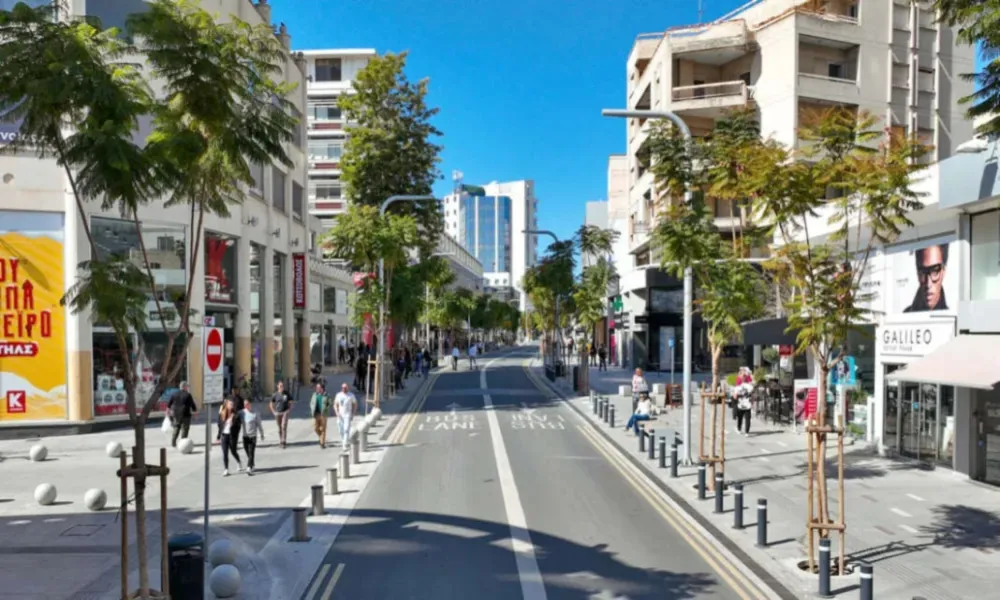

The debate over the future of Makariou Avenue is once again intensifying and risks being trapped in an overly simplistic dilemma: whether allowing more private vehicles back into the centre of the capital can, by itself, reverse the area's commercial decline.
It is a question that cannot be answered through the easy assumption that more cars automatically mean more customers and higher turnover.
Before considering whether traffic arrangements should change, there is a far more serious issue at stake: the funding of the project and the possibility that overturning the philosophy under which it was approved could trigger a requirement to repay European funding.
Since the redevelopment of Makariou was co-financed on the basis of specific sustainable mobility objectives, any changes must be approached with caution, particularly when the cost of a wrong decision could ultimately fall on taxpayers.
In that sense, the Ministry of Transport's position that it will not agree to changes before securing European funding safeguards is entirely justified. The management of public and European funds cannot be adjusted according to short-term pressures or bypass commitments undertaken by the Republic of Cyprus.
The fact that the project's evaluation period has not yet been completed makes the discussion even more sensitive. If the project is subject to a five-year assessment period following the final disbursement of funds, and around four years remain, any substantial changes must be fully justified and consistent with the original objectives.
This is where everyone needs to recognise that time must be allowed for the project to mature. It is unrealistic to expect that within two or three years what was once Nicosia's premier commercial street will return to the conditions of the 1990s and 2000s.
That does not mean the concerns raised by business owners are unfounded. Makariou faces real challenges and commercial activity has not returned to the levels many anticipated following the redevelopment.
The mistake is to assume that traffic restrictions are solely responsible and that bringing cars back is the cure.
Nicosia's retail landscape has changed dramatically. Shopping centres, e-commerce, changing consumer habits and the relocation of dining and entertainment venues to other areas have reshaped the city's commercial map.
It is difficult to argue that a complex economic and urban planning problem can be solved through a single traffic intervention.
Even the available data on commercial premises suggest a more nuanced picture. Of the 106 ground-floor properties along the avenue, 70 are occupied and 36 are vacant, while only 20 are currently available for rent.
These figures do not justify complacency, but neither do they support the image of a completely deserted avenue.
If the aim is to revitalise Makariou, the conversation must be far broader. It should include rents, the reuse of vacant buildings, attracting businesses, the near absence of public transport, peripheral parking, shading, cleanliness, safety and the overall quality of public space.
That is the real challenge.
The question is not how more cars can return to Makariou Avenue, but how more people can return.
And those are not the same thing.