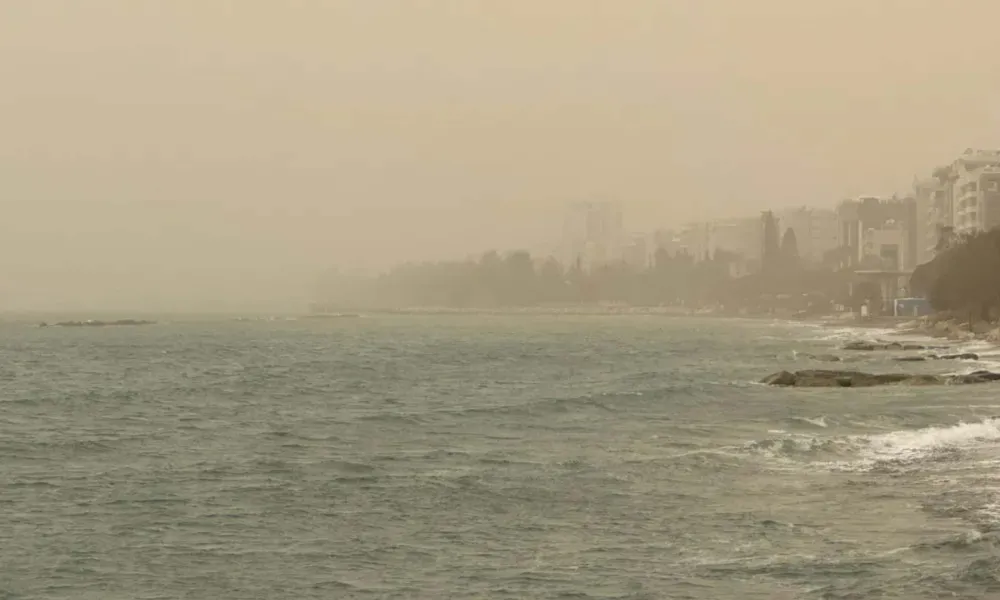

Dust storms affecting Europe are becoming more intense, particularly in Southern Europe and the Eastern Mediterranean, creating growing challenges for air quality and public health, according to a new international study involving researchers from the Cyprus Institute.
According to the Cyprus Institute, the study, published in the scientific journal Nature, links the increasing intensity of dust transport episodes from the Sahara and other desert regions to changes associated with climate change.
These include worsening drought and desertification in North Africa, as well as changes in atmospheric systems that favour the transport of dust towards Europe.
The findings indicate that climate change is affecting not only temperatures and extreme weather events but also air quality.
Southern Europe experiences approximately 46 desert dust episodes each year, increasing concentrations of airborne particles and degrading air quality.
According to the study, transported desert dust accounts for roughly one-third of the annual average PM10 particulate matter level considered acceptable under World Health Organization guidelines.
High concentrations of desert dust can have adverse health effects, including asthma flare-ups and higher mortality rates.
Researchers estimate that desert dust episodes in Southern Europe have been associated in recent years with an increase in daily mortality of around 0.67% and a rise in respiratory hospital admissions among children of approximately 2.5%.
The research also documents a gradual increase in transported dust across Europe over the past century, as reflected in dust measurements taken from Alpine ice deposits.
The findings are particularly significant for Cyprus, as the Eastern Mediterranean is among the European regions most heavily affected by desert dust transport and has recorded some of the largest increases in the intensity of dust episodes over the past decade.
The study further found that average desert dust concentrations in Southern Europe are more than twice as high as those recorded in Central and Northern Europe.
Researchers from the Climate and Atmospheric Research Centre of Excellence (CARE-C) at the Cyprus Institute, who co-authored the study, noted that desert dust is a natural phenomenon for the region.
However, they said the new study shows that dust episodes and their impacts are intensifying over time, while the conditions that favour more severe events are changing in ways linked to climate change.
This means that desert dust could become an even greater challenge for air quality and public health in the years ahead.
The researchers concluded that better preparation and adaptation to more intense dust episodes, combined with continued efforts to tackle climate change, will be crucial for protecting public health and improving air quality.
Source: CNA