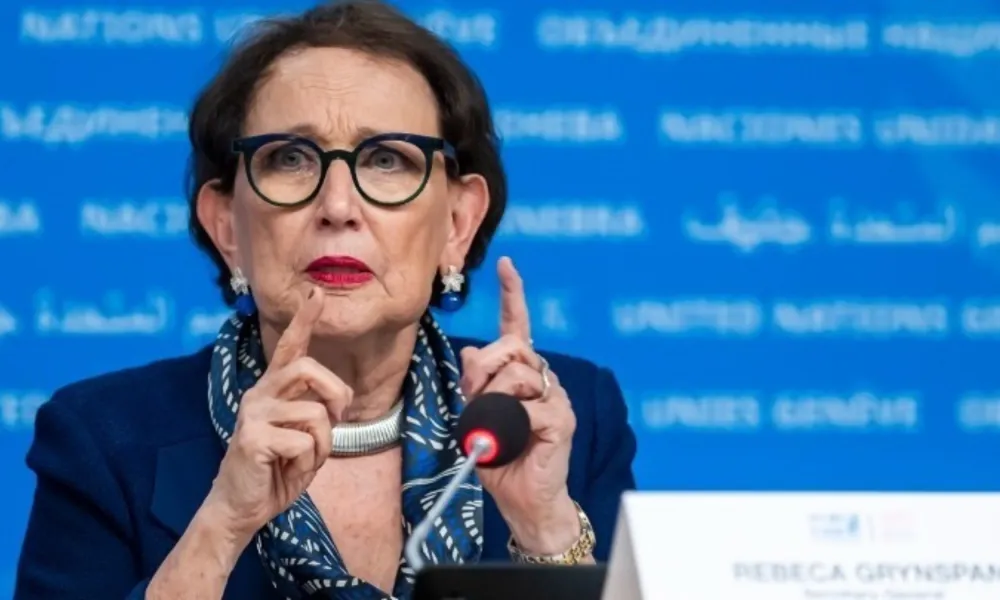

Rebeca Grynspan has widened her lead in the race to succeed António Guterres as the next Secretary-General of the United Nations, securing 12 encouragement votes and three discouragement votes in the eighth informal ballot of the UN Security Council.
The result represents Grynspan's strongest performance so far, but it remains unclear whether any of the negative votes came from one of the Security Council's five permanent members, whose veto power could block her candidacy.
Lead grows, uncertainty remains
The former vice-president of Costa Rica improved on her previous showing of 11 encouragement votes, reinforcing her position as the frontrunner in the contest.
However, the latest ballot did not distinguish between votes cast by permanent and non-permanent Security Council members, making it impossible to determine whether any permanent member continues to oppose her candidacy.
That distinction is crucial, as a successful candidate must secure at least nine votes in favour and avoid a veto from the United States, Russia, China, France or the United Kingdom.
Other candidates remain in contention
Behind Grynspan, the latest ballot produced few significant changes.
Rafael Grossi, director general of the International Atomic Energy Agency, received nine encouragement votes, four discouragement votes and two no-opinion votes.
Carolyn Rodrigues-Birkett of Guyana secured eight encouragement votes, five discouragement votes and two no-opinion votes.
Lana Nusseibeh of the United Arab Emirates remained on seven encouragement votes, six discouragement votes and two no-opinion votes.
While these candidates continue to attract support, none has matched Grynspan's recent gains.
Previous ballots highlighted veto concerns
The uncertainty surrounding the position of the permanent members stems from the sixth informal ballot held on October 16, when separate ballots were used for permanent and elected members.
At that stage, Grynspan, Grossi and Rodrigues-Birkett had each received two discouragement votes from permanent members.
Subsequent rounds have used a single ballot format, making it impossible to determine whether those objections remain.
Turkish candidate trails rivals
A new entrant to the race, Feridun Sinirlioğlu, nominated by Turkey on November 1, received three encouragement votes, eight discouragement votes and four no-opinion votes in his first ballot.
The result places him well behind the leading candidates.
Historic candidacy
Grynspan's candidacy is also associated with efforts to appoint the first woman Secretary-General in UN history and to return the position to Latin America and the Caribbean, following the region's long-standing claim to the post under the principle of geographical rotation.
While those considerations carry political weight, they do not override the need for agreement among the Security Council's permanent members.
Next vote expected on November 19
With Guterres' term ending in December, attention is now turning to the next informal ballot, which is expected to take place on November 19.
Diplomatic observers continue to view Grynspan as the clear favourite, although the final outcome will depend largely on whether any permanent Security Council member decides to exercise its veto.
Source: ANA-MPA