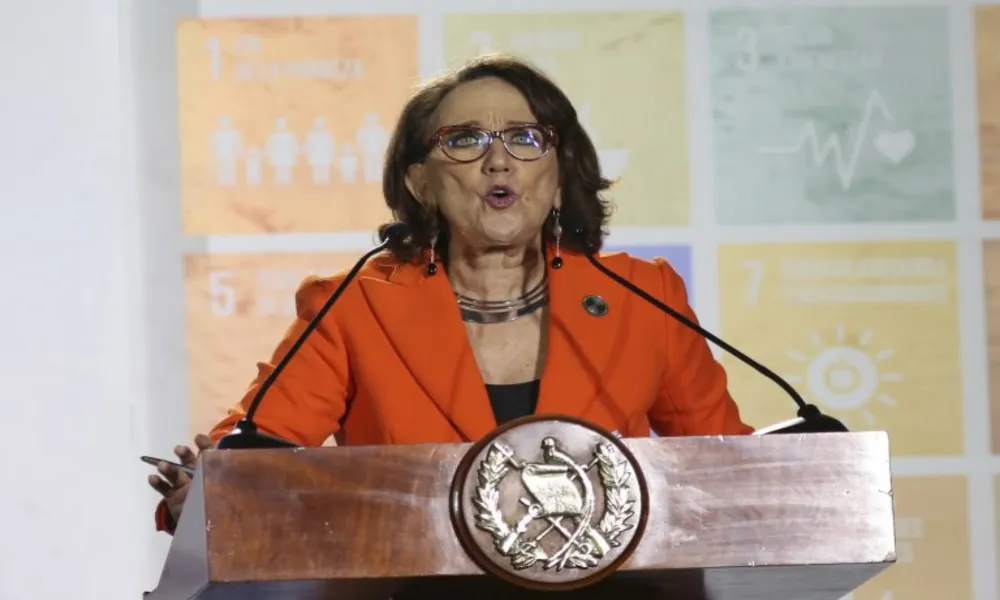

A new informal vote held behind closed doors at the United Nations Security Council on Thursday showed former Costa Rica vice president Rebeca Grynspan, 70, strengthening her position as the leading candidate to become the organisation's 10th secretary-general and succeed António Guterres at the end of the year, according to sources cited by Reuters.
Grynspan received 12 encouragement votes and three discouragement votes in the eighth informal ballot of the process aimed at selecting Guterres' successor. The current UN chief, 77, will complete his second five-year term on 31 December.
Whoever is selected will face multiple challenges, including ongoing wars, reductions in US funding for the United Nations and the organisation's declining influence as the current administration in Washington has withdrawn from dozens of UN agencies and programmes.
Grynspan extends lead
Before a formal recommendation can be made, candidates must go through an official vote.
That process is expected once a candidate appears capable of securing at least nine encouragement votes and no discouragement votes from any of the Security Council's five permanent members: the United States, United Kingdom, France, Russia and China.
It remains unclear how those five countries voted in Thursday's informal ballot.
Grynspan has now led in six of the eight informal votes held in recent months, although often by narrow margins.
The only exception came in August, when Carolyn Rodrigues-Birkett, 52, Guyana's ambassador to the UN, secured the highest number of encouragement votes.
In Thursday's ballot, Rodrigues-Birkett received eight encouragement votes and dropped to third place.
Second place went to Rafael Grossi, 65, the current director general of the International Atomic Energy Agency (IAEA), who received nine encouragement votes.
The results were almost identical to those recorded last week, although Grynspan gained one additional encouragement vote.
Diplomat Lana Nusseibeh of the United Arab Emirates, the most recent entrant into the race, finished fourth, as she did last week, with seven encouragement votes, six discouragement votes and two member states expressing no opinion.
Push for the first female UN chief
By comparison, when Guterres was selected, it took six informal ballots before the Security Council reached a consensus.
An informal tradition favours geographical rotation in the role, although this is not always observed. On this occasion, it is considered Latin America's turn to produce a secretary-general, which helps explain why most of the candidates come from the region.
In the more than 80-year history of the United Nations, no woman has ever held the position of secretary-general, and a number of member states are pressing for that to change.
The candidate eventually selected by the Security Council will be submitted to the UN General Assembly for approval.
To date, the General Assembly has endorsed the Security Council's choice in every case without exception.
Sources: Reuters