
Polish President Karol Nawrocki convened emergency talks with parliamentary parties on Saturday after a dramatic escalation in a long-running dispute over the Constitutional Court, with police deployed around the court building and rival camps trading accusations of violating the rule of law.
"Because of the threat to the internal security of the Republic of Poland, I am convening urgent consultations today with representatives of parliamentary forces," Nawrocki said in a statement read outside the Constitutional Court by his chief of staff, Pawel Szefernaker.
The crisis intensified on Friday when Judge Anna Korwin-Piotrowska announced that Constitutional Court President Bogdan Swieczkowski and Vice-President Bartlomiej Sochanski had been suspended from their duties for one month. Korwin-Piotrowska, who assumed the court's leadership on an interim basis, said the move was necessary to restore legality to the institution's functioning.
Judicial legitimacy
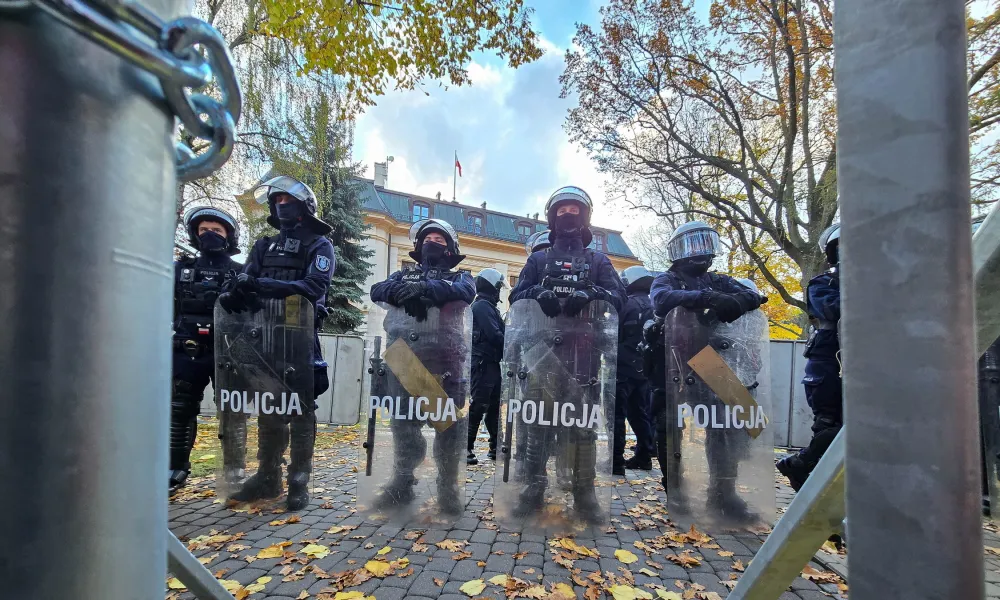
The decision triggered immediate reactions. Police deployed forces around the Constitutional Court building in Warsaw as protesters gathered to oppose the removal of its president. Tensions rose after some demonstrators allegedly breached barriers and threw objects at officers. Three people were arrested.
The confrontation marks the latest chapter in a dispute dating back to 2015, when the nationalist Law and Justice (PiS) party began reshaping Poland's judicial system after coming to power. The European Union repeatedly challenged those reforms, arguing they undermined judicial independence.
The Constitutional Court was at the centre of years of conflict between Brussels and PiS governments that ruled between 2015 and 2023. During that period, judges were appointed whose legitimacy has been questioned by both the European Union and the current government of Prime Minister Donald Tusk.
After returning to power in 2023, Tusk pledged to reverse the judicial reforms and restore institutional independence. Progress has been hindered, however, by disputes over judicial appointments and the refusal of President Nawrocki, elected in 2025 with PiS backing, to swear in some judges selected by parliament.
The latest dispute also centres on Swieczkowski, a former deputy justice minister under a PiS government, who has refused to recognise judges elected by the current parliamentary majority.
Special police units were deployed at the Constitutional Court on Friday after Justice Minister and Prosecutor General Adam Bodnar sought the lifting of Swieczkowski's immunity, while Korwin-Piotrowska announced she was assuming interim leadership of the court.
Rule of law
"The restoration of the rule of law is our duty," Tusk said. "After decades of lawlessness under PiS, it is a difficult process, sometimes painful, which requires decisive action. There is no other way."
Nawrocki was travelling to Senegal to attend the opening of the Youth Olympic Games when the developments unfolded. He immediately cancelled the visit and returned to Poland.
"In such a moment, the president must be in Poland. I am interrupting my flight to Senegal and returning," he wrote in a social media post.
Television footage showed the former boxer forcing his way into the Constitutional Court building after arriving in Warsaw on Friday night, pushing past judges who tried to block his entry.
The opposition has accused Tusk's government of attempting to bring the Constitutional Court under political control, with some figures describing the developments as a "coup". The government rejects those claims and argues it is seeking to restore the rule of law after years of politically motivated interference in the judiciary.
The dispute has become one of the most serious institutional crises in Poland in recent years and threatens to further paralyse state institutions ahead of parliamentary elections scheduled for 2027.
Sources: AFP, CNA