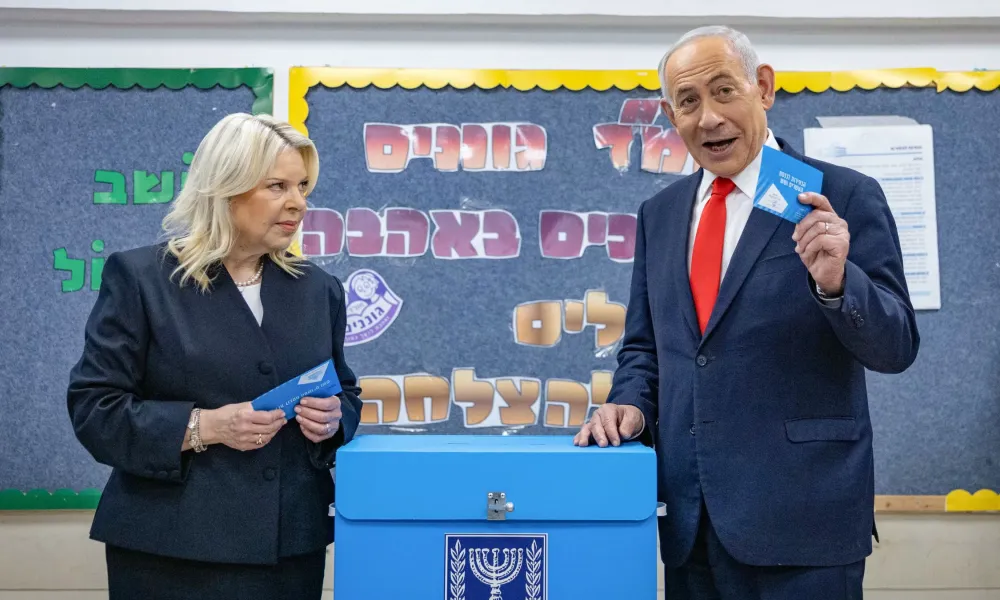

Israeli Prime Minister Benjamin Netanyahu and opposition leader Gadi Eisenkot have both pledged to form the country’s next government, as preliminary election results point to a political deadlock and potentially difficult coalition negotiations.
The latest figures reported by Israeli media outlet Ynet and financial newspaper Calcalist at 10.07am local time on Wednesday, 28 October, showed Netanyahu’s bloc leading with 54 seats, compared with 48 for the opposition alliance led by Eisenkot, after approximately 66.2% of votes had been counted.
Neither side is close to the 61 seats required for a majority in Israel’s 120-seat Knesset.
Netanyahu, 77, called for the formation of a “strong right-wing government”, urging what he described as the “Jewish and Zionist majority” to unite and make a fresh start.
He addressed supporters at around 3am, several hours after polling stations closed at 10pm on Tuesday, delivering an unusually brief speech. He did not directly address Eisenkot or claim victory, instead stressing that his Likud party remained the largest in parliament.
Likud was projected to win 27 seats, down from 32 in the outgoing Knesset, while Eisenkot’s Yashar party was forecast to secure 21.
Opposition declares a mandate for change
Eisenkot described the early results as a “complete rejection” of Netanyahu, declaring that voters had chosen change.
The former chief of staff of the Israel Defence Forces pledged to do everything possible to form a government and ruled out another election as a solution to the impasse.
However, his path to power remains uncertain. Without sufficient support from other parties, the opposition alliance may need to seek cooperation from Arab parties or attempt to establish a minority government.
Both options have presented political challenges, with Eisenkot previously indicating that he was not considering a coalition supported by Arab parties.
Yair Golan, leader of the centre-left Democrats party, called on the opposition to work with Arab parties to remove Netanyahu from power.
In a post on X, Golan criticised what he described as Netanyahu’s racist distinction between Jewish and Arab votes, arguing that cooperation with Arab citizens offered an opportunity to establish a government of change.
Arab parties emerge as potential kingmakers
One of the most significant developments in the preliminary results is the projected increase in representation for Arab parties.
Ra’am, a moderate Islamist party, and the United Arab List are expected to win a combined 18–19 seats, compared with 10 in the outgoing parliament.
The latest figures indicated that Arab parties were gaining ground, with Ra’am projected to add two seats.
Ra’am leader Mansour Abbas declared that Netanyahu’s political camp had suffered a major defeat and said he was prepared to cooperate with Eisenkot. Netanyahu, however, has firmly rejected the prospect of a government supported by Arab parties.
During his election campaign, the prime minister repeatedly targeted Arab political representation, using the slogan “Either the right or Palestine”.
The growing strength of Arab parties could prove decisive in determining which political bloc can assemble a viable coalition.
Political scientist Ilana Spaitsman, who organises conferences at Bar-Ilan University, said the emerging picture pointed towards a deadlock.
Netanyahu had no apparent route to forming a government, she argued, while Eisenkot would need either to reach an agreement with Arab parties or attempt to govern as a minority.
Yaeli Lifshitz, a student celebrating at Eisenkot’s party headquarters in Tel Aviv, said forming a government would require politicians to break with established conventions and build unprecedented alliances.
Security and Iran feature prominently
National security also featured prominently in the candidates’ election-night statements.
Netanyahu said Israel had a historic opportunity, working with US President Donald Trump, to eliminate what he described as the existential threat posed by Iran.
Eisenkot, meanwhile, warned the prime minister against using Israel’s security for political purposes.
The opposition leader also appealed to members of the security services, saying Netanyahu lacked both a mandate and the public’s confidence. He urged them to remain committed to the state and the interests of Israeli citizens.
Israeli media have reported disagreements in recent weeks between senior military officers and the prime minister, adding to the political tensions surrounding the election.
Record turnout amid deep divisions
Voter turnout reached 77.7%, the highest level since 1999, in the first election since the 7 October 2023 attacks that triggered the war in Gaza.
The vote took place amid mounting international criticism of Israel’s conduct of the war, settler violence and the expansion of Israeli settlements in the occupied West Bank under what has been described as the most right-wing government in the country’s history.
For many voters, the election was also an opportunity to express dissatisfaction with the country’s political direction.
Asia Eghbaria, a 23-year-old law student who voted in Umm al-Fahm, a predominantly Arab city in northern Israel, said she wanted change and to be treated as an equal citizen.
“I don’t want to be treated as a second- or third-class citizen. I want to live in peace and tranquillity,” she said.
The Central Elections Committee was expected to begin releasing official results progressively, with the process potentially taking several days.
Parties are now preparing for weeks of negotiations in an effort to secure the support needed to form a government. If those talks fail, Israel could face another election, a recurring outcome in the country’s recent political history.
For now, the preliminary results suggest that neither Netanyahu nor Eisenkot has a clear path to power, leaving the next government dependent on difficult negotiations and alliances that could reshape Israel’s political landscape.