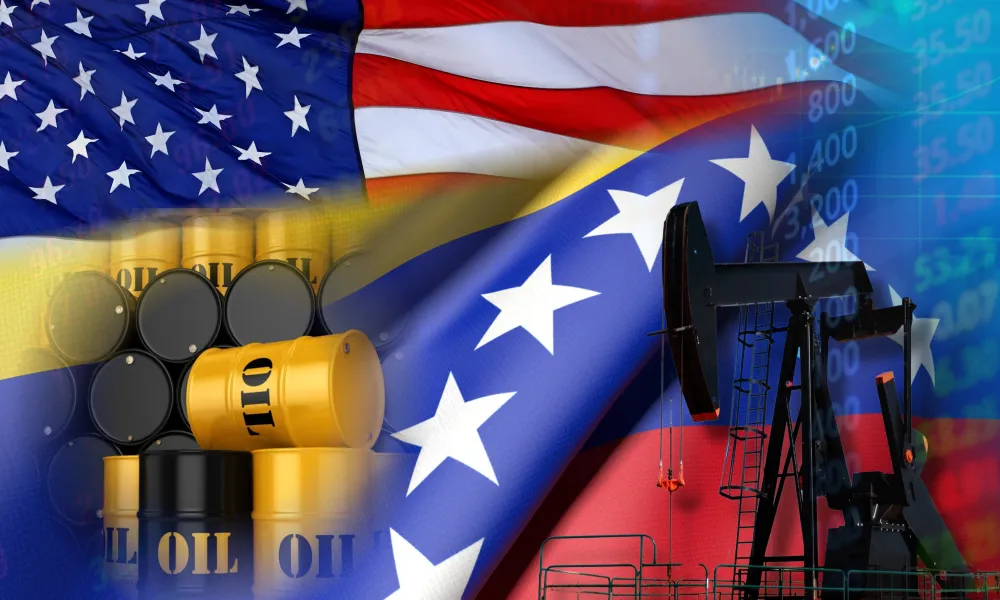

The United States and Venezuela announced on Friday what both sides described as a historic oil agreement that grants Washington majority control over the development of more than 65 billion barrels of proven crude reserves in the South American country.
Venezuelan officials said the agreement covers 17 strategic oil fields containing up to 65 billion barrels of oil and is expected to trigger more than $100 billion in investment.
US President Donald Trump called the deal the “biggest” in world history, in a post on Truth Social, claiming it would "more than double" US oil reserves.
"This Historic Transaction MORE THAN DOUBLES American Oil Reserves, greatly increases our Oil Supply, and will substantially lower Gas Prices for all Americans," Trump posted on social media.
Trump also said the agreement had been concluded in close cooperation with Venezuela's interim president, Delcy Rodriguez, and a group of private companies.
Caracas confirmed the signing of what it also described as a "historic" oil agreement with Washington.
Rodriguez said she deeply thanked her US counterpart, Donald Trump, according to a statement released on Telegram.
According to Rodriguez, the agreement provides for the development of 17 strategic fields containing up to 65 billion barrels of oil and will result in "an investment of more than $100 billion, and more than $209 billion in taxes for the State".
"These investments will contribute not only to the recovery and modernization of our industry, but also to our country's economic growth, the energy security of our hemisphere, and greater balance in international markets," she said.
Secretary of State Marco Rubio called the oil deal "a huge win for both the American and Venezuelan people". Few details were released.
"For the Venezuelan people, this deal will bring nearly $100 billion in private investment, support thousands of high-paying jobs, and drive the reconstruction of Venezuela's economy," Rubio said on social media.
Venezuela holds the world's largest proven oil reserves, estimated at more than 303 billion barrels, although its current production remains relatively limited.
At the same time, US strategic petroleum reserves have fallen to their lowest level since November 1982, according to data from the US Energy Information Administration.
Washington has committed to gradually releasing 172 million barrels from the 415 million barrels held in the Strategic Petroleum Reserve at the end of February in an effort to ease supply disruptions and rising oil prices following the outbreak of war in the Middle East.
Trump said the "historic" agreement would gradually lower fuel prices for ‘all Americans” both now and in the long term.
The US president also argued that the deal would come about "at no cost to the American Taxpayer".
US seeks greater role in Venezuela's energy sector
Following a US military operation earlier this year that resulted in the capture of then Venezuelan President Nicolas Maduro, the Trump administration has sought to accelerate the development of Venezuela's oil and gas reserves under US oversight.
Washington has encouraged American companies to expand their presence in Venezuela, although progress has been limited because of the substantial investment required to restore the country's oil infrastructure and increase production.
Past nationalisations by Venezuelan governments have also raised concerns among investors, including two cases that affected ExxonMobil.
Energy expert at Again Capital John Kilduff told AFP that the biggest problem for companies to operate in Venezuela is "the safety and security of your investment".
He said if the US is now going to control or own the oil fields, the goal would be "to establish a sort of state zone where US companies can go in, operate, and not be impacted, and hopefully eliminate the political risk that otherwise goes with investing in Venezuela."
According to Jorge Pinon, a researcher at the University of Texas at Austin's Energy Institute, several "grey areas" remain, particularly regarding the risk that a future Venezuelan government could unexpectedly change the "rules of the game", casting doubt on agreements signed today.
Oil majors require "stability" and assurances for the vast investments they make, Pinon told AFP.
Source: AMNA