
The transfer of the Right Hand of Saint Spyridon to Moscow, accompanied by Metropolitan Nektarios of Corfu, who also concelebrated with Patriarch Kirill of Moscow, has reopened debate over ties between the Church of Greece and the Moscow Patriarchate.
Speaking to Politis FM Morning Briefing with Katerina Eliadi, theologian Theodoros Kyriakou said the move could not be viewed as a personal initiative by the Metropolitan of Corfu but was, in his view, carried out with the knowledge and approval of the Church of Greece.
Action likely approved by Church leadership
Kyriakou pointed out that Metropolitan Nektarios is a member of the Permanent Holy Synod, arguing that such a significant move would be unlikely to occur without prior consultation.
"For him to undertake such an action, I believe he had the approval of the Holy Synod," he said.
Kyriakou added that, in his assessment, the Ecumenical Patriarchate would also have been informed.
'An attempt at reconciliation'
The theologian linked the Moscow visit to possible efforts to improve relations between Orthodox churches at a time when the issue of the autocephaly of the Orthodox Church of Ukraine continues to generate tensions across the Orthodox world.
"The problem currently facing Orthodoxy has been ongoing for years. Efforts towards reconciliation and rapprochement between the Churches and their primates need to be made," he said.
Kyriakou also noted the longstanding personal relationship between Metropolitan Nektarios and Patriarch Kirill, dating back to the period before the latter became Patriarch of Moscow, when both participated in church dialogue committees.
'Coup' claims dismissed
Kyriakou described media references to a supposed ecclesiastical "coup" linked to the visit and concelebration as exaggerated.
"If there had been any serious problem, they simply would not have allowed him to go," he said.
He argued that the visit appears to form part of a broader ecclesiastical initiative rather than an individual action.
Obstacles remain
Asked whether the visit could mark the beginning of a substantive dialogue with the Moscow Patriarchate, Kyriakou was more cautious.
He said the issue of the autocephaly of the Ukrainian Church remains a major point of disagreement, as the Russian Orthodox Church continues to reject the development.
He also referred to Patriarch Kirill's stance on the war in Ukraine, arguing that his support for the Russian side further complicates efforts to restore relations.
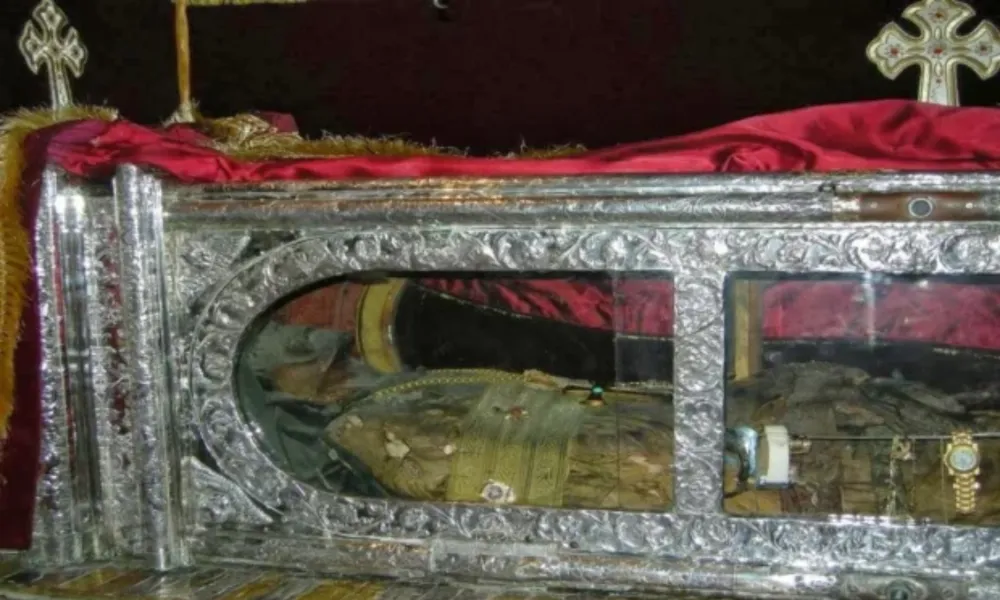
The relic of Saint Spyridon
Kyriakou also discussed the history of Saint Spyridon's Right Hand.
He noted that the saint's incorrupt relic is housed in Corfu, while the Right Hand remained outside the island for many years before being returned and placed in a separate reliquary.
According to Kyriakou, returning the relic was one of the first initiatives undertaken by the late Metropolitan Timotheos of Corfu after taking office in the 1970s.
He added that, in his view, the Right Hand should remain together with the rest of the saint's relic rather than being stored separately or transferred independently.
The transfer of the relic to Moscow, combined with the joint service involving Metropolitan Nektarios and Patriarch Kirill, has given the visit wider ecclesiastical and diplomatic significance at a time when relations within the Orthodox world remain particularly sensitive.