
Russian bombardments of the Ukrainian capital and the surrounding Kyiv region killed at least eight people in the early hours of Monday, seven of them in the city of Kyiv itself, where AFP journalists reported hearing dozens of explosions on the eve of the NATO summit in Ankara.
"The enemy is launching ballistic missiles," said Tymur Tkachenko, head of Kyiv's military administration.
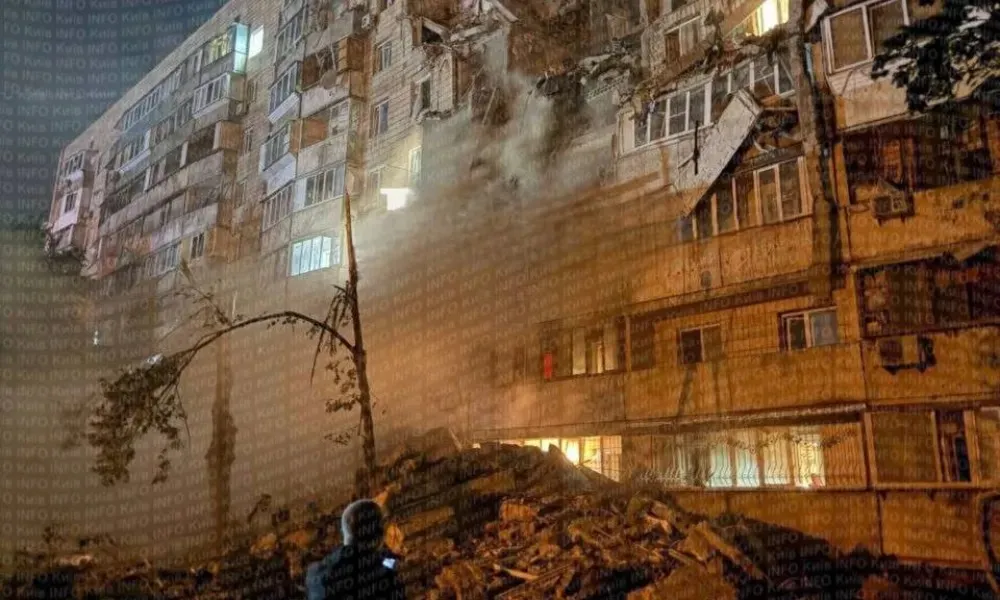
In Kyiv's Darnytskyi district, debris fell onto a 25-storey apartment block, trapping residents in flats on the upper floors, according to Mayor Vitali Klitschko. Fires also broke out on two floors of another residential building in the district.
Russian suicide drones striking are striking residential buildings in Kyiv tonight pic.twitter.com/3ueQYNQidi
— Visegrád 24 (@visegrad24) July 6, 2026
Elsewhere, in the Podilskyi district, debris that struck a 21-storey apartment building caused extensive damage, while a warehouse caught fire in the Obolonskyi district, according to the same source.
"The death toll" in the city "has now risen to seven", Tkachenko said in a later statement, without specifying exactly where the victims lost their lives. He also reported 24 injuries.
In the wider Kyiv region, in Buchanskyi district, one person was killed and ten others were injured, six of whom were taken to hospital, said Mykola Kalashnyk, head of the Kyiv regional military administration.
He accused the Russian armed forces of once again deliberately targeting civilians and civilian infrastructure.
Russia has been bombing Ukraine on a daily basis since the start of the war in February 2022.
The Russian military had previously warned it would retaliate for Ukrainian attacks involving almost 500 missiles and drones launched against Russian territory overnight from Friday to Saturday, particularly in the Leningrad region, whose capital is St Petersburg.
Last week, a wave of Russian missile and drone strikes on Kyiv killed 30 people and injured almost 100 others. It was the deadliest attack on the Ukrainian capital since the beginning of the war.
‼️The first footage of the impacts from Kyiv.
— Kateryna Lisunova (@KaterynaLis) July 5, 2026
Why are we living in a reality where there are phone calls, negotiations, and handshakes with Putin, Russians, and Russia in general?
How is it possible that, for five years in a row, Ukraine still cannot get enough Patriot air… pic.twitter.com/u61AgJfyt8
Part of Crimea without power
At the same time, power outages were reported in Sevastopol, on the Crimean peninsula annexed by Moscow in 2014, following a Ukrainian attack on energy infrastructure, according to Russian-appointed governor Mikhail Razvozhayev.
"A special regime has been implemented at various facilities, while public organisations are operating with backup power systems. Specialists are currently doing everything possible to restore electricity to homes," the governor said.
He urged residents to conserve their mobile phone batteries and noted that trolleybus services would not operate in the city of 550,000 people, which serves as the base of Russia's Black Sea Fleet.
Crimea was placed under a state of emergency at the end of June due to the consequences of repeated Ukrainian strikes, particularly fuel shortages and power cuts.
In recent weeks, Ukrainian armed forces have sought to impose an energy blockade on Crimea by targeting infrastructure and fuel tankers supplying the peninsula.
Crimea, which hosts numerous Russian military bases, is frequently targeted by Ukrainian attacks, especially using unmanned surface vessels, forcing Moscow to withdraw part of its fleet from ports on the peninsula.
Russia carried out a major attack on Ukraine's capital, Kyiv, overnight.
— OSINTtechnical (@Osinttechnical) July 6, 2026
Multiple high-rise buildings have been damaged, with the death toll already at 7 as Ukrainian rescuers attempt to dig and cut survivors out of the rubble. pic.twitter.com/3aBr91dlb8
However, this is the first time since 2022 that Crimea has faced energy shortages on such a scale.
More broadly, Kyiv has intensified attacks in recent weeks against Russia and Russian-controlled areas of Ukrainian territory, focusing particularly on energy-sector facilities in an effort to deprive Moscow of revenues that Ukraine says help finance the war.
Moscow Mayor Sergei Sobyanin said early Monday that 11 Ukrainian drones heading towards the Russian capital had been shot down.
Talks remain deadlocked
US-mediated negotiations aimed at ending Europe's deadliest armed conflict since World War II remain at an impasse.
US President Donald Trump is expected to meet Ukrainian President Volodymyr Zelensky on Wednesday on the sidelines of the NATO summit in Ankara, where leaders of the alliance's 32 member states are scheduled to gather from Tuesday.
A senior US official said the purpose of the meeting is for the two leaders to discuss "how we can end the war", describing the issue as "a priority for a long time."
At the NATO summit, European governments and Canada are expected to pledge military assistance worth €70 billion to Ukraine in both 2026 and 2027, according to diplomatic sources.
On the battlefield, Russian forces have continued to advance at a very slow pace in recent months, as the widespread use of drones has made the movement of vehicles, especially heavy ones, almost impossible and has inflicted heavy losses on both sides.
However, the Kremlin announced on Friday that Russian troops had captured Kostyantynivka, a fortress city of the Ukrainian army in the eastern Donetsk region, full control of which remains one of Moscow's principal war objectives.
Ukraine denied the claim, insisting that its forces still control the city and that fighting is continuing.