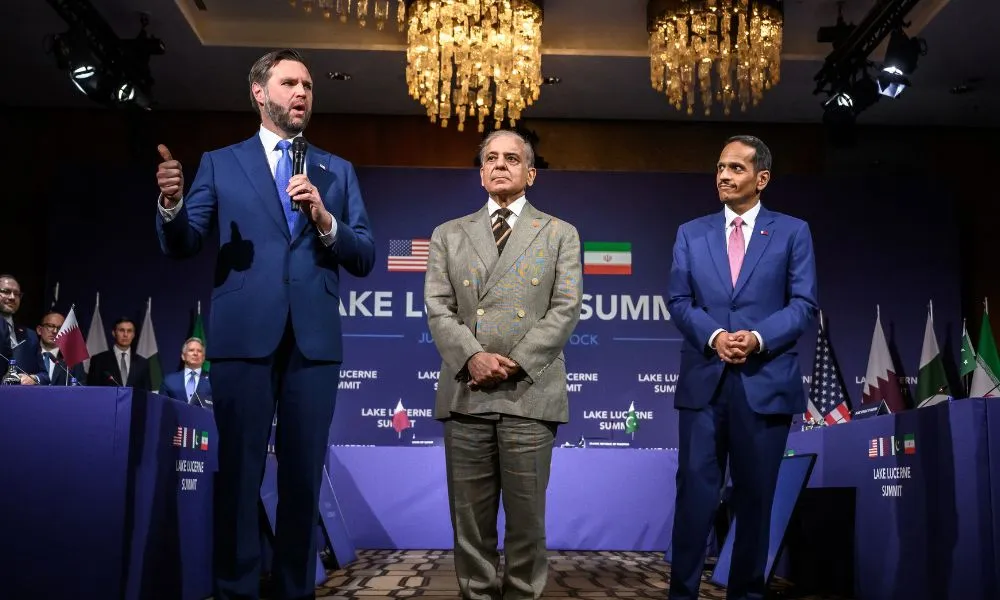
Eighteen hours of intensive talks, a temporary walkout, threats from Donald Trump during negotiations, and ultimately a note of optimism, this was the outcome of the first round of high-level talks between the United States and Iran at the Bürgenstock resort on the shores of Lake Lucerne in Switzerland.
The talks, which concluded in the early hours of Monday, mark the opening phase of a complex negotiating process that began with a memorandum of understanding signed in Versailles on June 17 by the US president and his Iranian counterpart, Masoud Pezeshkian. The memorandum provides for sixty days to reach a final agreement. The process, unstable from the outset, already shows how difficult the path ahead may be.
US Vice President J.D. Vance, who led the American delegation, described the first round as “a very, very good day” and outlined four key outcomes.
First, the creation of a communication mechanism to avoid incidents in the Strait of Hormuz, which will remain open to international shipping.
Second, an agreement to coordinate mine-clearing and restore commercial navigation in this strategic maritime corridor, which had been seriously disrupted during the conflict.
Third, the establishment of a de-escalation mechanism for Lebanon, aimed at preventing a broader military confrontation between Israel and Hezbollah.
Fourth, and most important according to Vance, Iran agreed to allow inspectors from the International Atomic Energy Agency to return to the country as a first step towards de-nuclearisation.
Unresolved issues
Despite the optimistic tone, key issues remain outstanding. Clashes between the Israeli army and Hezbollah did not stop despite ceasefire provisions. Vance acknowledged that Lebanon remains “a work in progress” and said that only the past 24 hours had been relatively calm.
According to Israeli media, the new de-escalation mechanism does not include Israel, and limits Israeli military actions to responding to “immediate” rather than “emerging” threats, a distinction with significant operational consequences.
Tensions were also heightened by Donald Trump himself, who during the talks threatened in a television interview to resume strikes against Iran if it closes the Strait of Hormuz. This prompted a temporary withdrawal of the Iranian delegation, led by parliamentary speaker Mohammad Bagher Ghalibaf. The delegation eventually returned to the table and talks continued until dawn.
Vance defended the president’s stance, saying Iran cannot expect Washington to remain silent while adopting a confrontational tone.
Nuclear issue remains central
The most critical issue, Iran’s nuclear programme, remained largely on the sidelines of the first round. Tehran clarified that only “brief discussions” took place, without addressing details.
Iranian foreign ministry spokesperson Esmail Baghaei was clear that it cannot be said that negotiations on the nuclear programme have begun.
The memorandum provides for the dilution of Iranian stockpiles of nuclear material that are close to weapons-grade levels, without clarifying how this will be implemented or whether future production of similar material will be prohibited.
At the same time, the US raised the issue of frozen Iranian funds. Jared Kushner proposed the creation of a mechanism with Qatar so that any released funds would be used for the benefit of the Iranian people rather than for financing terrorist activities.
Iranian foreign minister Abbas Araghchi said in a social media post that sanctions on Iranian oil and petrochemical exports have already been lifted, although this claim has not been publicly confirmed by the US side.
The road ahead
After the Iranian delegation departed for Tehran, technical teams from the US, Qatar and Pakistan remained in Bürgenstock to continue consultations throughout the week.
Pakistan’s Prime Minister Shehbaz Sharif described the talks as “successful” and spoke of “encouraging progress.” Swiss authorities said the parties agreed on a roadmap aimed at reaching a final agreement within sixty days.
However, analysts warn against excessive optimism. Karl Weinberg, chief economist at High Frequency Economics, said markets reacted to the initial agreement with “irrational enthusiasm” and suggested that Iran may extend negotiations well beyond the sixty-day deadline, possibly until January 2029, when a new US president takes office.
Ghalibaf also responded to US threats, stating that Iranian armed forces are “ready to respond” if the United States launches new strikes.
The road to an agreement remains long.