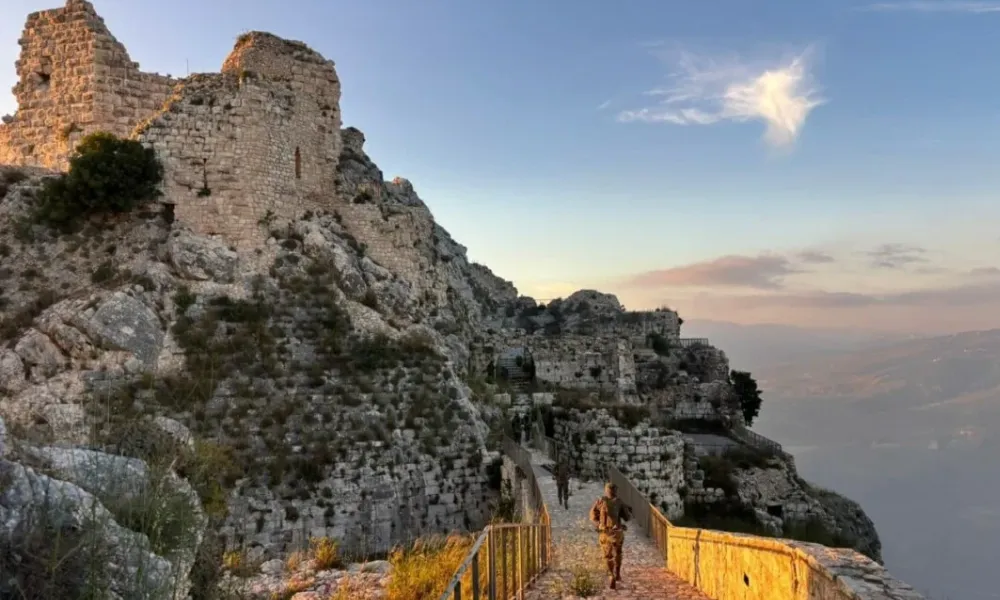

The Israeli army has seized the medieval Beaufort Castle in southern Lebanon, expanding its military operations against Hezbollah, Israel’s defence minister announced on Sunday.
Israeli defence minister Israel Katz said troops had taken control of the site today, Sunday, marking the anniversary of the Battle of Beaufort during the First Lebanon War.
44 שנים אחרי קרב הגבורה על הבופור, וביום האזכרה לחללי מלחמת שלום הגליל ובהם חיילי גולני שנפלו בקרב על הבופור - לוחמי צה"ל ובראשם חטיבת גולני, שבו אל פסגת הבופור והניפו עליה מחדש את דגל ישראל ואת דגל גולני.
— ישראל כ”ץ Israel Katz (@Israel_katz) May 31, 2026
בהנחיית ראש הממשלה נתניהו ובהנחייתי, צה"ל הרחיב את התמרון בלבנון, חצה את… pic.twitter.com/NjtlYSZqu4
“Forty‑four years after the heroic Battle of Beaufort, and today, on the day of remembrance for the fallen soldiers of the First Lebanon War (1982),” Katz said, Israeli soldiers “returned to the summit of Beaufort and once again raised the Israeli flag,” in a statement posted on Telegram.
Photographs released by Katz and video footage verified by AFP showed Israeli flags and flags of the Golani Brigade flying over the medieval fortress, as shelling echoed across the surrounding hills and plumes of smoke rose in the area.
Built on a dominant hilltop, the 900‑year‑old castle overlooks large parts of southern Lebanon, giving it significant strategic importance.
Israeli forces occupied Beaufort Castle in southern Lebanon today — the first time the IDF has been there since Israel’s full withdrawal in May 2000, 26 years ago.
— Clash Report (@clashreport) May 31, 2026
Beaufort Castle (Qala’at al-Shaqif) sits on a strategic ridge near the Litani River and has deep historical… pic.twitter.com/EVYh4s8Mom
Evacuation warning
At the same time, the Israeli armed forces issued an urgent warning calling on residents to evacuate all areas south of Lebanon’s Zahrani River, roughly 40 kilometres from the Israeli border.
“Any building used by Hezbollah for military purposes could become a target!” warned Avichay Adraee, the Arabic‑language spokesperson for the Israeli military, in a Telegram post.
“Residents of southern Lebanon must move immediately north of the Zahrani River,” he said.
Earlier, the Israeli army announced that its ground operation against Hezbollah was “expanding to additional areas”, two days after confirming that Israeli troops had crossed the Litani River.
Israeli forces appear to be preparing for a potential encirclement of Nabatieh, a city that serves as an economic hub and cultural heart of southern Lebanon. Control of the surrounding hills would give Israeli forces oversight of large swathes of southern Lebanon and the western Bekaa Valley, providing a significant military advantage.
Ceasefire collapses
A ceasefire agreed to end hostilities between Israel and Hezbollah formally came into force on 17 April, but has never been fully respected. Both sides accuse each other daily of violations and justify their attacks by pointing to the actions of the opposing side.
For many Lebanese, Nabatieh holds significance that goes beyond its strategic value. It has long been regarded as a symbol of resistance and has repeatedly found itself on the frontline of Israeli military operations, remaining deeply embedded in the political and historical memory of southern Lebanon.
On Saturday, Lebanese prime minister Nawaf Salam accused Israel of pursuing a “scorched earth policy and collective punishment”, destroying towns and villages and forcing residents to flee from the south of the country.
He warned that the situation was heading towards a “dangerous escalation” and called for an “immediate and meaningful ceasefire”.
“These actions will bring neither security nor stability to Israel,” Salam said. At the same time, he defended his government’s participation in talks with Israel following meetings between military delegations of both sides in Washington on Friday. A new round of US‑mediated negotiations is expected next week.
Salam stressed that the outcome of the talks “is not guaranteed”, but described them as “the least painful option for our country and our people”.
Sources: AFP, Guardian