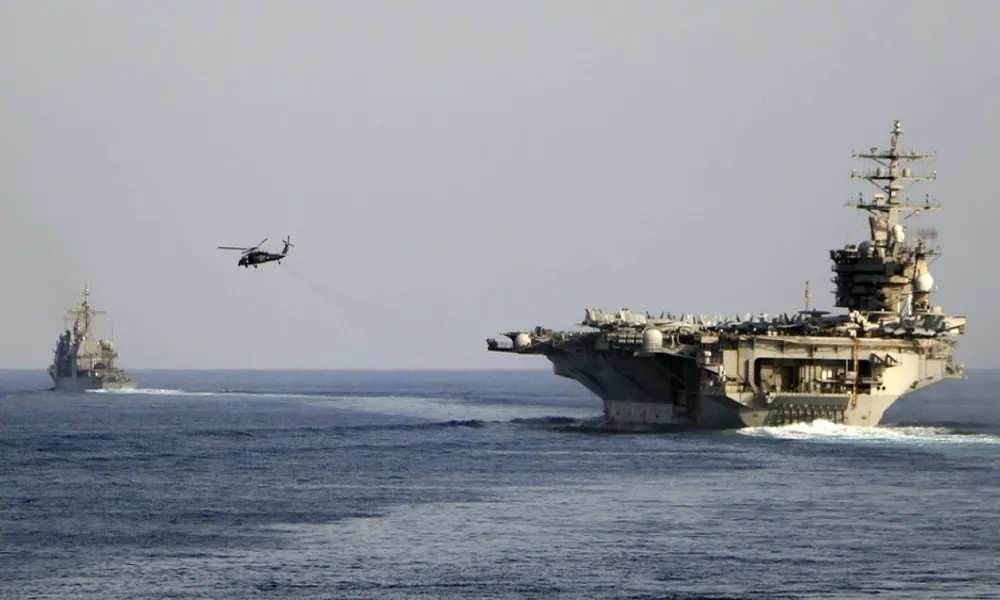

The United States fired on two Iranian-flagged oil tankers on Friday, disabling both vessels as they attempted to reach an Iranian port, while diplomats on both sides insisted that ceasefire talks were still alive. The strikes on the M/T Sea Star III and M/T Sevda, carried out by a U.S. Navy F/A-18 Super Hornet using precision munitions, brought to four the total number of vessels disabled by U.S. Central Command since hostilities intensified this week.
The attacks came a day after American and Iranian forces exchanged missile fire around the Strait of Hormuz, the narrow waterway through which 20 to 25% of the world's seaborne oil normally passes, and where roughly 1,600 ships remain stranded following Iran's effective closure of the passage after it was attacked by the United States and Israel on 28 February.
A ceasefire in name only
Both governments have maintained, against mounting evidence to the contrary, that a month-old ceasefire agreement remains in force. Iran's foreign ministry described the situation on Friday as a "nominal ceasefire," while Iranian Foreign Minister Abbas Araghchi accused Washington of choosing military action every time diplomacy appeared within reach. "Every time a diplomatic solution is on the table, the U.S. opts for a reckless military adventure," he wrote on social media, questioning whether the strikes were a deliberate pressure tactic or an attempt to drag President Trump into what he called "another quagmire."
President Trump, speaking to reporters on Thursday evening after the exchange of fire, dismissed Iranian attacks as a "trifle" and warned that Tehran should "sign their agreement fast." On Friday he told reporters he was expecting a letter from Iran that evening. "I'm getting a letter supposedly tonight," he said. "So we'll see how that goes." Secretary of State Marco Rubio, speaking from Rome after meeting Italian Prime Minister Giorgia Meloni, said Washington expected a formal response from Tehran on Friday and expressed cautious optimism. "The hope is it's something that can put us into a serious process of negotiation," he said.
At the centre of the diplomatic effort is a one-page American proposal, confirmed by three senior Iranian officials, calling for both sides to reopen the Strait of Hormuz and halt hostilities for 30 days while they work toward a comprehensive deal. A key sticking point, the officials said, is the American demand for advance commitments on Iran's nuclear programme and its stockpile of highly enriched uranium. Trump described the proposal's core requirement on Thursday as Iran agreeing it will not develop nuclear weapons and handing over what he called "nuclear dust." When asked whether Iran had agreed to that, he said yes, but added: "When they agree, it doesn't mean much, because the next day they forget."
New sanctions, oil slick, internet blackout
Washington announced a fresh wave of sanctions on Friday targeting individuals and companies in China, Hong Kong, Belarus and the United Arab Emirates accused of supplying Iran's military with drones and missiles. The move came ahead of a planned summit between Trump and Chinese President Xi Jinping in Beijing next week, with China's support for Iran a growing source of friction between the two countries. Treasury Secretary Scott Bessent has called on Beijing to use its leverage over Tehran to push for the strait's reopening, and has previously described China as sponsoring terrorism by sustaining the Iranian economy through oil purchases.
Satellite images published on Friday showed a large oil slick spreading across more than 20 square miles of the Persian Gulf off Kharg Island, Iran's primary crude oil export terminal. More than 3,000 barrels of oil may have been released, according to Orbital EOS, a global oil spill monitoring service. The precise cause of the spill remained unclear. Analysts cited the strain placed on ageing Iranian oil infrastructure by the U.S. naval blockade, the risk of leaks from tankers being used as floating storage amid a shortage of capacity, and a potentially ruptured undersea pipeline connecting Kharg Island to the Abuzar offshore oil field. Iranian state media did not report on the spill.
Iran's internet blackout entered its 70th consecutive day on Friday, with national connectivity remaining at 1 to 2% of normal levels, its most severe and prolonged disruption on record according to NetBlocks, the internet monitoring group.
Despite the intensifying conflict, U.S. financial markets largely shrugged off the tensions. The S&P 500 closed up 0.8% on Friday, recording its sixth consecutive week of gains, buoyed by stronger-than-expected jobs data showing U.S. employers added 115,000 positions last month. Brent crude settled at $101.29 a barrel, up about 1%, while average U.S. petrol prices fell slightly to $4.55 a gallon, still 53% higher than before the war began.
In Lebanon, fighting between Israel and the Iran-backed Hezbollah intensified on Friday, straining an already fragile ceasefire. Israeli airstrikes in the south of the country killed at least four people according to Lebanon's health ministry, while a number of rockets were fired into northern Israel. Iran has demanded an end to Israeli strikes in Lebanon, and any escalation there risks further complicating American diplomatic efforts to end the broader conflict.
Source: New York Times