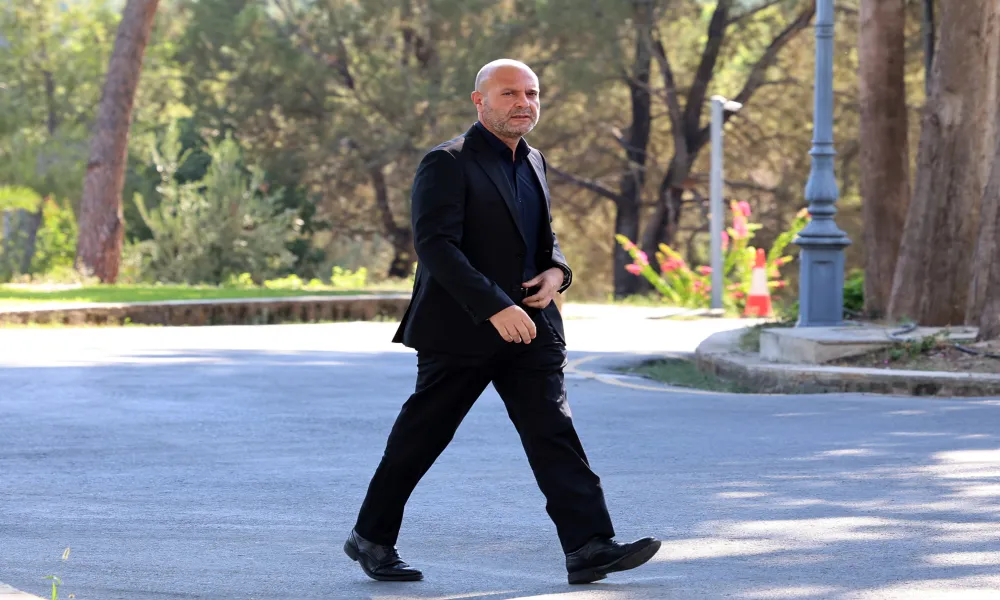

Elam is entering the race for the 2028 presidential elections openly seeking power, party leader Christos Christou has made clear, describing a party that no longer asks for others’ acceptance but sets its own terms. For months, one question has sat at the centre of the manoeuvring ahead of 2028: what Elam, which emerged as the third-largest party in May’s parliamentary elections with 10.9%, will do. In an interview with Sotiris Paroutis on the TolkersCy podcast Fuse, Christou left the final decision to the party’s congress in January, but he spelled out clearly what Elam wants and on what terms. The party is aiming for executive power, and its presence in any government would depend on the course of the Cyprus problem, a stance that shifts the dilemma onto President Nikos Christodoulides.
What Christou said
Christou rejected the term “normalisation”, which his interviewer raised several times, saying Elam “does not need normalisation from anyone, does not need legitimisation from anyone and does not need lessons in democracy.” Asked about his past involvement with Greece’s Golden Dawn, he said he held no institutional role and did not feel he had done anything against his country or his people, declining to offer the apology he was asked for. When the journalist contrasted Golden Dawn’s antisemitism with Elam’s current support for the alliance with Israel, he would only say that “there were political disagreements.”
On the role the party is seeking, he argued that a party that takes itself seriously must “participate in executive power so that it can implement part of its policies”, and that keeping Elam “forever in the corner” is what its opponents want. When Paroutis remarked that Elam was setting its sights on power, Christou replied: “But I haven’t hidden it.”
Two scenarios remain on the table, he said: running a candidate of its own or joining a broader alliance on an agreed political framework. He described Christodoulides as “a possible choice”, refusing to accept the word “most likely”, and said decisions would be taken by the party’s bodies after the congress at the end of January. The only exception he ruled out explicitly was the candidate of the left. When the journalist placed him on the same campaign platform as the president, he did not deny it, responding only with what Elam would do in the event of a disagreement on the Cyprus problem.
The Cyprus problem as a safety valve
Paroutis pointed to the contradiction of a party that disagrees with the president on a bizonal, bicommunal federation, on opening new crossing points and on friendly matches with Turkish Cypriot teams, yet is considering backing him. Christou acknowledged that Christodoulides handles the Cyprus problem in the same way as his predecessors, without having changed the framework of the talks. Against this, he set out the party’s position of “a unitary state based on the European acquis”, with no rotating presidency and the European Union as guarantor. He described as a personal initiative the proposal by Elam MP Evgenios Chamboullas to rename the Ministry of Defence the Ministry of Defence and Liberation, though he defended liberation as a strategic goal.
To the charge that Elam is putting the Cyprus problem on ice for the sake of power, he replied that the party’s participation could act “as a safety valve so that we are not led to any solution of Turkish specifications”, adding that in the event of a development it disagreed with, Elam would not hesitate for a second to walk out. As a precedent, he cited the resignation of Yiannakis Omirou as defence minister when the Clerides government failed to bring in the S-300 missiles.
Christou also rejected the far-right label, defining Elam as “a normal right-wing party” within the patriotic, nationalist and conservative right, and described Disy as a party moving very close to the centre, “not to say it has crossed the centre.” He singled out Foreign Minister Constantinos Kombos as the government’s best minister, for the alliances with Israel which, he said, by extension also concern the United States.
From necessary partner to setting terms
The government, Disy and Diko have come to treat Elam as a necessary partner. Judging by its leader’s words, the party itself now considers that it has earned its seat at the table and is setting conditions. Christou made no reference to Disy, but the wording he used formally leaves the door open to whichever candidate the party chooses on 28 November, the same day Elam elects three new vice-presidents.
The model he described on the Cyprus problem presupposes a party inside government with a pre-announced exit in case of disagreement, at a time when the president is seeking to resume talks. This places the weight on Christodoulides, who has so far avoided taking a position, while Elam has long acted as a tacit supporter of the government, disagreeing with him rarely and mainly on the Cyprus problem. Without Disy, the president necessarily needs Elam, formally or informally. On the basis of what Christou said, Elam is now asking for an agreed framework and a place in executive power, going far beyond its informal support in the second round of 2023.
Votes no candidate can ignore
Christou polls between 6% and 9% in the first-round scenarios of the recent RAI poll, figures no centre-right candidate can ignore. The president needs these votes to make it through the first round. A formal alliance, however, would bring him into conflict with Diko, with the European centre-right and with the centrist voters he also needs. With Disy in the middle of its internal contest, Christou’s description of the party as having shifted towards the centre can be read as an appeal to right-wing voters who will not identify with the winner. In foreign policy, with the alliances with Israel and the United States, Elam’s convergence with the government is already visible.
By the time of its January congress, Elam will have seen which candidate Disy chooses and how the Presidential Palace moves. Diko, which is not expected to decide before February or March, will find itself in the most difficult position, having to choose while already knowing whether backing Christodoulides means sharing a platform with a party that declares itself ready to govern and to walk out if it disagrees with a development on the Cyprus problem.