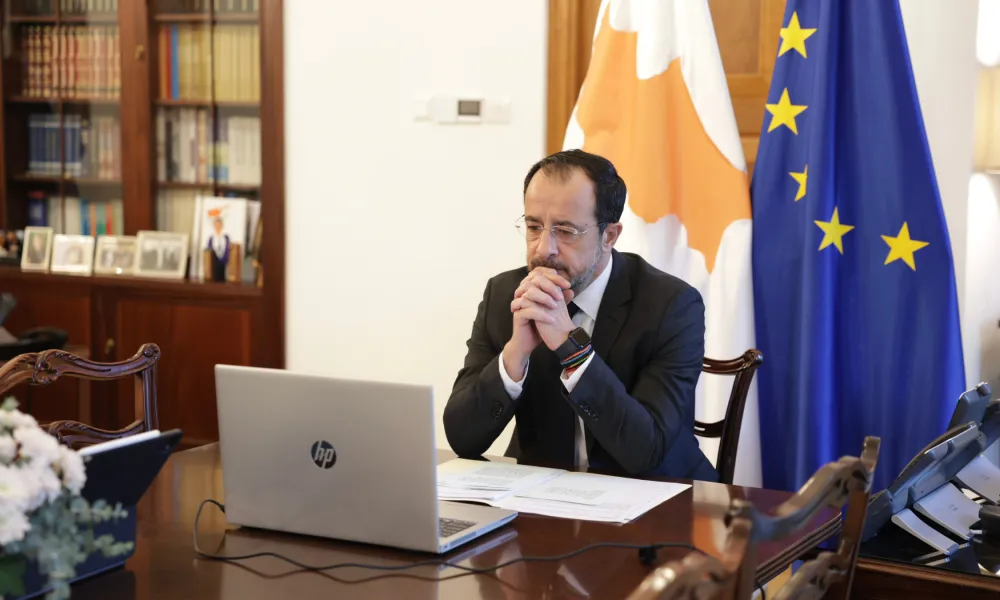

President Nikos Christodoulides continues to insist publicly that his concern at this stage is the “next generations” rather than the 2028 presidential elections, yet behind the scenes of Cypriot politics reality is moving at an entirely different pace. The president’s communication strategy, with constant appearances at local feasts, festivals and the openings of small projects, and his instruction that officials seconded to various ministries prepare speeches for every occasion so that he delivers them himself, rather than ministers or ministry officials, reveals an intensive preparation that points to an election campaign more than to the purely institutional exercise of his duties. In short, there is no need for the President of the Republic to rush, for example, to the opening of a small futsal pitch in a small community. Nor does it do the president any good to repeat every so often that he stands outside pre-election logic, when in substance he has proven, and continues to prove, that he is the master of electoral calculation.
A search for political footholds
The climate is heated enough, despite the president’s effort to present himself as a politician of a different caste, interested only in the “next generations”. In reality, Christodoulides faces a complex equation in his search for reliable political footholds for his re-election bid, at a time when the parties of the centre and the right are redefining their strategies while awaiting developments inside Disy. The president’s biggest minefield in securing a smooth campaign for re-election, free of too many obstacles, concerns the far-right Elam and the way it affects his relations with Diko, the party that, if not the backbone of the government, holds key ministries. Throughout its history, Elam has followed an independent course in the first round of presidential elections, building its political reach and limiting itself to selective support or refusal in the second round. Ahead of 2028, however, there are signs that some circles within Elam want to move differently. This mainly concerns officials who moved from Disy to broader far-right options and found a political home in the party. Given its strength, which now exceeds 10%, one of the questions under consideration within Elam is whether this time to pursue an open approach to, and support for, Christodoulides even from the first round, with the aim of immediate institutional legitimisation and a share in government.
Diko’s red line
This possibility immediately triggers the reflexes of Diko and of Nikolas Papadopoulos personally. The Diko leader, as some party officials claim, has made clear to the president, in the strictest terms, that his party will under no circumstances identify or align itself with Elam. Papadopoulos has made it plain that if Elam moves to back Christodoulides from the first round and the president accepts, Diko’s support for his candidacy on the first Sunday of the elections becomes completely impossible. This clear warning adds enormous political weight and an insurmountable difficulty to the president’s calculations, as he watches his main party ally draw a red line of principle, as Diko wishes to present it, that leaves no room for misinterpretation.
The president’s calculations
Christodoulides knows very well, on the other hand, that a path without the support or tolerance of the far right carries serious risks. The parties that backed him in 2023 are today recording combined losses of around 8–9% as party formations. While this does not automatically translate into the loss of all those voters, the absence of a strong current in the first round could leave him out of the second Sunday, turning the acceptance or rejection of Elam into a knife-edge tug of war. If he rejects Elam to satisfy Papadopoulos and Diko, he risks losing critical percentages; if he accepts it, he loses Diko and the moderate centrist base for good. At this critical crossroads, Christodoulides is forced into a delicate balancing act. His approach to Diko can no longer rest on alliances taken for granted, since the centrist party, aware of the difficulties and the pressures, is keeping channels open in other directions. Diko will not stay idle and is already examining alternative scenarios, including exploring an understanding with Akel around an independent candidacy of its own and behind-the-scenes consultations with the Disy candidate who will emerge from the party’s internal elections, which enter the final stretch on Monday. One of the main scenarios Diko is working on is a direct bid for power with its own candidate, so that it appears in the second round as the core of a new coalition government, with its leader claiming an enhanced institutional role.
The tactic and Disy
To head off such a flight by Diko and manage Papadopoulos’ stance so far, Christodoulides is trying to keep a low-key balance, avoiding formal commitments while maintaining contacts with figures from all the political camps and tendencies that backed him in the last election. The effectiveness of this tactic, however, depends to a great extent on developments inside Disy, which is moving these days to the intense rhythm of its internal processes and the elections to choose the figure who will receive its presidential nomination. At the party’s Pindarou Street headquarters, optimism prevails that a smooth, democratic and transparent vote will, if not act as a catalyst, at least reduce internal tensions, suspending the party’s introspection and rallying the wider party for the great battle of the presidential elections. If Disy manages to heal the wounds that have plagued it since the campaign for the 2023 presidential elections and at the same time stem the leaks towards the president’s camp, Christodoulides will find himself in an extremely difficult position, deprived of a significant part of the traditional right-wing base that backed him last time. If, on the other hand, Disy’s internal elections leave strong after-effects that weigh on the campaign of whoever wins, the president will have room to keep penetrating the party’s middle and upper ranks, weakening party discipline at the ballot box, as he did in 2023.
Back to earth
In short, Christodoulides is moving through a mined political landscape on the one hand, and on the other through an environment that works on his own terms, since he enjoys freedom of movement from within the power structure of the state. His declarations of care and concern for the “next generations” and his constant presence in the spotlight through daily institutional and communication activity serve a dual purpose. He seeks to project himself as a leader above petty party calculations, something he says though he hardly believes it, while anxiously managing the future of his alliances. With Elam considering moves from the first round, Papadopoulos waging an unyielding fight, drawing strict red lines that keep the far right away from his party and looking for alternative exits, and Disy trying to heal its internal wounds, the balances are more fragile than ever. Politics, of course, is often decided by unforeseeable factors. It is actions and real alliances that determine survival, not rhetorical disavowals. Christodoulides is good at such disavowals, but his opponents now know his tactics and will respond accordingly. What society has yet to see is whether, beyond the backroom manoeuvring over the make-up of political formations and alliances ahead of the presidential elections, the parties will address the real problems facing society or remain on the surface of the issues.