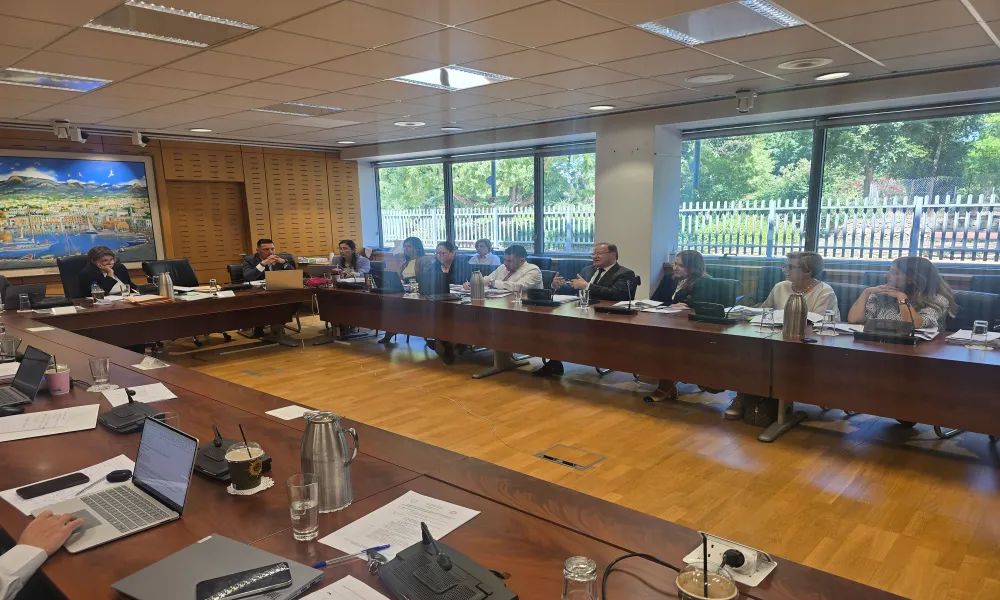



The creation of effective control mechanisms within the framework of the financial autonomy of the House of Representatives was at the centre of Wednesday's meeting of the Parliamentary Institutions Committee.
The committee's chair and Disy MP, Demetris Demetriou, said the aim was to create a mechanism that would strengthen transparency and the smooth operation of Parliament.
Charalambidou: A double obligation for self-control
The issue's rapporteur, Alma MP Eirini Charalambidou, noted that, despite having financial autonomy since 2019, the House must establish management mechanisms similar to those operating in other public institutions. As she said, it has a double obligation to implement self-control and good governance mechanisms.
Charalambidou stressed that internal control is intended to protect both employees and politicians, since the House is a political environment with particular power. She added that disciplinary procedures should also be provided for cases in which information is not supplied to Parliament's internal audit service, something that does not apply today. "If we want to honour the law on financial autonomy, the provisions of the Constitution must be fully met," she said.
The other Alma rapporteur, Odysseas Michaelides, distinguished financial autonomy from the view that the House has its own fund, since every payment is made by the Accountant General of the Republic. He proposed the legal establishment of a small internal audit service, which would also be able to turn to external services, along with an obligation to provide information to the internal auditor, who should be institutionally accountable to a body within the House that is independent of the administration.
House administration open to reform
Deputy Director General of the House Andreas Christodoulou said there was, in principle, no opposition to transparency and internal control. He said the House already has an Internal Audit Officer and expressed his readiness to provide information on problems or difficulties concerning Parliament's operation as an organisation of politicians and public servants. He noted that a bill on rationalisation and internal control remains pending before the Institutions Committee, and could provide elements for drafting the proposed legislation, adding that weaknesses had been identified when he assumed his duties and that efforts to rationalise operations had already begun.
Director of the House's Financial Management Service Marios Papapolyviou described internal control as an aspect of financial independence, suggesting it might be preferable for it to be established through regulations rather than legislation, so that it could be amended more easily in line with developments.
Director of the House's State Budget, Strategic Planning and Human Resources Service Maria Tsiakka said that strategic planning is followed by operational plans for each service, allowing internal control to monitor workflows, and noted that the first operational plan was almost complete.
Auditor General and Accountant General weigh in
Auditor General Andreas Papaconstantinou said internal control also supports external auditing, noting that the Audit Service's latest audit of the House took place in 2024. He stressed the importance of cooperation between the internal auditor and the House's Director General, as well as balancing the House's needs with safeguarding its autonomy, and referred to the weakened role of internal audit officers elsewhere in the public service, who report to the Director General of the relevant ministry.
Accountant General Andreas Antoniades said the House's autonomy entails strengthened control mechanisms in all areas, particularly the first line of control concerning the administration, calling for a clear allocation of duties and closer cooperation with the Internal Audit Service. He also proposed the creation of an audit and governance committee under the President of the House, comprising the chairs and members of the relevant committees, as well as the preparation of an annual report to monitor the action plan for implementing control procedures.
On behalf of the Ministry of Finance, Director of Accounting Services Marios Hadjidamianou agreed with the proposals, saying there is an institutionalised procedure for budget matters that should derive from strategic planning and the spending ceilings set by the Ministry of Finance. Representatives of the Internal Audit Service highlighted the importance of strategic risk analysis and planning, noting that the foundation of an internal control mechanism should be international internal audit standards adapted to the needs of the House.
Bill expected 'in the coming weeks'
After the meeting, Demetriou said all participants had welcomed the need for control mechanisms and lines of control. "These lines operate in the House, but they certainly need strengthening, and we all reached the conclusion that safeguarding this service through legislation or regulations is more than necessary. Therefore, in the coming weeks a bill will be submitted precisely to strengthen Parliament's internal control mechanism," he said.
The committee chair also stressed that the House must be able to discuss matters concerning its own operation, just as it examines and discusses issues relating to other services and ministries. Asked about a broader bill that remains pending, he said it had not previously been discussed because, as he understood it, there had been no willingness to justify and support it. He said that willingness now existed, and that the new bill would focus specifically on internal control, while other issues covered by the original proposal could also be discussed if there was the relevant political will.
Charalambidou said the Institutions Committee, under Demetriou's chairmanship and with its current composition, had advanced important bills guided by transparency and good governance, including legislation on asset declarations and lobbying. "An organisation such as Parliament, which has financial autonomy, is doubly obliged to have the necessary mechanisms of internal control, self-regulation and accountability," she said.
She noted that since 2019, when financial autonomy was approved, constitutional provisions had also existed on internal control matters, adding that the procedural aspect of the issue within Parliament had shown weaknesses which the Director General had indicated he was willing to correct. The mechanisms of control, she said, also safeguard management staff and employees in a strongly political environment.
Charalambidou said Alma intended to submit a bill on 8 October to regulate the issue, describing as important the interventions made by the Accountant General, who she said submitted a substantive memorandum, as well as those by the Auditor General and the Ministry of Finance. "I think we now know how we will proceed, but what is important is that the majority of committee members demonstrated the necessary political will to move in this direction," she concluded.
Source: CNA