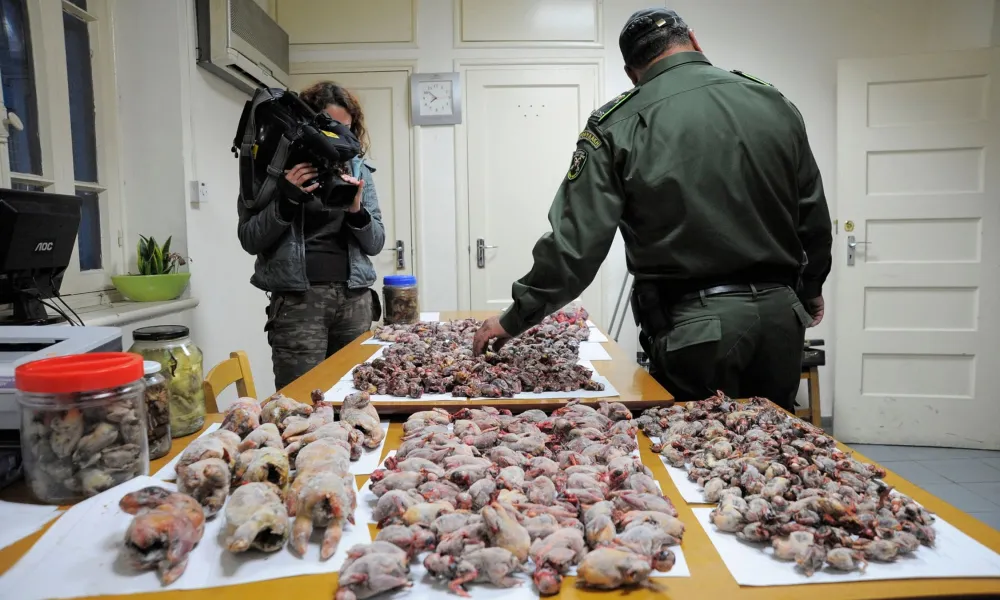



Poaching is estimated to generate more than €10 million a year, according to the Head of the Game and Fauna Service, Pantelis Chatzigerou, who made the statement before the Parliamentary Environment Committee, confirming a figure previously cited by environmental organisations.
During the committee's second meeting on the impact of the activities of specific activist organisations and activists, members also discussed strengthening the Anti-Poaching Unit and the need for effective measures to prevent and combat poaching.
Repeat offenders treat fines as a cost of doing business
MPs and guests said that between five and 10 "known and repeat" poachers operate professionally, treating fines as part of their operating costs. It was argued that the penalties currently in place are not strict enough, and it was reported that a bill to toughen them would soon be submitted, including provisions for the confiscation of a hunting gun or driving licence.
AKEL MP Nikos Ketturos referred to repeated offences by major poachers, citing the case of a trapper who was reported seven times in one year, fined €13,500, paid the fine and was reported again a week later. He also referred to cases in which members of the Forestry Department had themselves been reported by the Game Service, saying they take advantage of their position and access.
Disputes over police handling of activist complaints
Committee chairman and ELAM MP Linos Papayiannis presented cases in which, he said, police had not accepted complaints by lawful hunters or property owners against activists. Deputy Chief of Police Michalis Katsounotos requested specific information so the incidents could be investigated.
ELAM MP Linos Chatzigeorgiou asked why testimony against activists concerning illegal entry, harassment and surveillance was not accepted, and questioned whether a previous statement by a police representative, that all complaints against activists came from poachers, was accurate. Katsounotos replied that he did not have the relevant information, but said he could not contradict the representative if that statement had indeed been made.
Alma MP Litsa Drousiotou asked whether there was specific problematic conduct by activists not already covered by existing legislation, and requested data on the number of complaints filed against them. Immediate Democracy MP Yiannis Laouris said existing penalties were insufficient to stop poaching, telling the committee it was spending too much time on "something that must be resolved immediately," and asked for concrete proposals.
Police cite a 'difficult year' amid other pressures
Responding to MPs, Katsounotos said police were called upon to enforce the law, identifying as a key problem the fact that poachers frequently do not pay out-of-court fines, meaning cases proceed to court, where lower fines are imposed and payment in instalments is often allowed. He said police action on the issue may not have been as intensive this year as in previous years, describing it as a "difficult year" for the force given increased responsibilities linked to the Cyprus Presidency and patrols for foot-and-mouth disease. On the Anti-Poaching Unit, he said there was flexibility to temporarily reinforce it with a larger force from MMAD, based on information, complaints and reports received.
Calls for asset freezes and tougher sanctions
Disy MP Andreas Konstantinou proposed freezing poachers' assets. Katsounotos said that in cases involving systematic profit-making activity, an order to freeze assets could be requested. Chatzigerou said freezing assets was necessary to stop the organised trapping of blackcaps, and explained that while the law provides for out-of-court fines corresponding to the seriousness of an offence, some offenders choose not to pay and instead ask the court to hear all their cases together, resulting in a significantly lower combined fine.
"All cases of poaching are repeat cases," Chatzigerou said, noting that out-of-court fines had helped stop most ordinary people from poaching, but that professionals do not stop. He cited a group of poachers in Androlikou that, he said, hunts hares illegally every night and continues to be reported without interruption. He argued that a more drastic solution was needed and proposed that the Director of the Game Service be given the power to recommend the withdrawal of an offender's hunting gun or driving licence. On the subject of activists, Chatzigerou said there was a gap in the legislation, warning that the Service had prepared legislation to protect lawful hunting and cautioning that "a hunter will pull the trigger" if nothing is done.
Hunters and environmental groups push back
A representative of the Cyprus Hunting Federation said the organisation cooperated closely with environmental groups and did not target activists, stating that the Federation's priority was to safeguard hunting activity while supporting efforts to combat poaching within the framework of legality.
Koula Michael of Terra Cypria said everyone was equal before the law, but argued that organisations or individuals working for the effective enforcement of environmental legislation should be protected rather than targeted by the authorities. She said the Game Service's own complaints had originated from reports made by activists, and that in court cases where members of environmental organisations had appeared, they had been acquitted while poachers had been convicted, with activist witnesses deemed credible and contributing to those convictions.
Marina Grigoriou, representing the Federation of Environmental Organisations of Cyprus, said lawful and peaceful environmental activism was not a problem requiring restriction, warning that the way the issue had been placed on the committee's agenda risked the collective targeting of activists. "Freedom of speech and the right to express themselves must not be restricted," she said. She argued that no measures should be taken without proper documentation of the problem, and identified environmental protection, stronger controls, staffing of the Anti-Poaching Unit and coordination among the competent authorities as the key issues requiring attention.
Melpo Apostolidou of BirdLife Cyprus said that when offences are committed, a lawful reporting procedure already exists. She said her organisation had been legally collecting data on illegal bird trapping since 2002, forwarding it to police, the Game Service and the British Bases, and had submitted 79 reports over the past three years, of which 25 had led to criminal prosecution. Citing Game Service data, she estimated that 726,000 birds are trapped in Cyprus every year, a figure Chatzigerou disputed, though he agreed that illegal revenues could currently exceed €10 million. She called for tools with real consequences for systematic trappers, noting that the British Bases have the power to confiscate cars and guns from offenders.
Paralimni Deputy Mayor Cleanthis Koutsoftas said the municipality had received numerous complaints about individuals moving around properties, using cameras and monitoring citizens, causing fear among residents, and said such complaints were referred to police. He also criticised the participation of environmental organisations in municipal consultations on development matters, arguing that "NGOs cannot act as competent authorities on development and urban planning issues," a comment that drew reaction from the organisations present.
Chatzigeorgiou referred to a specific organisation he said had engaged in illegal activities, and asked the environmental groups whether they were concerned about being collectively targeted. Effie Xanthou of the Federation of Environmental Organisations replied that any sense of targeting stemmed from how the issue had been placed on the committee's agenda by a specific party, rather than from the conduct of other organisations.
Chairman vows to keep up pressure
After the meeting, Papayiannis said he had submitted information to state services regarding the activities of a specific activist organisation, whose members, he claimed, were paid monthly for testimony in court while presenting themselves as independent activists. "We will continue to put pressure until the phenomenon stops," he said, adding that meetings with ministers would follow. He argued that the number of serious poaching cases, no more than 10, did not justify treating the issue as a major problem, saying the authorities already know who is responsible.
Ketturos said it had been established that the money circulating through poaching exceeds €10 million a year, arguing that the competent authorities must find an effective way to address it. Drousiotou stressed that no one is above the law and described repeat offenders as a serious issue, pointing to a legislative gap that allows the same individuals to be reported again and again without consequence.
Source: CNA