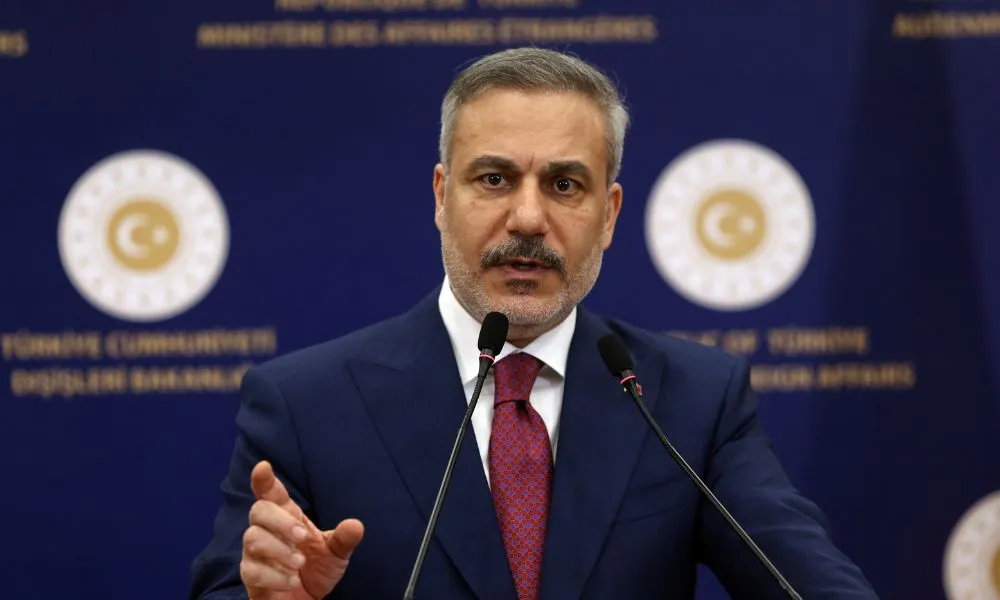

Turkey's Foreign Minister Hakan Fidan has claimed that the Greek Cypriot side is blocking efforts to modernise the Customs Union between Turkey and the European Union, despite what he described as broad support for the move among EU member states.
Speaking at a joint press conference in Ankara with Kyrgyz Foreign Minister Jeenbek Kulubaev following the seventh meeting of the Turkey-Kyrgyzstan Joint Strategic Planning Group, Fidan discussed Turkey's relations with the EU, the Cyprus issue, the Organisation of Turkic States and the upcoming NATO summit.
Isolation of TCs
Fidan said both Turkey and the EU wanted to update the Customs Union but claimed the process had stalled because of the stance of the Republic of Cyprus, which he referred to as the "Greek Cypriot side".
"Because the Greek Cypriot side is blocking this issue, the necessary steps cannot be taken at the desired pace," he said.
He argued that while an individual member state can use its position to block decisions in other policy areas, "the overwhelming majority" of EU member states support updating the Customs Union.
Fidan said he and Kulubaev had also discussed efforts to end what he described as the "unjust isolation" of Turkish Cypriots, calling them "an inseparable part of the Turkic world". The talks also covered the war in Ukraine and the risk of further regional escalation.
EU membership
Describing the Organisation of Turkic States as the embodiment of the "common will of the Turkic world", Fidan said Turkey wanted the organisation to become more institutionalised and effective.
Referring to recent meetings in Ankara with EU High Representative Kaja Kallas, European Commissioner for Enlargement Marta Kos and European Commissioner for Internal Affairs and Migration Magnus Brunner, Fidan described the visit as "an important milestone".
He reiterated that Turkey's full membership of the European Union remains one of Ankara's strategic objectives and said President Recep Tayyip Erdoğan had a "strong commitment and vision" for the country's European path.
According to Fidan, relations between Turkey and the EU have recently become more constructive, with high-level dialogues resuming on the economy, trade, migration, security, science and technology.
Ongoing wars
He added that the European Investment Bank had partially resumed its activities in Turkey and that discussions were continuing on Ankara's interest in joining the Single Euro Payments Area (SEPA).
Fidan said talks with the EU delegation also covered foreign policy, energy, transport, trade, migration and visa liberalisation. He argued that the EU recognises Turkey's strategic location, infrastructure and potential role in strengthening transport and supply links between Europe and Asia.
The discussions also addressed new transport and logistics corridors, as well as the wars in Ukraine and the Middle East, Iran, the Strait of Hormuz and Israel's regional policies.
Fidan said Turkey maintains "very good" bilateral relations with most EU member states, although he acknowledged that this was not always reflected in decisions taken by EU institutions.
He added that Turkey would continue working to overcome those obstacles.
Fidan also said Turkey would host both an upcoming NATO summit and the annual summit of the Organisation of Turkic States in Ankara, describing the events as further evidence of the country's strategic importance.