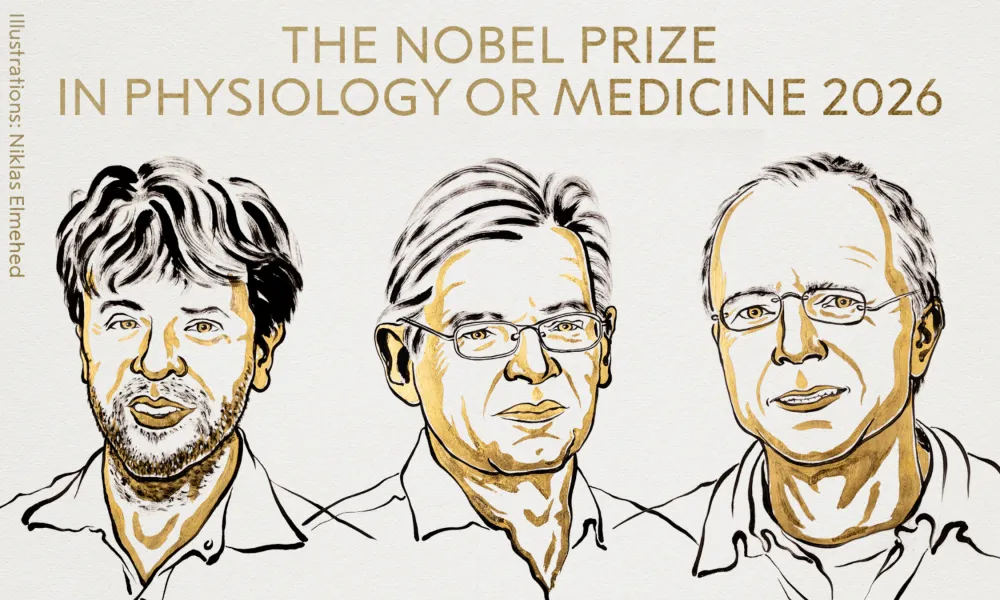

Scientists Karl Deisseroth, Peter Hegemann and Georg Nagel have been awarded the 2026 Nobel Prize in Physiology or Medicine for their discoveries concerning light-sensitive ion channels and the development of optogenetics.
The Nobel Assembly at Sweden's Karolinska Institute announced on Monday that Karl Deisseroth, Peter Hegemann and Georg Nagel had been selected for this year's award in recognition of their pioneering work in a field that has transformed neuroscience research.
The three scientists will share the prize money of 12 million Swedish kronor (approximately $1.2 million), which is divided among multiple winners when more than one recipient is selected.
Controlling brain cells with light
According to the Nobel committee, optogenetics makes it possible to activate or deactivate individual nerve cells within a living brain using light.
“The method now allows researchers to switch specific neurons on and off inside a living brain,” the committee said.
The technique has become a powerful tool for scientists seeking to understand how the brain functions and how neural circuits influence behaviour, memory, movement and disease.
Today, optogenetics is used in research laboratories around the world to investigate some of neuroscience's most fundamental questions.
A major breakthrough in neuroscience
The work of the three laureates focused on identifying and developing light-controlled ion channels, biological mechanisms that respond to light and can be used to precisely control the activity of cells.
Their discoveries laid the foundation for optogenetics, a technology widely regarded as one of the most important advances in modern brain research.
Nobel season begins
The Medicine Prize traditionally opens the annual Nobel Prize announcements.
It will be followed this week by the prizes in:
- Physics
- Chemistry
- Literature
- Peace
- Economic Sciences
Historic award
Over the past century, the Nobel Prize in Physiology or Medicine has recognised some of the most significant scientific breakthroughs in history.
Previous recipients include Alexander Fleming, honoured in 1945 for his work on penicillin, and Karl Landsteiner, who received the prize in 1930 for discovering human blood groups.
Last year's award went to Mary Brunkow, Fred Ramsdell and Shimon Sakaguchi for research that improved understanding of how the immune system protects healthy cells, paving the way for potential new treatments for diseases including cancer.
Source: ANA-MPA / Reuters