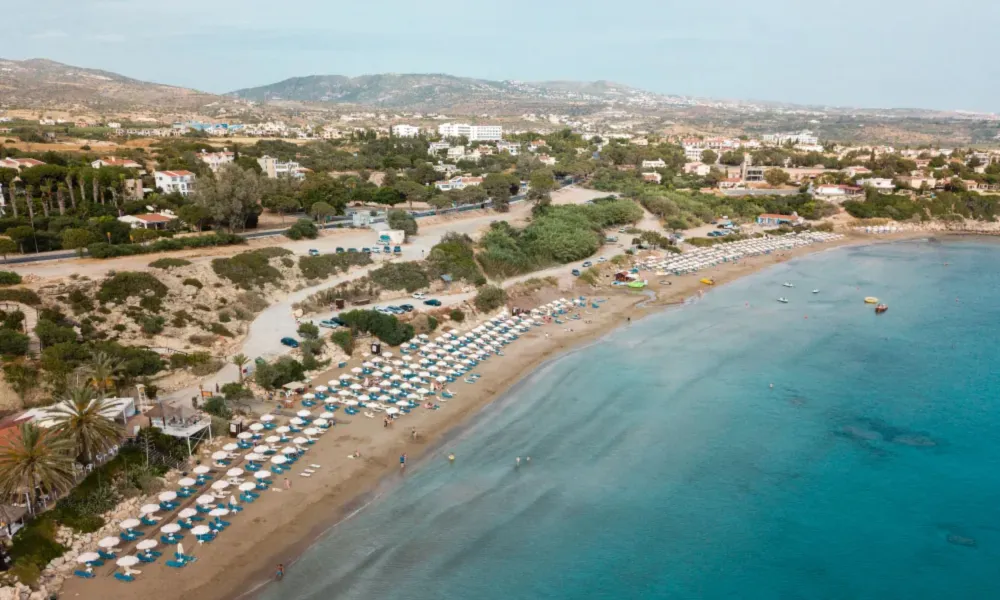

Akamas Municipality is moving forward with plans to install 220 submerged concrete units off Coral Bay as part of a pilot project aimed at addressing coastal erosion.
The project involves the placement of the structures at a depth of approximately four metres, over a length of around 100 metres, and at a distance of 115 to 130 metres from the shoreline.
The initiative was outlined in tender documents published this week, with bids due by 18 September.
The project, valued at €280,000 excluding VAT, is being funded through the Interreg Greece-Cyprus 2021-2027 cross-border cooperation programme, co-financed by the European Union through the European Regional Development Fund and national resources from Cyprus and Greece.
It forms part of the ECO-BEACHTECH project, in which Akamas Municipality is a participating partner.
According to the tender documents, ECO-BEACHTECH was designed to help coastal areas adapt to climate-related risks, including flooding and shoreline erosion, through integrated assessments, evaluation of protection measures and the pilot implementation of nature-based solutions.
Multiple objectives
Beyond addressing coastal erosion, the artificial reef is intended to:
- Improve marine habitats and enrich marine biodiversity.
- Support the development of marine fauna.
- Offer opportunities for recreational diving and snorkelling.
- Facilitate scientific research.
- Raise public awareness about coastal protection.
- Promote environmental education.
Construction and installation
The contract will run for 11 months, comprising five months of implementation and six months of liability and maintenance obligations.
Under the project:
- 200 concrete reef units will be manufactured by the successful contractor.
- 20 smaller submerged concrete units will be produced by the Eratosthenes Centre of Excellence at the Cyprus University of Technology (CUT) using 3D-printing technology.
The units will be installed in water approximately four metres deep and arranged across a section roughly 100 metres long.
Tender specifications state that the area occupied by the installation will be clearly marked and delineated for navigational safety, public access and project protection purposes.
The contract covers the manufacture and deployment of the submerged concrete units, as well as the marking of the marine area through appropriate signage and buoys.
Specialised floating equipment will be used to transport and safely place the structures in a predefined layout near the coast and at depths of less than five metres.
Marker buoys will be attached to concrete bases and positioned at the four corners of the installation, together with two intermediate markers.
Upon completion, all navigation and boundary markers must be properly aligned.
Testing 3D-printed "smart reefs"
According to the Interreg Greece-Cyprus programme, ECO-BEACHTECH is being implemented through a partnership involving:
- University of the Aegean (Lead Partner)
- North Aegean Regional Development Fund
- Eratosthenes Centre of Excellence, CUT
- Akamas Municipality
The project aims to deliver both practical coastal protection measures and new scientific knowledge.
Among its planned activities are:
- Pilot installation of artificial reefs.
- Experimental construction of artificial reefs using 3D-printing technology.
- Comparative studies on the ability of different reef designs to attract marine organisms.
- Mapping and assessment of underwater sand deposits.
Researchers hope the work will contribute to the development of new forms of "smart reefs" while improving understanding of their environmental performance.
Field studies already completed
Preparatory work in Coral Bay was completed last November.
According to information published by the programme, collaboration between the University of the Aegean and the Eratosthenes Centre of Excellence generated important baseline data through a series of field studies.
These included:
- Reef design studies, involving detailed topographical, bathymetric and morphological surveys to identify the most suitable location for environmentally friendly artificial reefs.
- High-precision mapping, using drone surveys, RTK GNSS receivers and terrestrial laser scanners to create detailed models of the nearby coastal cliff.
- Wave monitoring, including hydrodynamic experiments and the installation of wave-recording equipment to collect data during winter conditions.
- Partner coordination meetings, focused on advancing licensing procedures and technical preparation for the project.
The data collected are expected to support both the design of the artificial reef system and future coastal management efforts in the Coral Bay area.