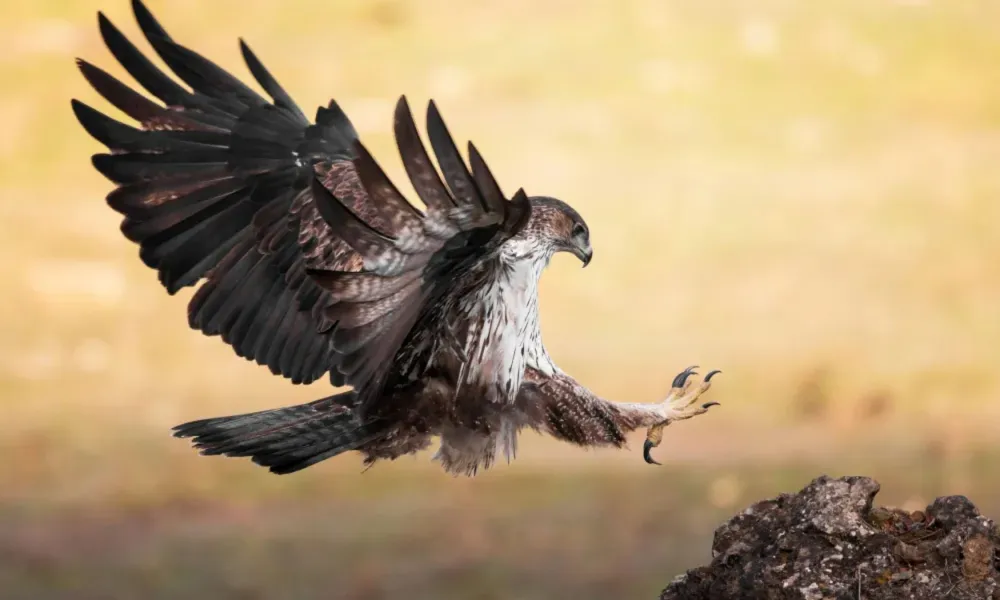

A new partnership bringing together six organisations aims to strengthen the protection of three emblematic birds of prey in Cyprus: the Griffon Vulture (Gyps fulvus), the Bonelli's Eagle (Aquila fasciata) and the Long-Legged Buzzard (Buteo rufinus).
The Raptors for LIFE project, which is scheduled to officially begin in October 2026 with 60% co-financing from the EU LIFE programme, is being implemented by BirdLife Cyprus as lead partner, together with the Game and Fauna Service of the Interior Ministry, the Portugal-based Vulture Conservation Foundation (VCF), the Electricity Authority of Cyprus (EAC), the Cyprus Police and the State General Laboratory.
Through this five-year initiative, the partners aim to secure the long-term conservation of the island's three largest birds of prey by addressing the main threats responsible for high mortality rates, including poisoned baits, electrocution and collisions with electricity transmission and distribution infrastructure, shooting, and drowning in open water reservoirs.
Building specialist expertise
Nicos Kasinis, senior officer at the Game and Fauna Service, highlighted the significance of involving the EAC, Cyprus Police and the State General Laboratory in a biodiversity protection programme for the first time.
He told Politis that these organisations will gain additional expertise in raptor conservation through cooperation with foreign organisations possessing extensive experience in the field.
Role of the EAC
Kasinis noted that electricity companies in countries such as Portugal and Spain, where the Vulture Conservation Foundation is active, work closely with government agencies and conservation groups to reduce bird deaths caused by electrocution and collisions.
He said the EAC will have an opportunity, through the VCF, to engage directly with foreign electricity providers that have developed advanced solutions to these problems, allowing it to strengthen its own technical knowledge.
Police and State General Laboratory
Kasinis said similar benefits are expected for the Cyprus Police and the State General Laboratory, both of which are regarded as key partners.
"The Police have a very important role to play in investigating serious cases involving either poisoning or the shooting of protected species," he said.
Under the programme, police laboratories are expected to receive technical support and training so that investigators can prepare wildlife crime cases to a standard capable of supporting successful prosecutions in court.
The State General Laboratory is also expected to benefit through improved capacity to analyse animal samples for traces of poisons and rodenticides, which pose a significant threat to birds of prey.
The project includes international study visits, training programmes and workshops led by foreign experts.
"Therefore, we regard this project as a step forward for all of us, and especially for organisations participating in biodiversity protection programmes for the first time," Kasinis added.
Vulture population remains critically low
Cyprus' Griffon Vulture population remains in a particularly fragile condition, numbering just 37 birds.
In recent years, poisoned baits and electrocution have emerged as the two most significant threats to the species' survival.
The Bonelli's Eagle, the only eagle species still nesting in Cyprus, remains vulnerable to persecution, poisoning and risks associated with energy infrastructure.
Meanwhile, the Long-Legged Buzzard, although it has expanded its range across the island in recent decades, continues to face serious threats from shooting, electrocution, collisions and drowning, all of which require further scientific study.
Building on previous projects
The new project builds on the achievements of two recently completed programmes, LIFE with Vultures and LIFE Bonelli's eastMed.
Those initiatives contributed significantly to the protection of the Griffon Vulture and Bonelli's Eagle, while improving understanding of the causes of mortality affecting both species and the impact of those threats on their populations.
In the case of the Griffon Vulture, the population was strengthened through the transfer and release of birds from Spain. The projects also enhanced cooperation among authorities responsible for preventing and combating the illegal use of poisoned baits.
Target population of 200 vultures
One of the goals of Raptors for LIFE is the introduction of additional vultures to Cyprus.
According to Kasinis, a population of 37 birds cannot be considered secure.
"We consider 200 individuals to be the safe population level, provided that the population includes dozens of breeding birds. Therefore, we still have a long way to go," he said.
Through the Vulture Conservation Foundation, additional vultures had already been brought to Cyprus from Spain during the implementation of the LIFE with Vultures project.
For the first time in several years, those efforts resulted in the re-establishment of a breeding population on the island.
Three pairs successfully produced chicks this year, marking the first such breeding success in many years.
Planned actions
The Raptors for LIFE project will implement a broad range of targeted actions, including:
- Strengthening expertise in poison detection through new equipment and specialised training.
- Identifying previously undetected toxic substances in poisoning incidents to address emerging threats.
- Providing scientific evidence to support criminal investigations and prosecutions involving wildlife poisoning.
- Expanding measures against the illegal use of poisoned baits and establishing an additional poisoned-bait detection unit with a specially trained dog.
- Tagging and monitoring birds using GPS transmitters.
- Modifying dangerous sections of the electricity transmission and distribution network to reduce electrocutions and collisions.
- Introducing measures to prevent drowning in open reservoirs.
- Reinforcing the Griffon Vulture population through further releases.
- Improving procedures for investigating and prosecuting wildlife crimes.
- Increasing engagement with hunters, livestock farmers, agricultural communities, rural residents, students and the wider public.
- Enhancing the technical expertise of all participating organisations through training and seminars delivered in cooperation with international partners.